
The Mystery of the Empty Envelopes

When I was in college, apart from reading textbooks, I loved reading other books too—especially mystery stories. There was a library near the college, and I became a member of it. After classes, I used to spend my evenings in the library. One day, I came across a book containing Sherlock Holmes's exciting detective stories. Sherlock Holmes is the main protagonist in the stories written by Sir Arthur Conan Doyle. He is a private detective who investigates crimes and solves them simply by noticing the tiniest clues.
I was so inspired by reading these stories that I decided, "I will be a detective too! I will unravel mysteries and become famous like Sherlock Holmes."
Then the vacation began, so I went to my village. I had a separate study room there, and I decided to turn it into my detective office. I even hung a nameplate on my door. Instead of "Sherlock Holmes," I wrote: "Herlock Somes."
The moment I reached the village; my friends came to meet me. Among them, Jogia was my best friend. He looked at the nameplate and seemed very confused.
"Who is Herlock Somes?" he asked.
"He is the disciple of Sherlock Holmes!" I said proudly.
He exclaimed again, "Who is this Sherlock Holmes?"
I explained to him that Sherlock Holmes was a renowned detective who lived at 221B Baker Street, London. Herlock Somes is his disciple, who lives in this village. He is also an expert at solving mysteries.
Jogia eagerly asked, "Where is he? May I meet him?"
"He's standing right in front of you."
As if he had solved a mystery himself, he said, "You mean, you are the detective!"
I replied, "Yes, I am the detective. I am waiting for an opportunity. As soon as an incident is reported, I will solve the mystery."
Jogia expressed his interest in helping me. He requested, "Can I join you? I will assist you in solving cases."
"Of course," I replied. "You will work with me. I am in need of an assistant. Sherlock Holmes had also an assistant. His name was Dr. Watson. So, from today, you are Dr. Watson, the assistant to a detective."
We sat in our office for a long time, waiting for someone to come to us with a secret mission. But no client came.
I thought, “Are there no mysteries in our village? No problems? No crimes? Or do people not know that an intelligent detective live here? Or do they think of us as children—inefficient and inexperienced? Perhaps we should have opened our office in the town instead.”
Just as we were about to give up, our first "client" walked in!
It was a girl named Mini. Her full name was Minati. She was from our neighbourhood, so we knew her well. She was studying at the village high school.
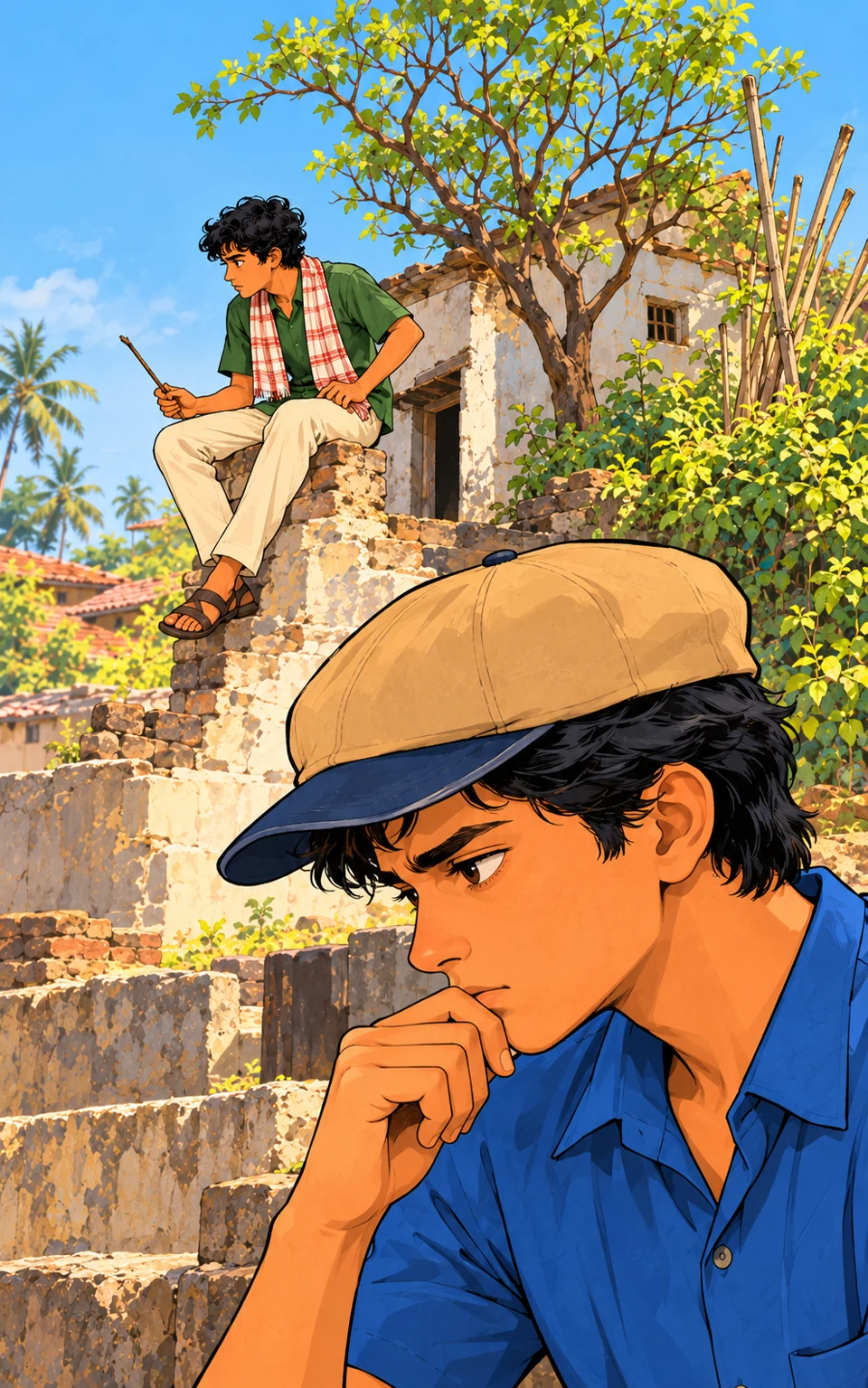
She entered my study room, which served as our office, and looked at us in surprise. Perhaps our signboard had caught her attention. "A detective's signboard is hanging here!"
I proudly introduced myself. "Yes, Mini. This is a famous detective's office. You can seek his help if you have any problem."
Mini looked a bit unsure. "Can you really solve mysteries of any kind?"
"Yes!" I told her. "That is exactly why we have opened this office. At the most, probably You have read Detective Mohini orThe Heroine of Detectives: Meera. That story is only about police officers. The police can catch thieves, but they cannot solve every mystery. We use scientific methods of clue-hunting to solve the strangest mysteries in the world!"
Mini looked at me with curious eyes. "How do you solve a mystery?" she asked.
I tried to look very important. "That cannot be disclosed. It is a professional secret! Right now, I do not have any case in hand. Let a case come. Then I will show you how I pull back the curtain on the truth."
"Would you solve a murder case too?" she whispered.
I asked, "Is there any information about a murder in the nearby area?"
She replied, "No. I just want to know if you can or not."
I puffed out my chest and boasted, "My teacher, Sherlock Holmes, solved many great crimes! I am his most efficient disciple. Do you have a case for me? Give me a case, and I will prove my worth."
Mini started to laugh. "I do have one. Can you solve it?"
With great interest, I asked, "What is the problem?"
With the same smile on her lips, she said, "My cat hasn't eaten any fish for the last two days! Can you solve the mystery behind this?"
I felt like banging my head against the table. Was the first case of such a famous detective going to be about a cat refusing to eat fish? What a fate! Sherlock Holmes would probably have chased such a client away, perhaps even firing his gun in annoyance, for bringing him such a trivial problem! But since we were just starting our career, I decided to be patient and kind.
It was time for the interrogation.
I took out a notebook and began questioning Mini a series of questions like a seasoned detective.
"Who is the culprit?"
"The cat."
"Age?"
"Almost one year."
"Does he drink milk?"
"Yes."
"Does he eat fish?"
"Yes."
"Raw or fried?"
"Fried."
"When did he eat fish for the last time?"
"Two days ago."
"Has he vomited during the last two days?"
"I don't know."
"Does he make strange faces occasionally?"
"I haven't noticed."
"Is he avoiding people?"
"Yes."
"Is the cat white with black spots?"
Mini gasped. "Yes! How did you know its colour?"
"Because there are black-and-white cat hairs on your dress."
Mini looked closely at her dress and was amazed. "You could notice such things?"
With a smile of self-satisfaction, I replied, "For a detective, it is essential to observe everything minutely."
She seemed impressed and delighted. She asked, "What should be done next?"
I gave her my expert advice. "Give the cat some fresh green grass to eat."
"Grass?" Mini asked. "Is he a cow?"
I asked, "Who is the detective here—you or I?"
Mini left.
The next day, she came back. She looked pleased.
"Your medicine worked! My cat ate fried fish this morning!"
I laughed like a victorious hero. "It wasn't medicine; it was simply a smart solution. I am not a traditional healer or an exorcist. I am a detective."
Mini became serious again. "I have another problem. Can you solve it?"
I looked at her intently and said, "If it's related to a cat or a dog, I'm not interested at all. I need a complicated case full of mystery."
Mini replied firmly, "It's not related to any cat or dog. I haven't discussed it with anyone except you. If you solve this one, I'll know for sure that you are a real detective."
I assured her that I would certainly solve the problem.
Then Mini revealed that the problem was related to her.
"I have been receiving letters at my school address. But there is no sender's name on the envelope. I mean, they are anonymous. And the most important thing is that every envelope is completely empty! What is the mystery behind this? I am very upset because of it."
I jumped up with joy! This was the perfect case. If a famous writer were to write about it, the book would be titled The Secret of the Empty Envelope.

I grabbed my notebook like a real detective and started writing down the clues.Sherlock Holmes first gathers all the facts like this and then begins his investigation. I used the same approach.
I told Mini, "I am going to ask you some very important questions. You must give accurate answers because our investigation will proceed on the basis of your replies."
"Ask away!" Mini said.
"How many letters have you received so far?"
"Four."
"Did they all arrive at once, or at different times?"
"At different times. I receive one every two or three days."
"Does the postman bring them?"
"No. The postman doesn't come to our street."
"Then who gives them to you?"
"The Headmaster of our school."
"Why your Headmaster?"
"All the school mail goes to his table first. He calls the students one by one and gives them their letters."
"So, is that the rule of the school?"
"The Headmaster didn't just give me the letters; he scolded me too!"
"What did he say?"
"He asked me whether I came to school to study or to pass secret notes."
"Just this much?
“No. He said further.”
“What else did he say?”
"He said that if one more letter came, he would call my father to school!"
"Do you suspect anyone behind this?"
"I have no idea."
"Does anyone else know about these letters?"
"Yes, some of my friends know about them."
"How did they come to know?"
"How could it be a secret? The school peon came to the classroom to call me because the Headmaster wanted to see me. I went to his office, and everyone noticed it. When I came back, they all asked why I had been called."
"What did you say?"
"I didn't tell them the truth. I lied. But they know that I am receiving letters, but..."
"But what?"
"They don't know that the envelopes are empty. I haven't told anyone except you."
"Good. Now, I need to see those empty envelopes."
"Is it necessary?"
"Of course. Without seeing them, how can I start my investigation?"
"Okay, I will give you the empty envelopes."
"One more important point. Will you please tell me whom you suspect?"
"If I knew that, why would I have assigned this job to you?" she said with a smile.
In this way, we got our first detective case: the mystery behind the empty envelopes.
When Mini had come, Jogia was not present in the office. When he returned and heard about our first case, he started dancing with excitement and said, "We will surely solve the case. It’s our first detective case!"
"Patience, my friend," I said.
Later, Mini gave us the four envelopes. Jogia and I examined them very carefully. Mini’s school address was written on the front, but the handwriting was very strange. The letters were wiggly and messy. It looked as if the sender was trying to hide his real handwriting so that no one could recognize it. He had intentionally written in such a manner.There was no sender’s name on the back. But then, my sharp detective eyes noticed something very important. It was the glue used to seal the envelopes.
Normally, when you buy a yellow envelope from the post office, it already has a stamp on it. On the back, there is a strip of dry glue. You only need a little water or saliva to make it sticky so that you can close it. That amount of glue is enough to seal the envelope.But in all these envelopes, there was extra glue smeared all over the edges—much more than what the post office normally provides. Why would someone use so much extra glue to seal an envelope that had nothing inside? I wondered. It was a complete mystery!
What could be the intention behind sending someone anonymous envelopes that were completely empty? We had to unravel the mystery. But how?
"Where do we start our investigation?" Jogia asked.
"At the school," I said thoughtfully. "I think the mystery is hidden right there. Let’s first meet the Headmaster."
Even though I was in college, I still visited my old school often. We had a fun club called the "Chapala Kishor Chakra," which was connected with the Kishor Chakra programme of Akashvani. Here, we used to organize singing, dancing, literary meetings, and speech contests for the students.
The Headmaster of our time had been transferred. The person who had recently taken charge as the new Headmaster was Mr.Lambodara Pradhan.We were on good terms with him also.
Jogia and I went to the school and met him in his chamber. He was busy with paperwork.
We greeted him with folded hands.
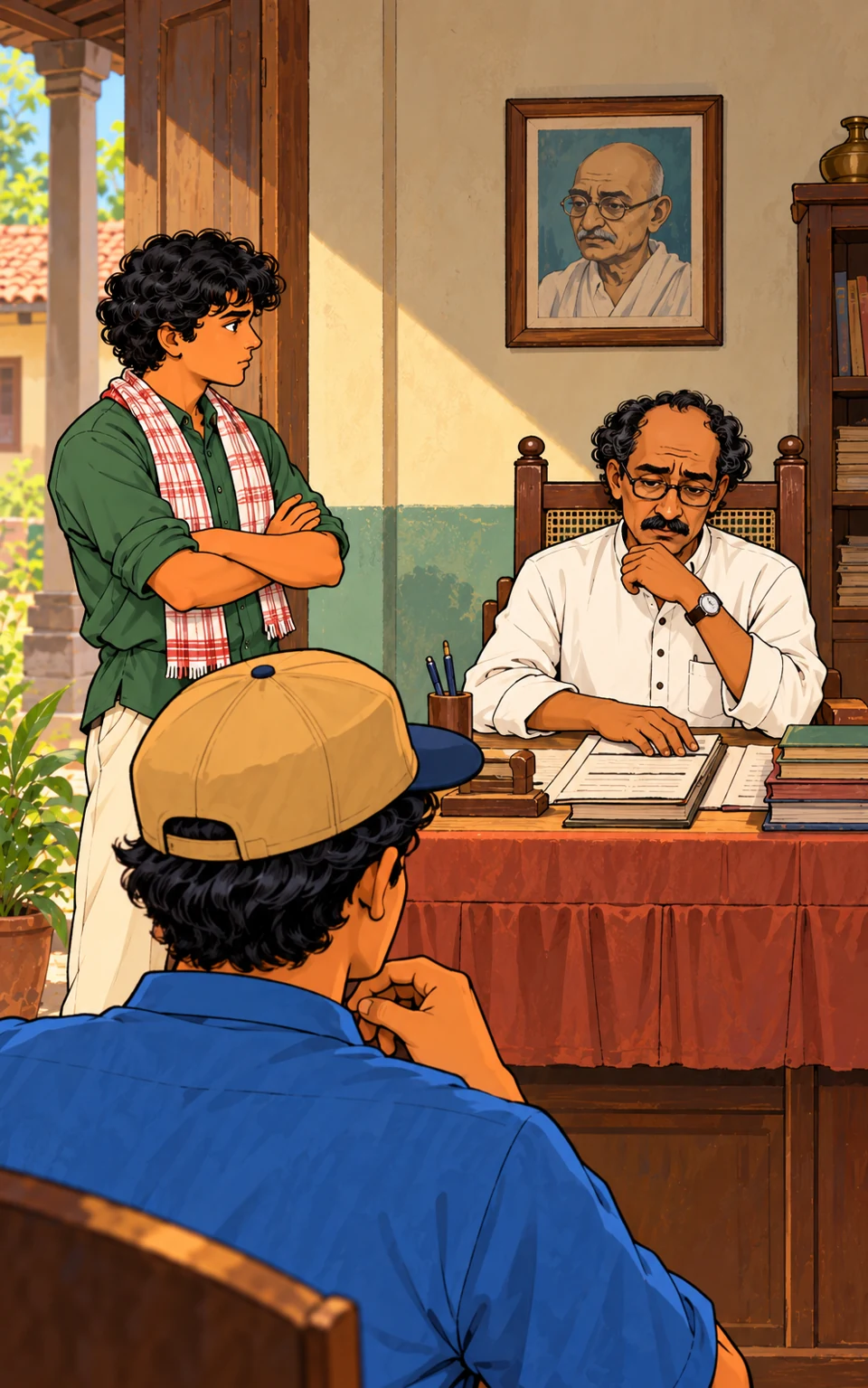
He was happy to see us and asked about our well-being. After exchanging a few formal pleasantries, I wanted to come to the main point, so I said, "Sir, we need your help with something."
"A task for me? Tell me, what is it?" he asked.
I said, "A girl in Class 10 of your school named Minati has been receiving strange, nameless letters at the school address."
The Headmaster seemed to recall the matter for a moment and said, "Ah, yes. I know. I had even warned that girl. This is not right."
"But Sir," I argued gently, "how is the girl to blame for this? She isn't the one sending them; she is only the one receiving them. The name of the sender is not known. I mean, the letters are anonymous."
The Headmaster said regretfully, "I wasn't aware of all this. I don't know who wrote the letters or what they contained. I don't think it is right to open and read someone else's letters. What else can I do to assist you in this matter?"
I said, "The letters are anonymous, but it seems that whoever wrote them is someone from within this school."
The Headmaster did not agree with me and said, "No, no! That’s impossible. I know very well that none of the students of my school could be involved in such an incident. Since I joined, I have started a special 'Moral Science' class where an entire period is devoted to imparting moral lessons. I can also see its positive effects. The students are not as naughty as they used to be."
Despite my hesitation, I had to appreciate his efforts. I said, "That is wonderful work. We are only asking children to study their textbooks, while values and moral education receive little attention. Not only your school, but every school should have a dedicated class for teaching ethics."
The Headmaster smiled with a sense of pride. "That is why I insist that no student from our school is involved in this matter."
I said with a hint of sarcasm, "So, is some student from another school writing these letters? Has Minati become so famous that even students from other schools have come to know about her? Have boys from outside our village also recognized her?"
The Headmaster said with a frown, "No! No! I don't mean that. I firmly believe that these letters may have been written by some former student or one of Minati's neighbours. Those who discontinue their studies halfway are often drawn into such foolish acts."
It seemed as though the Headmaster was indirectly criticising me or Jogia. I am a former student, and Jogia had failed and was now trying to appear for the examination again. However, I did not feel insulted.
I said, "No matter who the writer of the letters is, shouldn't we stop this mean act? Just think about how much mental distress an innocent girl must be going through after receiving such letters. If she is humiliated in this way, she may even give up her studies."
The Headmaster was lost in thought. After a while, he said, "What should we do?"
Taking it as a golden opportunity, I exaggerated a little about myself. I told him, "Sir, besides my regular studies, I am also pursuing a separate course in Crime Investigation. Since I am taking this course, I believe I can help identify the culprit. Moreover, I have to submit a case study as part of the course. If you assist me, we can easily track down the person responsible. It will benefit me in two ways—I can treat this as a successful case study and submit it for my course."
The Headmaster's face lit up.
He agreed to extend his support and said, "If you can catch him, I will give you every possible assistance. And yes, if it turns out that the boy belongs to our school, I will never spare him. I will expel him from the school and issue him a compulsory Transfer Certificate. There is no place in my school for such a delinquent student. I will show him how strict I can be when it comes to maintaining discipline."
After delivering such a long lecture on discipline, he picked up a glass of water from the table and took a sip. Then he said, "Now tell me, what should we do? How do we proceed?"
I explained my plan in detail. I said, "At the moment, we have only four envelopes, and they contain the culprit's handwriting. We will use that handwriting as the basis of our investigation. Our first step will be to examine the handwriting of the students in this school. To do that, we will organise an essay-writing competition for all the students. The competition will be conducted on behalf of our club, the Chapala Kishire Chakra. The students will be told that the winners will receive prizes during the school's Annual Function. But our real objective will be different, and it must remain confidential. Only you, Jogia, and I will know the true reason behind the contest. Jogia alone will oversee and manage the entire programme. I will stay in the background and observe everything from a distance.Once the essays from the competition are collected, we will examine each one carefully. By comparing the handwriting, we will be able to identify the culprit."
The Headmaster warmly accepted our proposal. He said, "It is an excellent proposal. However, I have one suggestion. Instead of holding the competition among all the students, it would be better to organise it only for the Class 10 students. That will be more convenient for us in every way.I don't think any student from a lower class would write a letter to a girl in a higher class. Therefore, if anyone has written such a letter, it is most likely to be a boy from Class 10."
I got another opportunity to praise the Headmaster. I said, "Sir, this idea is also worth appreciating. Only someone with a research-oriented mindset could come up with such a thought."
The Headmaster, as if he did not understand what I meant, said, "But I haven't done any research course."
I said, "A course is only about learning theory. The real essence lies in a person's mind. It lies in a person's intelligence."
As I said this, I gestured towards his head, implying that the Headmaster possessed a highly advanced and insightful way of thinking. The Headmaster was delighted.
We then took our leave and returned.
On our way back, Jogia asked me, "Are you really doing some kind of research course in crime investigation?"
I said, "If I hadn't said that, do you think Lambodara Pradhan would have cooperated with us? Sometimes you have to say such things to get a job done. A few harmless lies have to be told. I've only read a few Sherlock Holmes stories—that is the extent of my 'course.'"
Jogia said, "Oh, I got it."
The next day, we met Minati again. She had come to our office to meet us before going to school.
She asked, "Did you go to the school yesterday?"
I replied, "Yes, I did."
That meant Minati must have seen us on the school premises.
She asked, "Had you gone there to investigate this matter?"
I flatly denied it and said, "No."
I wanted to keep some things secret from Minati because investigators always keep their work confidential until the end. If Minati tells any of her friends that we are investigating the matter, the news would spread very quickly throughout the school. As a result, the unknown culprit will find it out and become alert. Who knows—the culprit might even be standing very close to Minati.
I gave an explanation as if I were defending myself and said, "Jogia had some work there. He had gone to discuss the programme that the Chapala Kishor Chakra was going to organise at the school with the Headmaster. You know that I am no longer a part of the Chapala Kishor Chakra. Ever since I went to college, they have kept their distance from me. Let them do whatever they want. It does not matter to me at all."
Mini asked, "What is the status of my case?"
I said, "The investigation is going on. Please be a little patient."
She was getting late for school, so she left in a hurry.
Our second place of suspicion was the village post office. It was located in the middle of the village. In front of the post office, a red-coloured letterbox hung from a cement pillar. People used to drop their letters into it. The post office was run by two employees: the postmaster and the postman.
Since it was a village post office, there was no fixed time for opening or closing it. Usually, they opened the post office around one o’clock in the afternoon. The postman took out all the letters that had been dropped into the letterbox. He stamped each one with the black circular stamp of the postal department. Then he kept all the letters piled together on one side.
Every day, around one o’clock, a man would arrive on a bicycle carrying a mailbag from the nearest sub-post office. He was called the runner. The postmaster would inspect the seal on the mailbag brought by the runner. After confirming that the seal was intact, the mailbag would be opened. The letters would then be emptied out and piled up on the postmaster’s table. The postman would stamp the letters. Earlier, he had stamped the letters to be dispatched. Now, however, he stamped the back of the letters that had just arrived. That must have been part of the departmental procedure. After stamping them, the letters were kept separately.
A small leather bag would be taken out from inside the mailbag. It was locked. It contained money. The postmaster had the second key to the lock. He would unlock the bag, take out the money, and keep it with him.
Meanwhile, the postman would fill a brown cloth bag with the letters collected from the local letterbox and the letters that had already been stamped. He would then seal the bag. The postmaster would inspect the seal once again. After that, the runner would take the sealed brown bag back to the nearby sub-post office.
After that, it was the postman's job to deliver the incoming letters to the respective neighbourhoods according to their addresses. However, he did not do so in that manner. Instead, he would spend the entire afternoon roaming around the village square. He would stop at the tea stall for a cup of tea, meet the villagers, and chat with them. Whenever he happened to meet someone from a neighbourhood for which there was a letter, he would simply hand the letter over to that person.
He would say, "There is a letter for so-and-so. Please deliver it to him." Likewise, if a money order had arrived for someone, he would send word through others: "Tell so-and-so that a money order has arrived for him. He should come and meet the postmaster tomorrow."
The postmaster used to attend to the other official duties of the post office, such as selling postage stamps, postcards, and envelopes, as well as accepting deposits and handling withdrawals for customers. The post office also sold a blue inland letter . In Odia, it was known as an Antardeshiya Patra . However, the villagers found the name difficult to pronounce, so they simply called it an "England Letter."
The postman's name was Natabara. He was from our village. I examined Mini's letters carefully, one by one. I checked all the postal stamps on them. Most of them were smudged and hard to read. However, I noticed something important: the stamps on the front and the back looked the same. So, I concluded that all the stamps were from our village post office. In other words, the letters had been mailed from this very post office by being dropped into the local letterbox. In other words, all these letters had been sent from this very post office.
Jogia and I met the postman, Natabara Nayak.
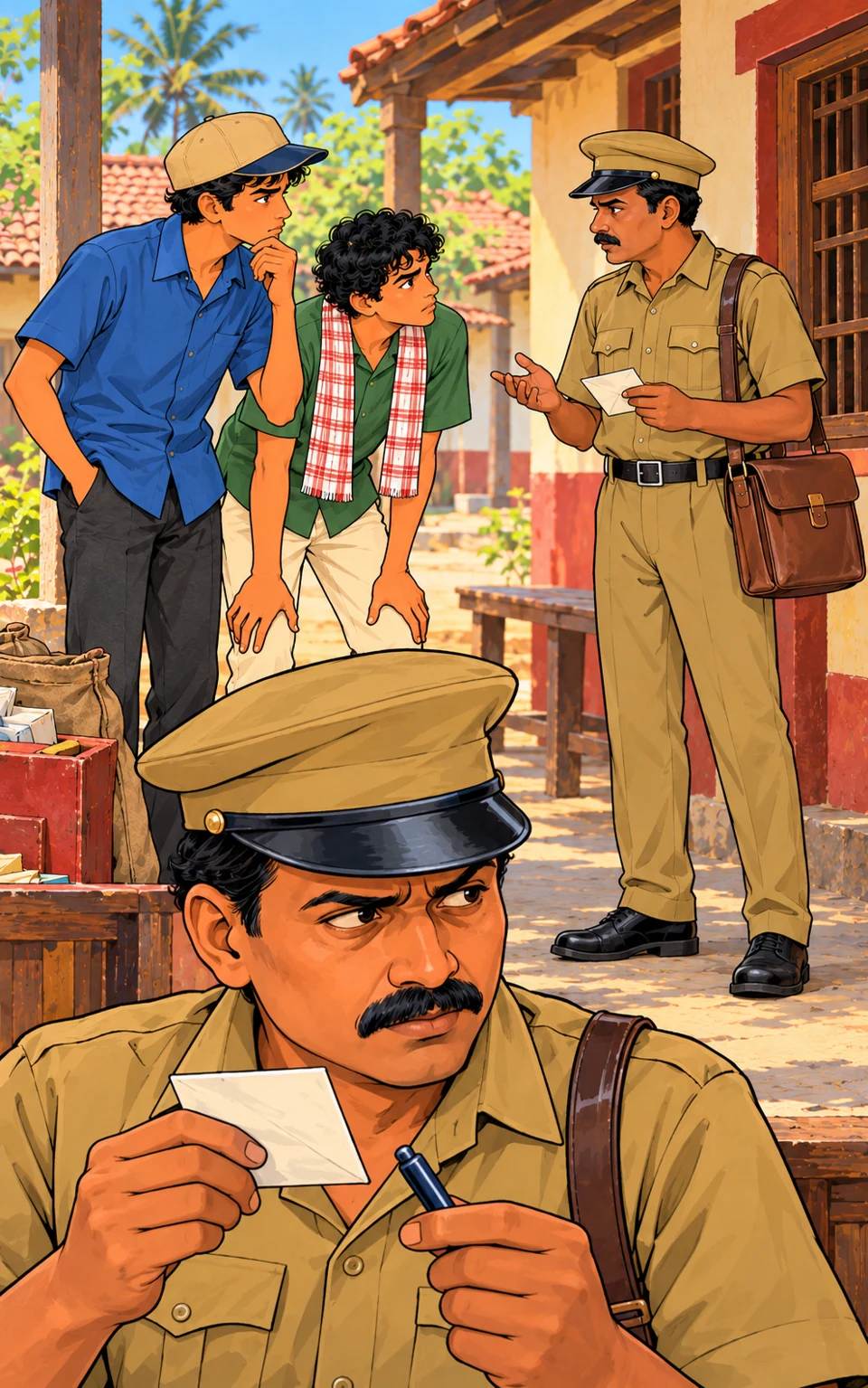
He was a dark-complexioned, middle-aged man. He always wore a brown-coloured shirt—his office uniform, perhaps provided by the department. After coming out of the office, he would take off his shirt and carry it on his shoulder. Wearing only a vest, he would roam around the village square.
The two of us met him. We greeted him with folded hands and addressed him respectfully, "Uncle!" We do not remember ever having addressed him this way before.
We said, "Uncle, we want to know a few things from you."
He was surprised and asked, "About what?"
I said, "About this post office and the letters."
He looked pleased and put on his uniform. He said, "Ask whatever you want to ask."
He probably expected that we would ask him about how letters from the postal department arrived, how money was sent, and how money was deposited. But we came directly to the investigation instead.
"Who picks up the mail for the High School?" I asked.
His doubt was natural. He asked, "Why?"
I said, "There seems to be some problem with a letter."
He spoke in a way that seemed to defend himself and said, "Earlier, I used to deliver them myself. But you can see how much work there is here. I simply don't have enough time. There was often a delay in delivering the letters to the school. Two newspapers come to the school through the post. If a newspaper is delivered the day after it arrives, who will read it then? They became very unhappy about it. Now Dambaru, the school peon, collects all the letters and newspapers from this post office. This new arrangement is better in every way."
I asked, "Apart from official letters and newspapers, do letters also come to the school addressed to the students?"
He said, "Yes, they do. I do not deliver those either. They are also collected from here by Dambaru. He delivers those letters to the school."
I asked, "Uncle, especially in the names of girls, many anonymous letters come, don't they?"
He said, "They may be coming. How would I know?"
I said, "Anonymous letters have come in the name of a girl we know. She has been crying because of them and is deeply distressed. She is no longer willing to go to school."
He said with a sad expression, "What can we do about this?"
I took the four envelopes addressed to Minati out of my pocket. I showed them to the postman and said, "Uncle, please look at these. From which post office did these letters come?"
He took the envelopes and examined them from both sides. He identified the postal marks on them. My suspicion was almost correct.
He said, "Yes, these were sent from here. These are the stamps of our post office."
I asked, "That means these letters were dropped into this post-box?"
He said, "Yes, it is possible. The letter box is open day and night. Who knows when he might have come and dropped them in? Such naughty children are causing a lot of trouble. They even put torn pieces of paper and small sticks inside the letter box. When I take out the letters, I find all those things and feel very irritated."
I asked, "Uncle, have you ever seen any student from the school come here to post a letter?"
He seemed to avoid the question. He said, "I don't sit here watching the letter box all the time. Who knows when someone comes and drops a letter into it?"
"Have you seen any student buying an envelope from this post office lately?" I asked.
"Many boys come here to buy envelopes. Can we ask them why they are buying them?"
I said, "Uncle, if you could help us a little, we might be able to catch the boy who has been sending those anonymous letters."
He asked, "How will you catch him?"
I replied, "Uncle, please help us a little."
He asked, "What do you want me to do?"
I said, "If a letter addressed to Minati ever arrives at the school address, please let us know."
He replied, "I can't do that. It would be against the rules."
I said, "No, no! We won't take the letter. We just want to have a look at it. After we've seen it, you can hand it over to the school peon."
He seemed a little reluctant and said, "But this is quite a risky job."
I explained, "Uncle, this is a matter of life and death for a girl. As I've already told you, she's been crying constantly. She's even afraid to go to school. If tomorrow, out of humiliation, she does something drastic, all of us will share the blame. I'm trying to find the person who has been writing those anonymous letters. All I need is your cooperation. That girl is like your own daughter. Please think about her."
My long and earnest appeal seemed to soften his heart. He more or less agreed to our proposal and said, "Look, all this is illegal. If anyone outside finds out, I could lose my job. I will never hand over someone else's letter to you. A letter addressed to a young girl is even more sensitive."
With folded hands I requested, "We only want to look at the letter."
He replied, "All right."
At that moment, I couldn't help thinking about the way Postman Natabara Nayak used to deliver letters. He would often hand a bundle of letters to just anyone and ask him to pass them on to the intended recipients. There were even instances where letters reached people as late as fifteen days after they had arrived. Yet, when it came to our request, the burden of ethics suddenly took center stage. We were warned about the risk to his job. All right.
I repeated my request once more. "Uncle, please remember—the girl's name is Minati."
Postman Natabara replied, "I'll remember."
Later, however, Jogia told me that Natabara uncle had three daughters, all of whom were in school. His eldest daughter was studying in the same high school. That was probably why my words had touched his heart and why he had agreed to help us.
We then headed back.
On the way, Jogia asked me, "What good will it do if we get to see the letter? It will just be another anonymous letter. Natabara, the postman will hand it over to the school peon, Dambaru. Dambaru will place it on Headmaster Lambodara Pradhan's table. Lambodara Pradhan will read the address on the envelope and send the peon to call Minati. He'll hand the envelope to her and probably scold her a little, saying, 'Why do so many letters keep coming in your name?' Minati won't have any answer. She'll run away from there in tears. Then her classmates will ask her why the Head Sir had called her."
I interrupted Jogia and said, "Why are you talking as if you're writing a story? You're thinking too far ahead! Dr. Watson, Sherlock Holmes's companion, used to think like that. After all, he was the one who narrated all those stories from his own point of view."
Jogia laughed and said, "Then I must be your worthy assistant."
I laughed too and replied, "There's no doubt about that."
Jogia then returned to his earlier question. "But what do we gain by looking at that letter?"
I said, "Our job is to investigate. No one knows which lead will succeed and which won't. An investigator keeps his eyes and ears open in every direction. He stays alert at all times. Who knows where a clue might turn up?"
Jogia asked, "Do you really think we'll find something?"
I replied, "We might. Or we might not. But we should keep watching how things unfold."
From time to time, I would stop by the post office. I watched the children who came to buy envelopes or postcards. I also kept an eye on those who dropped letters into the letterbox. But I never noticed anything that seemed suspicious.
The Chapala Kishore Chakra organised an essay competition at the school. Jogia managed the entire event on his own. I deliberately stayed away from it. The Headmaster and the other teachers made sure that all the students of Class Ten participated in the competition, and almost everyone did.
The topic for the essay was "A Letter to a Friend."
After the writing session was over, Jogia announced on the spot that the organisation would award attractive prizes to the best entries. He then bundled up all the essays and brought them to my house.
Jogia and I began comparing the handwriting on the envelope addressed to Minati with the handwriting in the students' essays. Unfortunately, none of them matched. Whoever had written the address on the envelope had deliberately disguised his handwriting by writing in crooked, distorted letters. Even so, we compared it carefully with every essay. But we couldn't find any resemblance at all.
Jogia offered his opinion. "The person who sent the letters isn't among these students."
I expressed my doubt. "Does that mean the sender didn't take part in the essay competition?"
Jogia replied, "Why didn't he participate? Could he have guessed that the essay competition was just a drama? That we had laid a trap to catch him?"
"How could he possibly know that?" I asked.
"He might have found out from some source," he said.
"What source?" I asked. "Only you, I, and Headmaster Lambodara Sir knew about this. There was no way anyone else could have known."
Jogia said, "What about Minati? Someone could have learned it from her."
I replied, "Minati didn't know either. That's precisely why I kept myself away from the entire affair."
Jogia let out a deep sigh. "Perhaps the Headmaster was right. The person isn't a student of this school. It's probably someone from outside—perhaps a wayward boy who has already left school."
Looking worried, I said, "If he's from outside, how are we going to catch him?
Jogia suggested, "Call Mini again and question her once more. If she suspects anyone at all, let her tell us. Then we'll follow that lead."
I nodded in agreement. "All right. We'll proceed that way. I don't see any other option."
Just then, the Headmaster sent for us.
He asked, "Have you found anything?"
I replied, "No. We've already examined all the handwriting samples. There isn't the slightest similarity among them."
"What will happen now?" he asked.
"I've sent the papers to a handwriting expert," I replied. "He will definitely be able to identify the writer."
He looked concerned. "You've sent all the papers to the expert? Then how will the competition results be announced? The students keep coming and asking about them."
I said, "The results will certainly be announced, and the successful participants will receive their rewards. We just need to be a little patient."
The Headmaster, sounding somewhat irritated, said, "Finish this drama quickly. If this continues, all of us may end up being disgraced because of it."
I returned home.
We had reached a dead end. There was no clue in any direction, and no way to move forward. It felt as though we were searching for a black cat in the dark.
I said to Jogia, "Go and ask Postman Natabara whether Minati has received any more letters."
Jogia asked, "Do you think another letter will come?"
"Why wouldn't it?" I replied. "The person has already sent four letters. Why wouldn't he send a fifth?"
Jogia reasoned, "He didn't send anything with the first four letters. Perhaps he'll send something in the fifth letter."
"He might not send anything," I said.
Surprised, he asked, "Why?"
"If he suspects that we're investigating the matter, it's only natural that he'll become cautious."
"How would he know that?"
"We shouldn't assume the culprit is a fool. Sherlock Holmes once said that it is often the person who considers himself very clever ends up stepping onto the path of crime. He may be keeping an eye on us."
"Who is he?"
"That's exactly what we're trying to find out, my friend."
Within two days, postman Natabara brought us fresh news. Another letter had arrived for Minati. Instead of handing it over to the school peon, Dambaru, he had kept it with him and informed us. We immediately went to the postman's house.
Before we could say anything, he warned us, "You can't take the letter. You may only look at it."
I laughed and said, "I remember my promise. Otherwise, your job will be at risk."
"Exactly," he replied.
I asked, "Can we only look at the letter? Can't we even touch it?"
Softening a little, he said, "Yes, you may touch it."
He handed the envelope to me, but his sharp, watchful eyes remained fixed on me like those of a hawk. I took the envelope in my hands and examined it carefully. I turned it over, inspecting both sides. I looked closely at the postal stamps on the front and back and then carefully examined the sealed flap. There was no sign of any extra glue. It had been sealed with the adhesive used by the postal department, probably moistened with saliva or water.
What seemed most important, however, was that the envelope was not empty. There were papers inside, which meant there was a letter enclosed.
After examining it, I returned the sealed envelope to postman Natabara.
I said, "Thank you."
Jogia asked, "Did you find anything?"
"Nothing," I replied. "But now I hope we might."
Applying his own reasoning once again, Jogia said, "The handwriting on this envelope seems a little different to me. Perhaps someone else has written this letter."
I asked, "You noticed that?"
He replied, "Perhaps the person has become cautious now."
"That's possible," I said.
As was his usual practice, postman Natabara handed the letter over to the high school peon, Dambaru. Dambaru must have followed the same routine as always and placed it on the Headmaster's table. In due course, it would have been handed over to Mini, accompanied by some harsh remarks and an intolerable look from the Headmaster.
The next day, Mini came to our house.
She looked as though she had been crying.
"Another letter has arrived," she said.
"Oh? Show me the letter," I said.
Sobbing, she replied, "But where did this another letter come from?"
"What do you mean, where did it come from?" I asked. "Four letters had already arrived before this, hadn't they?"
She shook her head. "This isn't from the same person."
"How do you know?"
"The handwriting belongs to someone else."
"So, you've become a handwriting expert now?"
"I am very scared."
"There's nothing to be afraid of," I said. "I told you, didn't I? We will definitely catch the culprit."
"But there is a piece of paper inside this letter."
"Oh? Give me the paper. Let's see what has been written on it."
She replied in a frightened voice, "There is nothing written on it."
She looked utterly terrified.
I examined the envelope carefully from both sides. The first thing that caught my attention was the glue. It had been sealed twice. When I had seen the envelope at the post office, there had been only one layer of glue. Now there were two. That meant someone had opened the envelope, read what was inside, and then sealed it again.
Everything began to fall into place. There was someone in between—a person who was opening these envelopes, reading the letters, and resealing them afterward. But who could that person be?
I looked at the sheet of paper that had been inside the envelope. It was completely blank. There was nothing written on it. Yet it seemed to me that someone had held it over a flame. That suggested the person in the middle had tried to reveal hidden writing on the blank sheet.
Some clever people write letters using invisible ink. As far as I know, writing done with lemon juice cannot be seen under normal light. It remains invisible until the paper is heated over a flame, at which point the writing appears in a faint reddish-brown colour.I knew this technique, and apparently the person in the middle knew it as well. That was why the paper had been heated. One corner of it was slightly scorched. It had become stiff and brittle, almost like a wafer.I kept these observations to myself.What could be the mystery behind all this?
I asked Mini, "Do you suspect anyone?"
"Yes," she replied. "I do have my doubts about someone."
For the first time since all this had begun, Mini pointed a finger of suspicion at someone.
"Who?" I asked.
"Gopal."
"Who is Gopal?"
"He studies with us."
"Is he a troublesome boy?"
"He seems harmless," she replied, "but he's a quiet devil."
"You never mentioned Gopal before."
"No, I didn't. But now I feel he is the one who has done all this."
"Apart from him, do you suspect anyone else? It now seems there may be two different senders. The handwriting in the earlier letters and the handwriting in this latest one appear to be different."
She looked deeply disturbed, as though she were on the verge of tears.
"What will happen to me now?" she asked. "Has everyone started taking me lightly?"
I reassured her, "Don't worry. The culprit will be caughtnvery soon."
Three people now came under suspicion: first, the postman Natabara; second, the school peon Dambaru; and third, the Headmaster.
It was possible that the postman had opened the letter, read it, resealed it, and then handed it over to Dambaru. Or perhaps Dambaru had opened it, read it, and sealed it again before placing it on the Headmaster's table. It was equally possible that neither of them was involved and that the real culprit was Headmaster Lambodar himself.Obsessed as he was with good conduct, he might have made it a habit to open and read students' letters. Any letter he considered objectionable could have been removed and thrown away. Since this latest envelope contained only a blank sheet of paper, he may have tried to reveal hidden writing on it. After finding nothing, he might simply have placed the paper back inside the envelope.
Who is this "great gentleman" who inspects the letters of schoolchildren?
Because of what Mini had told me; Gopal had now also entered the circle of suspicion. He is her classmate, but I knew very little about him. I took out the essays from the competition and pulled out Gopal's entry. His handwriting was excellent. As I read his essay, I was astonished. It was written to a remarkably high standard. I compared his handwriting once again with the handwriting on the envelope's address. There was no similarity whatsoever.
I said to Jogia, "We need to gather some more information about Gopal."
The information Jogia brought back was encouraging. Gopal was an outstanding student who always stood first in his class. Everyone regarded him as a well-behaved and exemplary boy.
Yet I couldn't understand why Mini had called him a "quiet devil."I decided it would be best to speak with Gopal myself.
One day, after school was over, we waited for him on the road the students used while returning home. When he appeared, we called him aside. He came over and stood before us like an obedient and respectful student.
I asked, "Is your name Gopal?"
"Yes," he replied.
I decided to put him at ease by praising him a little.
"I read the essay you wrote for the essay competition," I said. "It is excellent."
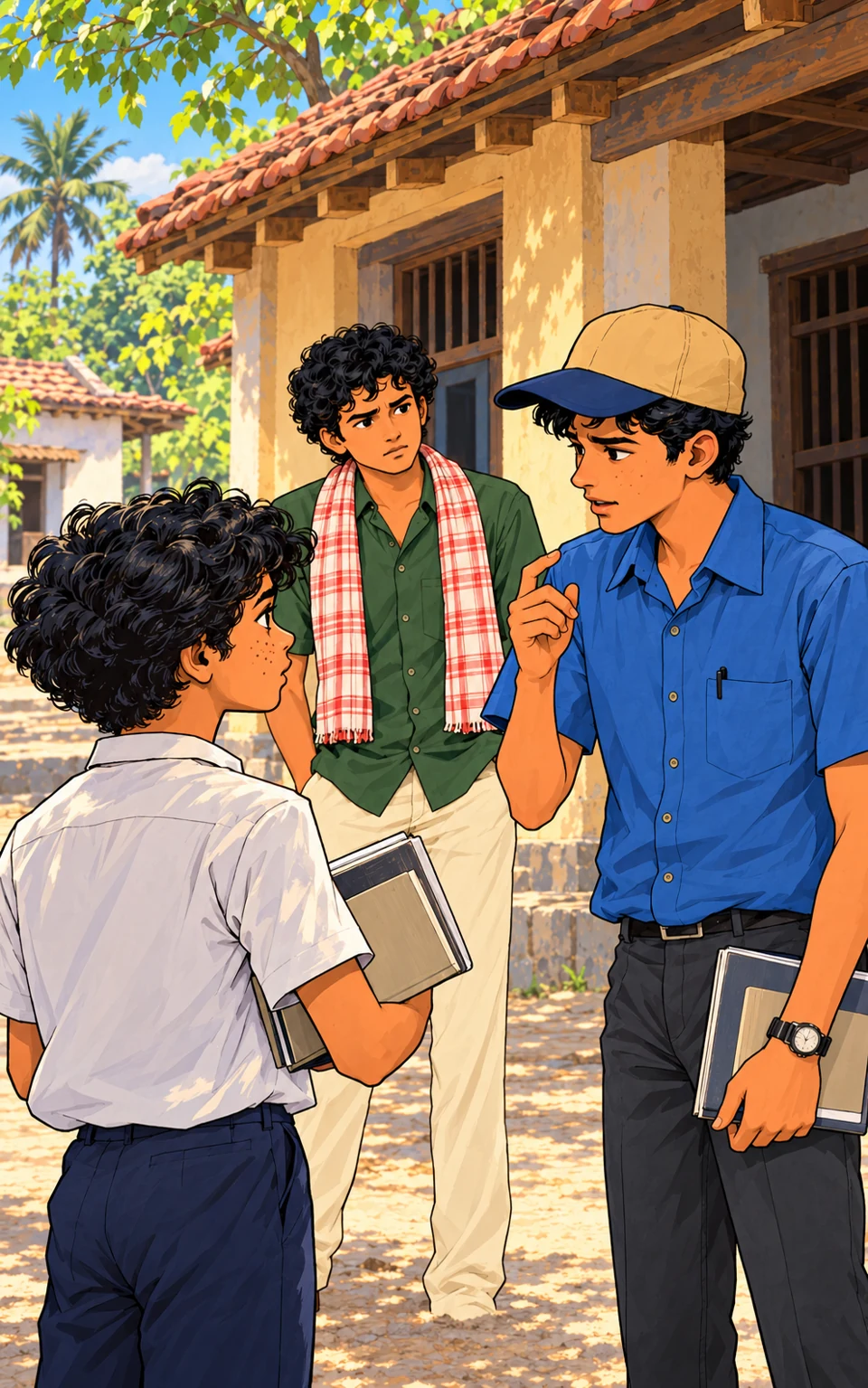
He was clearly pleased by the compliment. Like many village children, he blushed shyly. Then he asked, "When will the results of the competition be announced?"
"Very soon," I replied.
In a polite voice, he asked, "Will my name be on the prize list?"
I said, "The results haven't been officially announced yet, so it wouldn't be proper for me to say anything now. However, I believe you'll certainly be among the top three winners."
After a brief pause, he asked, "Did you have anything else to discuss with me? If not, I'll leave now."
"Wait," I said. "You're a talented boy. I'd like to talk with you and learn more about your interests. You children are our future. We adults have all been busy with our own work, so the activities of our Chapala Kishore Chakra haven't been running as regularly as they should. We're thinking of entrusting the responsibility of the organisation to promising youngsters like you."
His face brightened with interest. He became eager to talk more about himself.
"I'd also like to shoulder such responsibility," he said. "I also write stories and poems."
"Really? That's wonderful," I said.
"I had a notebook full of stories," he replied. "I'd written quite a few in it."
"You had one? Does that mean you don't have it anymore?"
His expression changed instantly.
"If I still had it," he said, "I would have shown it to you. You could have told me what was good and what needed improvement."
"What happened to the notebook?" I asked.
"It was stolen."
"When? How?"
"I don't know," he replied. "Someone must have taken it at school."
"That's really unfortunate," I said. "Can you tell me something about those stories?"
"All the stories were written in the form of letters," he replied. "If the notebook had ever been published, I was going to give it the title A Bunch of Letters."
"Good! Very good!" I said. "That's an excellent idea."
But he still looked dejected.
"I often wonder where that notebook with all my stories disappeared," he said.
I gently changed the subject.
"There's a girl in your class named Minati. Do you know her?"
"Yes," he replied.
"What kind of girl is she?"
In a low voice, he answered, "She's a good girl."
"I've read her essay too," I said. "It's good as well."
He looked puzzled and gently objected.
"How could she have written an essay?"
I was surprised.
"What do you mean?"
He replied, "She didn't even take part in the essay competition that day."
"She didn't? I seem to remember reading her essay."
He insisted, "How is that possible? She wasn't present at school that day. Please check the entries carefully. You won't find an essay by her."
After that, there was no point in continuing the conversation with Gopal. We bid him goodbye and left.
A renowned investigator once observed that, during an investigation, many facts come to light that seem to have no connection with the main incident. Yet a good investigator never dismisses them outright. Who knows? A fact that appears trivial or irrelevant at first may later prove to be the key to solving the case.
From our conversation with Gopal, we learned that he was neither a complicated nor a mischievous boy. Nor did he appear to be hiding anything. However, we did come away with three incomplete pieces of information that might—or might not—prove useful in the investigation.
First, Gopal and Minati do not seem to be on good terms.
Second, Gopal used to write stories, and the notebook containing those stories has gone missing.
Third, Minati had not participated in the essay competition, yet she has never told us so.
A new problem—or rather, a new mystery— now emerge. Someone is opening and reading letters before they reach their intended recipient. Although this was not part of our original investigation, once the mystery has come to light, it deserves our attention.
Three people fell under suspicion: the postman, the school peon, and the Headmaster.
For the time being, we decided to rule out postman Natabara. Had he been involved, he would probably not have cooperated with us so readily. When we examined the envelope, it had remained in his possession. If he had already opened and read it, there should have been a second layer of gum where it had been resealed. There was no such sign.Of course, we could not completely rule out the possibility that he had opened it after showing it to us. For the moment, however, we set that possibility aside.
That left the school peon, Dambaru, within our circle of suspicion.
We went to the school to meet him.
Dambaru was a dark-complexioned, sturdily built man in his forties.
Seeing us standing nearby, he asked, "What is it?"
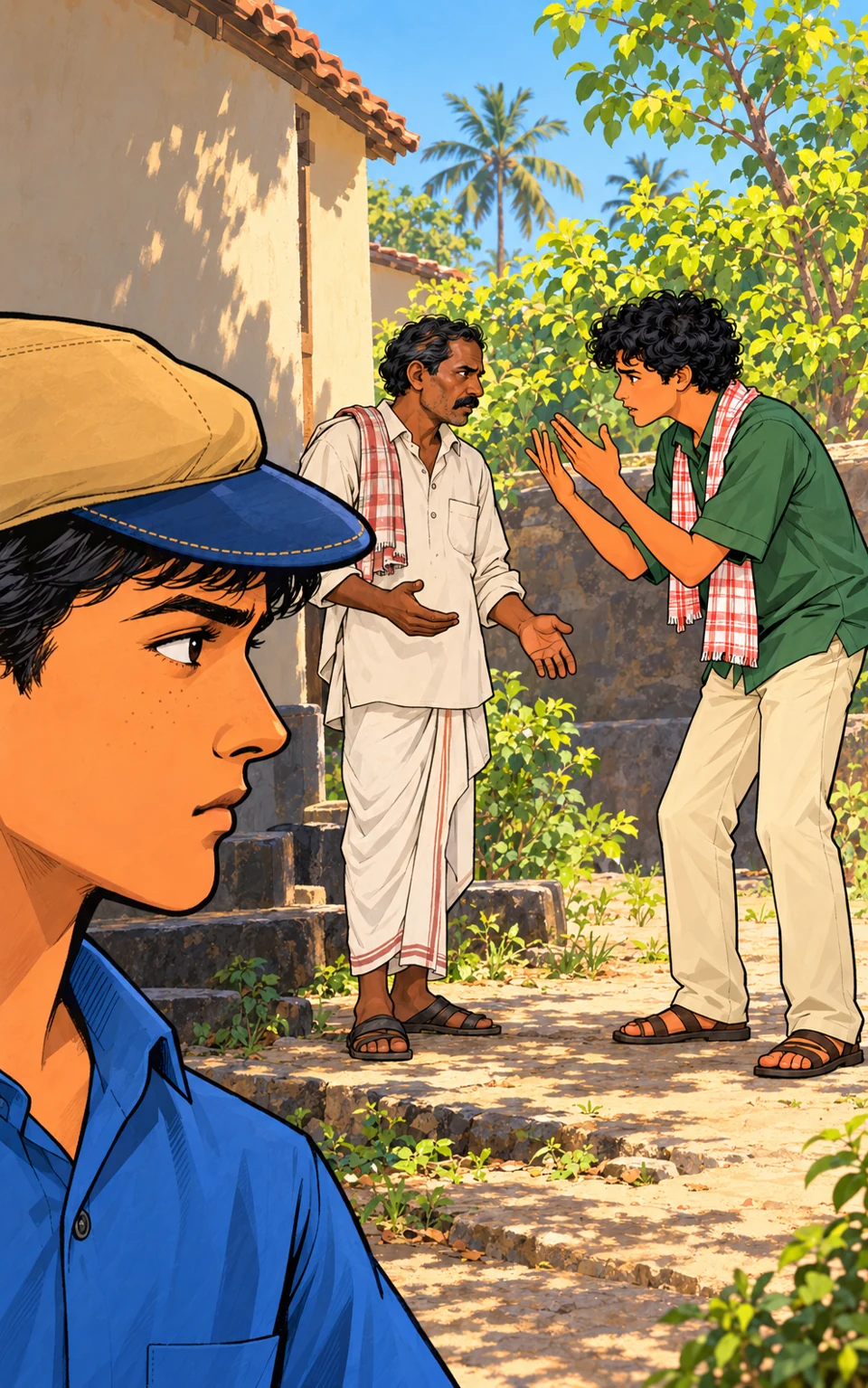
We had already greeted him respectfully, so a faint smile appeared on his face.
I said, "Brother, could we borrow a little gum?"
"What do you need it for?" he asked.
"I need it to seal this envelope," I replied.
I showed him a plain envelope. It contained a few sheets of paper, making it look as though it held an application for a job or a scholarship.
He went into the school office and returned with a bottle of gum. I poured a little onto the flap and sealed the envelope I was holding. The moment I saw the gum; I had a strong feeling, it was the same kind that had been used to reseal Minati's letters after they had been opened.
My suspicion grew stronger. Dambaru and Headmaster Lambodar Pradhan now seemed even more likely to be involved.
Jogia said, "Brother, we'd like to ask you something."
"What is it?" he asked.
I said, "Brother, you may not know this, but I'm investigating an incident. The Police Headquarters has entrusted me with the responsibility of looking into it."
At the mention of the police, he instinctively took two steps backward.
He asked, "Why would the police entrust the investigation to you instead of handling it themselves?”
I had expected that question.
I replied, "I'm taking a course in Crime and Investigation. As part of our training, we're sometimes assigned real cases like this."
"Is that so?" he said. "I have no idea about this."
I continued, "Someone from around here must have lodged a complaint with the police. Otherwise, why would they investigate this matter?"
"Who knows?" he replied. "Maybe someone did."
He looked slightly frightened, which, for the moment, was exactly the effect I had intended.
He said, "Go ahead. Ask whatever you want. If I know the answer, I'll tell you."
I asked, "Quite a few letters arrive at this school for the girls, don't they?"
"Yes," he replied. "They do."
I said, "Someone has been opening those letters before they reach the girls and reading them."
He looked startled.
"Who's been reading them?" he asked.
"That's exactly what the police investigation is trying to find out," I replied. "You collect the letters from the post office, don't you?"
"Yes, I do."
"And after bringing them here, you place them on the Headmaster's table."
"Yes," he replied.
"Then the Headmaster calls the students and hands the letters to them."
"Yes."
"So, who is opening and reading those letters before they are delivered?"
"I can't say."
"Could the Headmaster himself be doing it?"
"I don't think so."
"Then who else could it be? Look, after reading the letters, someone seals the envelopes again. The gum used to reseal them is the school's gum. The same gum you just gave me has been used on all those envelopes. So, it's obvious that the person opening the letters is someone within this school. I strongly suspect the Headmaster. If you cooperate with us, we can catch him."
He seemed a little worriedand then said, "No. It isn't the Headmaster."
"Then is it one of the other teachers?" I asked.
"No."
I pressed him further.
"Then who is it? Tell me plainly. Based on your information, I'll send a confidential report to Police Headquarters."
At the mention of Police Headquarters, he looked even more frightened. I felt my strategy was working. He seemed to know far more than he was willing to admit. I was convinced that a little more pressure would make him reveal the truth.
He asked, "What complaint has been made to the police?"
I replied, "If no complaint had been made, why would I have been asked to investigate?"
"What will happen now?"
"If you cooperate, the culprit will be caught and sent to jail."
He thought for a moment before replying.
"You've told me about this today only. Give me one day. I'll find out the details and let you know."
I tried to influence him further.
I said, "That person is clever too. Two days ago, a letter arrived for a girl named Minati. He opened it. Instead of a letter, there was only a blank sheet of paper inside. He even heated the paper over a flame to see whether any secret writing had been hidden on it."
His eyes widened in astonishment.
"How did you find out so many details?" he asked.
In a firm, threatening tone, I replied, "We've already gathered a great deal of evidence. The police are also keeping a secret watch."
To frighten him even more, I added, "Before this, several letters had been sent to Minati. He not only opened those letters but also removed the letters from inside. We're collecting all the evidence. You will become our approver."
He seemed shaken.
"I'll tell you everything tomorrow," he said, and hurried away.
As we were returning, Jogia asked, "Has Police Headquarters really assigned you this investigation?"
I laughed.
"Oh, no! Not at all. If you want someone to reveal the truth, sometimes you have to frighten him with a little false information."
Jogia asked, "Even if we identify the person who has been opening the letters, we still won't know who has been sending them, will we?"
"Be patient, my friend," I replied. "Let's solve one mystery first. The other will also be solved."
The next day, we met Dambaru after school. He led us toward the fields. After walking some distance, we sat down on a small mound.
Dambaru looked frightened and deeply troubled. Without any prompting, he came straight to his confession.
"I was the one who opened and read the letters before they reached the girls."
Jogia and I exclaimed together, "Brother—you?"
He lowered his head.
"I don't know whether what I did was right or wrong," he said. "But I did it all. I always believed I was doing the right thing. Now that the police know everything, I'm a bit frightened. It's true that many letters arrive for the girls in our school. Anonymous letters come as well. I don't like such things. I did this to protect the school's reputation. Whenever a letter seems suspicious, I open it. If I find anything indecent written inside, I remove the letter. Then I seal the envelope again with gum. The Headmaster hand overs the envelope to the girl whose name is written on it. But since there is nothing inside, the sender's purpose is defeated. The girls may be a little frightened and simply take away the empty envelopes. Gradually, they forget about them. They don't remain too upset."
I said, "So you've appointed yourself the guardian of public morality."
He replied, "By doing this, I thought I was doing a good deed. I believed I was helping to improve society."
I said, "But what you're doing isn't right. Someone might receive a perfectly decent letter. Someone else might receive an important one. Removing it before it reaches the recipient is simply wrong."
"I don't open every letter," he protested. "I only open those that have no sender's name or that seem suspicious. After reading a letter, if I feel it's genuine and should reach the girl, I put it back in the envelope and seal it again with gum."
I asked, "Who gave you that responsibility? Who gave you the authority to open other people's letters?"
He did not appear to feel guilty at all.
He said, "Is it wrong for me to want our school to have a good learning environment? Is it wrong to want our girls to study well, for no one to look at them with bad intentions, and for no one to harm them? It is true that no one assigned me this responsibility, but I took it upon myself. It is everyone's responsibility to improve society. Who needs to give someone permission to do that? Many obscene things are written on the walls of our school. Anyone who reads them will surely feel ashamed. No one gave me the responsibility, yet I erase all those things. Every day, I inspect the walls of the school to see whether anything inappropriate has been written. As soon as I find something, I erase it.Our Headmaster conducts moral education classes, and everyone praises him for it. Is that class part of an official course? Did some authority issue an order for him to conduct it? Why should anyone wait for instructions before doing a good deed?"
After giving such a long explanation, he fell silent. He had spoken with deep emotion, and I was impressed.In his own mind, he had made himself a guardian of morality. His actions cannot be called a crime outright. There was no reason to completely reject his intention.
He asked again, "Am I doing something wrong?"
I said, "No, brother. You are not doing something wrong. You are trying to do what you believe is right. The responsibility of improving society does not belong only to highly educated people or those holding important positions. Any aware and responsible citizen can take up that responsibility. Your efforts deserve appreciation."
He folded his hands and said, "Please don't tell anyone about this. I don't want praise or recognition. Doing this work gives me a sense of mental peace. If people come to know about it, it will create controversy. Not everyone may support what I am doing. Especially those students who write anonymous letters may oppose me and try to trouble me in some other way. I request both of you to keep this matter a secret."
He stood before me with his hands folded. I did not feel like saying anything more to him. We had never expected to suddenly encounter such a strange and unusual person. The people we see before our eyes do not always reveal their true selves. We often believe that only wicked and dishonest people hide their ugly nature and wear a mask of respectability before the world. But that is not always true. Sometimes, even ordinary people conceal noble, almost divine qualities, within themselves. It is not always right to judge a person merely by their outward appearance.
I held his hand and said, as though taking an oath, "I promise that we will keep this matter a secret. We will not do anything that may cause you harm."
He asked, "But what about the police investigation you mentioned?"
I reassured him once again.
"I will handle that," I said. "I will write such a report that the entire matter will appear to be based on false information."
He felt relieved.
It was time for us to leave.
What had I actually set out to investigate, and where had I ended up? For those who seek the truth, it is not unusual to lose their way during an investigation. Yet it is also true that, even after losing their path, they often find themselves closer to the truth.
I returned to the matter I had originally come to investigate.
I asked, "So, you were the one who opened the letters that came for Minati?"
He admitted, "Yes."
"Was there anything improper written in those letters?"
"I couldn't understand those letters."
"What do you mean?"
"The letters were anonymous, and the meaning of what was written inside was unclear. For some reason, I felt that those letters should not reach Minati. So, I removed them. Only the empty envelopes reached her. Her reputation would not be tarnished. That was all."
"What you did was right," I said. "It was necessary to protect Minati's reputation."
"I couldn't understand those letters," he repeated.
"All right, then give us those four letters now."
Jogia corrected me.
"Not four—five."
"No, no," I said. "There were only four letters. The fifth envelope did not contain a letter."
Dambaru said, "The fifth envelope contained a blank sheet of paper."
"You must have heated it to find out whether there was any hidden writing on it," I said.
"Yes," he replied. "After that, I put the blank sheet back inside the envelope. I have kept the other letters hidden. I will give them to you tomorrow."
I decided that I would determine my next course of action only after those letters came into my hands.
After Dambaru left, Jogia looked at me in surprise.
"How did you know that the fifth envelope contained not a letter, but only a blank sheet of paper?" he asked.
I said, "I was the one who sent the fifth letter. I sent it to find out where the second layer of gum was coming from. I wanted to know whether the thick layer of gum on the first four letters had been applied by the sender or by someone else. Anyway, my suspicion has now been confirmed."
The very next day, the four stolen letters came into my hands.
After reading them, I was surprised once again. School peon Dambaru was right—he truly could not understand them. The reason was simple: they were not letters at all. They were stories written in the form of letters.
By comparing the handwriting, I realized that it matched Gopal's handwriting. At once, I remembered that Gopal wrote stories and that his notebook containing stories written in the form of letters had gone missing.
It did not take long for me to understand the truth. These letters were actually pages torn from Gopal's story notebook.
The entire picture became clear before me. The role of this third person was extremely important. He had stolen Gopal's story notebook, torn out pages from it, and sent them to Minati. The crooked handwriting on the envelopes could have belonged to this third person.
When those letters reached the school, Dambaru became suspicious and opened them. He read them but could not understand their meaning. However, believing that they might damage Minati's reputation, he removed the letters. As a result, only four empty envelopes reached Minati.
But who was this person? What was his motive?
He wanted to make Gopal appear guilty.
Who could he be?
Meanwhile, I met Minati once again. From time to time, she had been checking how far the investigation had progressed. The moment she saw me, she asked:
"You had spoken with Gopal, hadn't you? What did he say?"
I asked her in return, "Who told you that I had spoken with Gopal?"
She smiled mysteriously.
"I know," she replied.
I said sarcastically, "You seem to be keeping a very close watch on me. Now I really can't understand who the investigator is—you or I?"
She said, "The case is about me. It is natural for me to feel curious and anxious. That is why I am only keeping track of what is happening."
I changed the subject and asked, "I heard that you did not take part in the essay competition organised by the Chapala Kishore Chakra."
She replied, "No, I did not take part."
"Why?"
"I did not go to school that day."
"Why didn't you go?"
"I cannot say that."
"I heard that you are a good student. You should have participated in the essay competition. If you had taken part, you would have come first."
"No, I would not have come first."
"Why do you think so?"
"Gopal probably would have come first."
"How do you know?"
"I'm only guessing."
"He stands first in the class, and you stand second, don't you?"
"Yes."
"Are you jealous of Gopal?"
"Why would I be jealous?"
"If Gopal were to go away somewhere, if he left the school, then who would stand first in the class?"
"Where would Gopal go?"
"That is true. After all, where would he go?"
After a while, I asked, "I heard that Gopal writes stories and poems."
"He probably does. I don't know."
"Have you ever read any of his stories?"
"No. Those aren't really stories."
"If you haven't read them, how can you say they aren't stories?"
"I've heard it from others."
Suddenly, she changed the direction of the conversation and said, "So Gopal has come first in the essay competition."
I said, "How can I say that? I no longer have any connection with the Chapala Kishore Chakra."
She surprised me by replying, "Do you think I cannot understand anything? I know that you conducted this competition. There must certainly be some reason behind it."
I was amazed by Minati's intelligence. She was not as innocent as I had first assumed. She knew many things, and she was capable of making sharp guesses as well. She kept a close watch on everything happening around her. She possessed many of the qualities of a true investigator.
But why was she watching me so closely? Was she investigating the case, or was I?
Minati seemed like a mystery herself.
I did not discuss the matter any further with her that day.
Meanwhile, my vacation was coming to an end. I would soon have to leave the village and return to the city, where I would once again have to focus on my studies. The case that had come into my hands as part of my plan to become a detective remained unfinished. The deeper I went into the investigation, the more mysterious it became. A third person had entered the case, but I had no idea who he was or what his motive was. I could not understand how to reach him.
I informed Minati about the situation. She came to my study room—the room we had named the office of detective Herlock Solmes.
I said, "Look! I have almost solved your case. I have identified the culprit. But there is still a little work left. Until that is completed, we may be able to identify the culprit, but we will not be able to prove it."
She asked, "You haven't finished the work yet? Who is stopping you?"
"No one is stopping me," I replied. "But my college will reopen soon, and I will have to leave within a few days. That is why the investigation may remain incomplete."
"Then you failed," she said. "Why don't you accept that?"

I replied in a challenging tone, "Why should I accept that I failed? Answer two or three of my questions correctly, and I will catch the culprit immediately."
Accepting my challenge, she said, "Ask! Ask whatever you want!"
Sometimes investigators, while searching in the darkness, swing their sticks around randomly and then suddenly throw them in one particular direction. That act of throwing the stick is not always guided by conscious reasoning; sometimes it comes from a sudden instinct of the mind.
It seemed as though I was guided by some inner voice and I threw a stick into the darkness, aiming at some unknown target.
I said, "Let us assume your suspicion is correct. Let us assume that Gopal is the person who sent all these letters. We have all the evidence against him. What would you do then?Naturally, you would complain to the Headmaster. After that, what would happen? The Headmaster would punish Gopal. He might even expel him from school. He might humiliate him. Perhaps Gopal, unable to bear such humiliation, would never return to school.After all this, who would benefit? Probably you. At present, you stand second in your class. After this, you willstand first."
She stared at me with wide eyes. She said nothing.
I continued, "No one knows what was inside those envelopes. We only saw the envelopes and read the addresses written on them. Someone had written those addresses in a strange, distorted handwriting, as though he wanted to make sure that no one could identify him easily. Our aim was to organise the essay competition and collect his handwriting samples. But we failed. He understood the purpose behind the competition and deliberately avoided taking part. We prepared a list of students who had not participated in the competition and collected one handwritten composition notebook of each from the school. All of those notebooks have been sent to a handwriting expert in Kolkata. By matching them to those crooked and distorted letters, the expert may be able to identify the real writer."
After hearing my second statement, she looked frightened.
"Will they be able to catch him?" she asked.
"They certainly will," I replied.
"But what if he is not from our school?"
"He is definitely from our school," I said. "He is one of those students who did not participate in the essay competition."
She remained silent. She looked worried and thoughtful.
I asked, "How many of your letters had disappeared?"
"Four," she replied.
"This is where you are mistaken, Minati," I said. "Five letters had arrived at your address. You have always been thinking only about those four."
She remained silent.
I took out the four letters from my desk drawer and held them out to her.
I said, "These are the four letters that disappeared from your envelopes. Please take a look at them."
The moment Minati saw the letters in my hand, her face turned pale. With a faint cry of shock, she asked, "Where did you get these?"
I said, "So you recognise these letters. That means you must have seen them before they disappeared."
She became nervous and stammered, "How could I have seen them?"
"But your face has already given you away," I said. "It is clear that you have seen these letters before. If you had never seen them, how did you immediately know that these were the same letters?"
She hesitated.
"No! I mean... I..."
I said, "I found these through my investigation. They are all written in Gopal's handwriting. They are pages from his lost story notebook. Now I understand what happened to that notebook. If you wish, we can continue the investigation further."
Minati looked as though she was about to cry. Lowering her eyes, she said, "Forgive me. Please don't shame me any further. Your college has reopened, hasn't it? Let the matter end here. I admit that you are capable of doing this. You really can become a good detective."
I said, "It is better if the investigation ends here. If I continue, whatever I discover may become uncomfortable for you."
Suddenly, she said, "Let me go."
"Won’t you take these letters?" I asked. "Of course, you have seen them before. You have read them too. These are Gopal's stories. You said you did not like them."
She came close to me, held both my hands tightly, and said, "Please forget whatever happened. Let the matter end here."
After saying this, she quickly left.
Before leaving for college, I met Headmaster Lambodara Babu.
He asked, "Has that rascal been caught? I have been thinking about what punishment I should give him."
I said, "Sir, you were right. This was not done by any student of our school. It was the work of an outsider. The moral education classes you have been conducting are showing good results. Such classes should be held in every school. For taking such an innovative initiative, you deserve to receive the President's Award."
The Headmaster smiled, overwhelmed by the praise.
I said, "But I have already made arrangements so that no more letters will come to Minati. No student will receive any objectionable letters either. And if any such letter does arrive, only an empty envelope will reach the recipient."
After leaving the Headmaster's office, we met Dambaru, the school peon, on the veranda. We greeted him. In fact, our heads bowed even lower while greeting him than they had while greeting the Headmaster. He was a moral guardian in disguise. His action may have been wrong, but his intention was noble. He deserved to be saluted twice.
We started our journey back home.
On the way, Jogia asked me, "So, was Minati behind everything? Was she the one who tore pages from Gopal's story notebook and sent those letters to her own address? Was her intention to defame Gopal? Am I right?"
I did not want to expose Minati directly.
I replied, "How can we say that now? The investigation still has two more steps remaining."
Jogia asked, "When will this investigation finally be completed?"
I said, "For the time being, the investigation has been suspended."
"What work do I have now?" he asked.
I replied, "You are now relieved of your duties as the assistant of Herlock Solmes. Your next responsibility is to look after the arrangements for the annual celebration of the Chapala KishoreChakra. The students have been repeatedly asking the Headmaster about it."
The results of the essay competition organised by the Chapala Kishore Chakra were announced.
Gopal secured first place in the competition.
But his lost story notebook was never found.
I returned to college with the quiet satisfaction of having successfully solved my first detective case.
The Mystery of the Stolen Book
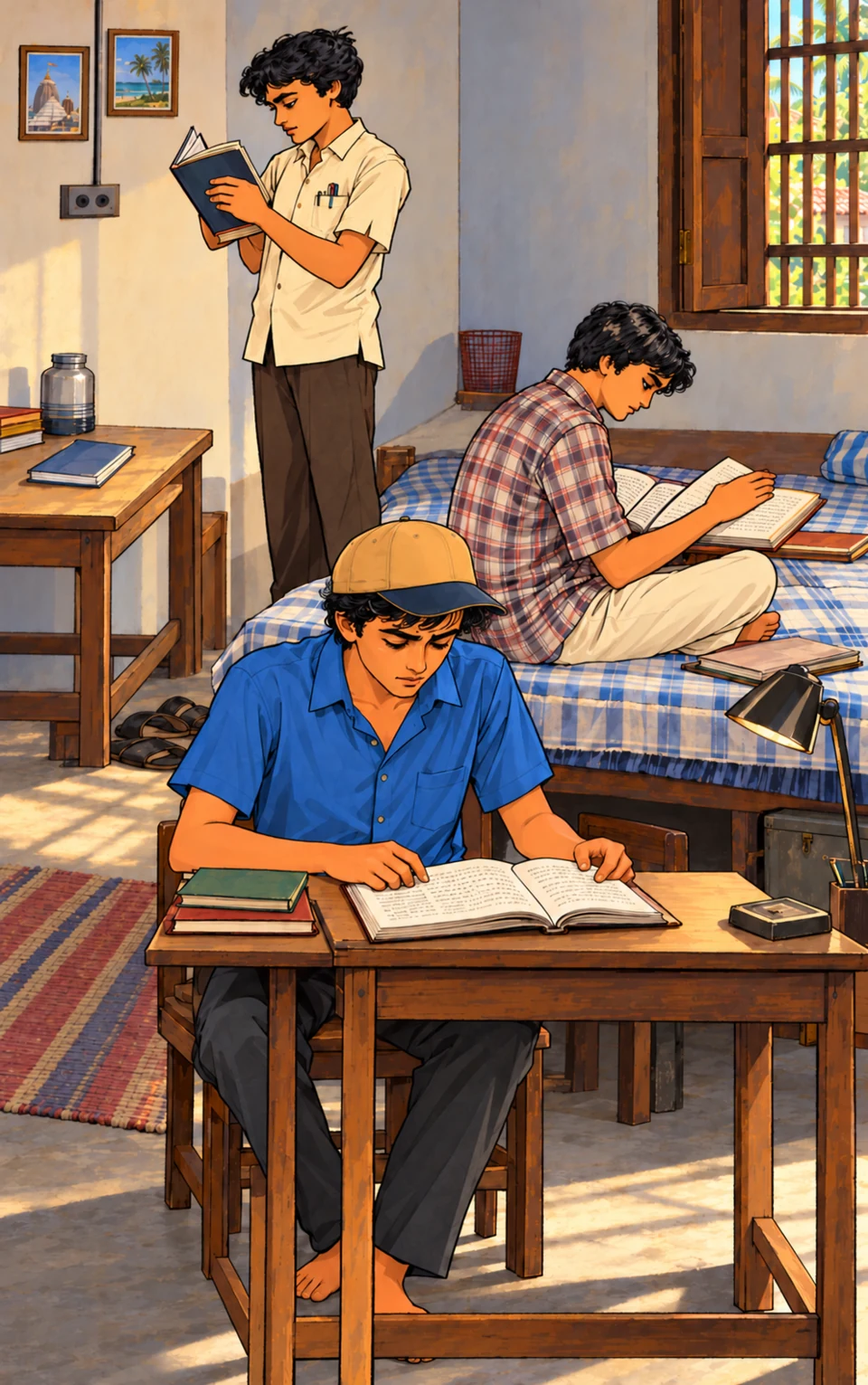
It was my first year in college, and I was living in the hostel. Our room number was 37. My roommates were Naba and Padmanabha.Naba was always buried in his books, completely absorbed in his studies. Padmanabha, on the other hand, was forever wandering off somewhere. Keeping track of where he had disappeared to was almost impossible.
Whenever the subject came up, I would proudly tell my friends that I intended to become a detective when I grew up. I was fascinated by detective work. Naturally, my love for reading stories and novels grew stronger with each passing day. Most of the books I read were detective stories, and it was from them that my dream of becoming a detective had taken root.
I also used to tell my friends that I had enrolled, through correspondence, in a course on investigation. In other words, I was studying to become a detective.But little did I know that, at that very time, a real-life case would fall into my hands—and that I would actually have to solve it.
My friends were thrilled when they heard about it.

“You have to unravel this mystery,” they urged me. “Only then can you hope to become a great detective someday. Morning shows the day. After all, a person’s true nature reveals itself from childhood. The same is true of detectives. You can recognize one from an early age. They keep a sharp eye on everything around them. They notice things that ordinary people simply fail to see. So, you have to solve this case!”
I had no choice but to take up the case and set out to solve it. My friends encouraged me, promising that they would give me their full support. Even Vijay, who lived in Room No. 35, volunteered to become my assistant.
I became the famous detective Sherlock Holmes, and Vijay became Dr. Watson. Together, we set out to solve the case.
Here is what had happened.
Sanjay, Durgamadhab, and Ranjan lived in Room No. 47. One day, a book belonging to Sanjay suddenly disappeared.In fact, the book was not his. He had borrowed it from Ram Bhai, who wasone yearsenior to him. The disappearance of the book came as a bolt from the blue for Sanjay.The three roommates—Sanjay, Durgamadhab, and Ranjan—searched the entire room together. They looked into every nook and cranny and searched everyone’s trunk as well. But the book was nowhere to be found.
Nearly in tears, Sanjay cried out, “What am I going to do now? What will I tell Ram Bhai? How can I tell him that the book has been stolen?”
The three roommates had always shared a good relationship. But after the book disappeared, they began to look at one another with suspicion. And now the case had landed in my hands. All three of them urged me, “You have to solve this case.”
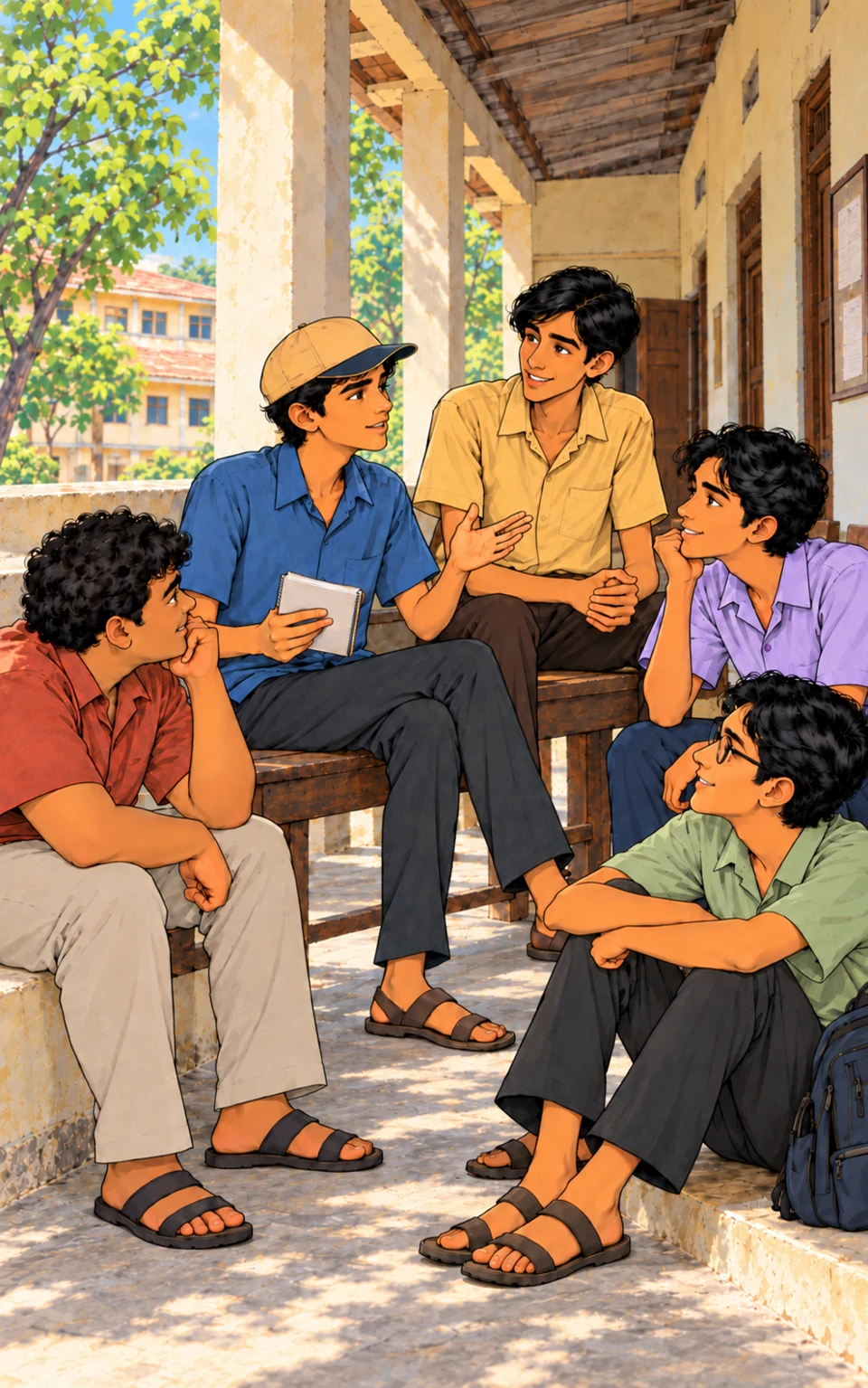
Meanwhile, they had already sworn on the sacred garland of the temple deity that none of them had anything to do with the theft.The book Hanuman Prashna was also consulted. At that time, Hanuman Prashna was considered a great aid in identifying thieves and recovering stolen property. According to the book, Angira indicated that the lost object would certainly be found and was somewhere in the north-eastern direction.A thorough search was therefore conducted in the north-eastern part of the hostel. But even after all that searching, the book was nowhere to be found.
I announced that, first of all, I would question each of the three roommates separately. That would be the starting point of my investigation.That afternoon, the interrogation began in Room No. 47—the room shared by Sanjay and the others. The three roommates waited outside while I remained inside. One by one, they entered the room to face my questions. The door was kept locked from the inside, while Vijay stood guard outside.
Sanjay was the first to face my interrogation.
My first question was:
“What kind of book was it?”
Sanjay replied, “It was a Physics book—a supplementary book, that is. It wasn’t a textbook prescribed for our course. I was having trouble understanding Physics, so Ram Bhai had given me the book. He is from a village near mine.”

Before he could say anything more, I interrupted him.“I know him. He is one of our seniors, and his room is upstairs. I’ve seen him talking to you, too. Now tell me—when was the book stolen?”
Sanjay replied, “If I knew when and how the book was stolen, I would have caught the thief myself!”
I became alert. That hadn’t been the right question.
So, I changed the question.
“Tell me, when was the last time you saw the book?”
“I read it three days ago,” Sanjay replied.
“Where did you put it after you finished reading?”
“On my study table.”
“Who else takes books from that table?”
“Sometimes Durgamadhab and Ranjan do. They take my permission before taking them.”
“When you’re not around, does anyone ever disturb your table?”
“I don’t know.”
“Have you ever noticed your books being moved or disturbed?”
“No.”
“When did you first realize that the book was missing?”
“When I looked for it because I wanted to read it.”
“Can you give me the dates and tell me everything in order?”
He paused for a moment.
I took out my notebook and began writing down his answers as he spoke.
“So, you read the book on November 20, correct? You read it at night. You didn’t need the book on the 21st, nor on the 22nd. Then, on the morning of the 23rd, you noticed that it was missing. That means the book must have been stolen either on the 21st or the 22nd.”
I asked another question.
“Who else comes to your room?”
“Everyone does. Before going to college, all our friends drop in here, call out to one another, and then leave.”
“Did any of them notice the book? I mean, did anyone ask about it? Did anyone repeatedly look at the book?”
“No. I don’t remember anything like that.”
“Look, if a book of yours has been stolen from your room, then the first people who naturally come under suspicion are your two roommates—Durgamadhab and Ranjan. Which one of them do you suspect more?”
“I don’t suspect either of them. They’re good friends of mine. They’ve already sworn on the sacred garland of the deity that they had nothing to do with it.”
“Had either of them ever asked to borrow this book?”
“They had. They borrowed it and read it. I never refused when they asked. After finishing it, they brought it back and put it on my table.”
“Between the two of them, is either one particularly greedy or jealous?”
“I don’t know.”
“Look, a person doesn’t necessarily steal something simply because he wants to possess it. Someone might make a book disappear out of jealousy. Have you ever noticed anything like that in either of these two friends?”
“No.”
My interrogation of Sanjay was nearly over.
“You may leave now,” I told him. “That’s all for now. If necessary, I may need to talk to you again. For the moment, ask Durgamadhab to come in.”
Sanjay went outside, and Durgamadhab entered.
Durgamadhab was quite a stout fellow, and he came in breathing heavily. One might even have thought that he was nervous about facing the interrogation.
I was sitting on the bed. He sat down on a chair.
I asked him, “So, Sanjay’s book has been stolen. What do you know about it?”
“Not much,” he replied. “All I know is that it was a Physics Reference Book. He had borrowed it from Ram Bhai, one of the seniors.”
“Have you seen the book?”
“Yes, I have. It was a hardbound book of nearly five hundred pages.”
“Have you ever read it?”
“Yes! Sanjay showed it to me. I read a few pages.”
“What did you think of it?”
“It was good. The topics in Physics were explained in simple language, which made them easy to understand.”
“Did you want to read the book?”
“Yes, I did. Sanjay had even told us that whenever he wasn’t using it, we could read it. He only asked us to handle it carefully because it belonged to someone else.”
I said, “There is a suspicion that you were the one who made the book disappear.”
Durgamadhab looked even more frightened.
“Am I being suspected?” he asked.
“It is only natural to suspect you. The three of you live in this room. If one person’s book is stolen, the other two naturally come under suspicion.”
“Are you saying that either Ranjan or I stole the book?”
“No! I didn’t say that. I said you are under suspicion. Now tell me—whom do you suspect? Ranjan?”
“No! Ranjan wouldn’t do such a thing.”
“If Ranjan wouldn’t do it, then you must have done it.”
“No! Neither of us did it. Why would we? Sanjay never refused to let us read the book. He told us that whenever we wanted, we could take it and read it. Why would we steal it? Besides, where would we read it after stealing it? We couldn’t read it in this room. The moment we took the book out; we would be caught. So why would we steal it?”
Faced with Durgamadhab’s seemingly irrefutable logic, I appeared a little troubled.
I said, “The book wasn’t stolen with the intention of reading it. It was stolen out of jealousy. Perhaps someone wanted to make sure Sanjay couldn’t study it, couldn’t understand Physics, and would be humiliated in front of Ram Bhai. The book was made to disappear with that intention. Now tell me—who did it? You or Ranjan?”
He replied, “No! Neither of us did it.”
“Then tell me—who do you suspect? Who do you think did it?”
“I can’t suspect anyone.”
“But Sanjay suspects you.”
He stared at me in astonishment.
I softened the statement a little.
“Sanjay didn’t tell me that directly. But from my conversation with him, I get the impression that he has his suspicions about you. So be careful!”
He seemed to lose heart and sighed, “Oh!”
“You may leave now. If you happen to come across any unusual information, let me know.”
He said, “Yes,” and got up. Knowing that Sanjay suspected him, he looked somewhat worried as he left.
Then Ranjan entered the room and sat down in front of me. I closed the door from the inside.
I asked, “Whom do you suspect?”
“I don’t know anything. I have no idea how the book was taken, who took it, or when it was taken.”
“But you are under suspicion, aren’t you?”
“Why me?”
I repeated what I had already told the others.
“There are three of you in the room. One person’s book has been stolen. Naturally, the other two come under suspicion.”
“But we had nothing to do with it.”
“That’s not enough simply because you say so. Sanjay suspects you.”
He looked startled.
“Sanjay said that? He suspects me?”
I quickly clarified, “No! He didn’t say that. But I think the suspicion is there in his mind. I could sense it.”
Ranjan looked hurt.“What did Durgamadhab say? Does he suspect me too?”
“No,” I replied. “He doesn’t suspect you. But he suspects Sanjay.”
Ranjan gave a faint smile.“But Sanjay’s book was stolen!”
I said, “Sanjay could be putting on an elaborate act. The book doesn’t actually belong to him. He could have staged the whole theft and kept the book for himself.”
“But where will he keep it?” Ranjan asked. “Where can he read it? Won’t he be caught by us?”
“Look,” I said, “the academic year will be over in just a few months. There’s no guarantee that Ram Bhai will return to this hostel—or even to this college—next year. And you two won’t be Sanjay’s roommates either. By then, Sanjay can easily take the book out and read it.”
Ranjan gave a little grunt.“So, this is all some kind of trick by Sanjay?”
“Perhaps. Or perhaps not. But remember one thing—you are still under suspicion. Be careful.”
He looked somewhat dejected.
I asked, “Which of the three of you is the most careless? I mean, who is likely to leave the door unlocked and wander off?”
“None of us,” he replied. “Whenever we go out, we lock the door.”
“Do you leave the windows open?”
“The windows stay open. But the table cannot be reached through the window.”
“What if someone usea stick?”
“No! Such a large book cannot be lifted with the help of a stick.”
“Whom do you suspect?”
“No one. I’m wondering how Sanjay could have done such a thing. We searched his trunk. The book wasn’t anywhere. It is not easy to hide such a large book somewhere.”
“He may have had an accomplice,” I suggested. “Someone from another room. Perhaps the book is hidden in that person’s room. Tell me, who else is close to Sanjay, apart from the two of you?”
He thought for a moment.
“Since you’ve put the idea in my head, I’ll look into it too. I’ll find out who else Sanjay is close to.”
I said, “Don’t tell anyone about our conversation—not Sanjay, and not Durgamadhab either. Keep your eyes and ears open. If you notice anything suspicious, let me know.”
Ranjan and I came out of the room. A crowd of hostel residents immediately gathered around me.
“Did you find anything?”
“What did you find?”
“Who did it?”
A barrage of questions was volleyed at me.
I smiled gently and said, “This is only the beginning of the investigation. Very soon, the mystery of the stolen book will be solved.”
Vijay and I then set off together toward the market.It was customary for all the hostel boys to go out for a little walk in the evening. But that day, one unusual thing caught my attention: Sanjay, Durgamadhab, and Ranjan did not go out together.They normally went everywhere together, calling out to one another and heading out as a group. But that evening, each of them went out separately.
Vijay asked me, “Did you get any clue from your conversations with them?”
“No,” I replied. “I didn’t get any real clue. But I said certain things to each of them that have made them suspicious of one another.”
“I can see that,” Vijay said.
“What do you mean?”
“They’ve all gone out separately now. And look at their faces—they’re all puffed up like that of sulky children.”
“It is only when they turn against one another that the real truth will come out.”
By the time we returned from the market, it was already study hour. After dinner, I went back to Room No. 47.
Sanjay was delighted to see me.
“Come in, come in,” he extended a warm welcome.
Durgamadhab, however, seemed rather rude. Ranjan also spoke in a slightly raised voice.
“What is it now?”
I said, “The book is in this room.”
“Impossible!” Durgamadhab exclaimed. “We’vealready searched everywhere.”
Ranjan quickly added, “We’ve checked every nook and cranny.”
Sanjay said, “If you want, you can search again.”
“I’ll take a look at the windows first,” I said.
There were three windows in the room. One opened toward the veranda, while the other two were in the opposite direction.All the hostel rooms were designed in the same way: each had a single door opening onto the veranda, while two windows faced the opposite side. Beyond those windows, about twenty feet away, stood the boundary wall. The stretch of ground between the windows and the wall was thick with grass and weeds. It was neglected and dirty, and hardly anyone ever went that way.The front side of the hostel was kept reasonably clean, but the back was quite the opposite. The overgrown grass and weeds there were cleared only once every month or two.
As I examined the windows and their railings, I noticed something interesting. The hook on one of the windows was loose. In other words, it did not close properly. With just a little pressure, the window could easily be pushed open.Someone could have closed the window from inside, but anyone standing outside could still have opened it without much difficulty.
After examining the window, I asked, “Did you know that this window doesn’t lock properly? Anyone standing outside could open it without much effort.”
They stared at the window in surprise. They seemed amazed that I had uncovered such a hidden detail.
“No! We didn’t know,” they replied together.
I said, “The book may have been passed out through this window.”
Ranjan objected.
“But earlier you said the book was still inside this room.”
“I did,” I replied. “At that time, I didn’t know about the secret of this window. Now that I do, it seems possible that the book was taken out through here.”
I looked outside through the window. It was dark, and I could see nothing. There wasn’t even an electric light on that side. In fact, that area was never illuminated. All looked out through the window with me.
“We’ll check it in the morning,” I said. “I have a feeling there’s something out there, just beyond this window.”
They continued staring out through the open window, but apparently, they couldn’t see anything.
I left their room.
The next morning, I noticed Durgamadhab searching through the overgrown, neglected area at the back side of their room. He was rummaging through scraps of paper, pieces of torn towels, empty bottles, and all sorts of rubbish, looking for something.I didn’t ask him what he was looking for.
He kept searching for a long time. Then, as it got close to the time to leave for college, he returned to his room, had a bath, took his breakfast, and set off for college.I met him in the college.
“Did you find anything?” I asked.
“No.”
“But you were searching very carefully.”
“Yes, I was. I also feel bad about the whole thing. Everyone suspects me, so I thought I should investigate it myself.”
“Good! It would be nice if we all became detectives.”
Then he gave me a strange piece of information.
“I found a book cover,” he said. “I think it might have belonged to the stolen book.”
“Oh?” I exclaimed.
“Yes. Sanjay had taken very good care of the book. He had even put a cover on it. While searching around the back of the hostel, I found that cover.”
“Was the cover lying directly beneath the window of your room?”
“No. It had landed some distance away. It must have been blown there by the wind from somewhere. There’s no way to say for certain which window it had been thrown from.”
I then shared my own deduction with him.
“One thing is clear from this: the book’s cover must have been changed somewhere along the way. Someone put a new cover on the book in an attempt to conceal it. And the culprit is staying on this very floor of the hostel.”
He agreed.“Could be!” he said.
“The culprit is on our floor,” I continued. “He may well be a Science student. Otherwise, what will an Arts or Commerce student do with a Physics book?”
“Who is he?” he asked.
“It will come out! It will come out, my friend! You keep your eyes open. If you find anything suspicious anywhere, let me know. And yes—be careful! Don’t tell anyone about finding this cover. The culprit might become alert.”
“No,” he assured me. “I haven’t told anyone. I’m searching on my own as well.”
“Good! Very good!”
That afternoon, I went upstairs to meet Ram Bhai in his room.
Ram Bhai was justone batch senior to us. He was a very simple and well-mannered person. I had met him many times before, though we were not particularly close.
I asked about the book.“Brother, you had given Sanjay a book, didn’t you?”
“Yes, I did,” he replied. “It was a Physics Reference Book.”
“Do you know that the book has gone missing?”
“Yes. I’ve heard something about it.”
I asked, “What do you think about it now?”
He exclaimed, “What is there to think about?”
“I mean, how are you going to get the book back?”
“How am I going to get it back? It’s gone missing, isn’t it?”
“So, you will justlet it go?”
“What else can I do?”
“I don’t think you should simply give up on the book like that.”
“What else can I do? Sanjay is from a village near mine. I helped him with everything, from getting admission to college to settling into this hostel. He is almost like a younger brother to me. How can I demand the book back from him?”
Pretending to offer him some friendly advice, I said, “Brother, let me tell you something. Please don’t tell anyone about this. But do as I say.”
“What?”
I told him my plan.
“Put some pressure on him to return the book. Insist that you want it back. Pretend to get a little angry.”
“What good will that do? Poor Sanjay will only be troubled.”
“He won’t be troubled at all,” I assured him. “Go to his room. Make a scene so that everyone can hear you. Pretend to be absolutely furious. You’ll see—the book will suddenly reappear, just as mysteriously as it disappeared.”
He looked at me with a mixture of belief and disbelief.
“Why are you getting involved in all this?”
I explained my purpose.
“I’m investigating this book-theft case. I’m not a policeman. I’m a detective in my own way, using my own methods. I live in Room No. 37, and I’m a first-year Science student. I’m determined to solve this case because everyone is beginning to suspect one inmate. That fellow is under tremendous mental pressure. Who knows what he might do in such a state? He could lose control and do something drastic. I’m carrying out a little investigation of my own, behind the scenes, to protect him.”
Ram Bhai looked troubled.“Could he really commit suicide?”
“Why not? Being unable to bear the humiliation, he might do something like that.”
“Who is he? We all shouldcouselhim.”
I quickly discouraged him.
“People under severe mental pressure can behave strangely. The more you try to help them, the more likely they are to misunderstand you. Let it be for now. Atright time, you will know everything. If you can just help me in this small way, I’m sure we can bring the matter to a proper conclusion.”
Ram Bhai asked, “Will the problem really be solved?”
I assured him, “It certainly will.”
I had lured Ram Bhai into helping me with a little carefully crafted fiction. And it worked.That very night, shortly after study hour, Ram Bhai came to Room No. 47. He stood outside Sanjay’s room, near the doorway, in the veranda.It was dinner time. Everyone was coming out of his room and heading toward the dining hall. They were leaving in groups.
At our hostel, the moment the study hour ends, a bell rings for dinner. It is as though all of us simply wait for that bell to ring. Webecome desperately hungry by then, eagerly waiting for the chance to head to the dining hall.The moment the bell rings, a wave of excitement sweeps through the hostel. The hungriest boys rush out first. Most of them are first-year students. The senior students, having gained a little experience by then, take their time coming out.Besides, the dining hall tends to get crowded at first, and the seniors have no desire to squeeze themselves into the rush.
That day, the entire veranda was packed with first-year students. Amid the crowd, Ram Bhai began his performance.Everyone knew him as a quiet and gentle boy. But at that moment, he was so furious that anyone seeing him might have thought that there was no more terrifying man in the world than him.
He demanded that Sanjay return the book.
Loud enough for everyone to hear, he said, “I need that book now. I have an examination coming up.”
Sanjay lowered his head and replied, “The book has been lost.”
Ram Bhai became even angrier.
“Whether it has been lost or stolen, what difference does that make to me? Am I supposed to fail my examination? I absolutely need my book. Somehow or other, you must find it and give it back to me.”
Sanjay looked helplessly from one side to the other. He could not decide what to do. In a feeble voice, he said, “We are looking for it.”
Rambhai raised his voice even higher. Speaking loudly enough for everyone to hear, he said, “I will not let this go. I will spare no one. I will lodge a complaint with the hostel superintendent. I will go to the police station, if necessary. The inspector at the town police station is my maternal aunt’s son—he is like my own brother. I will have the police enter the hostel. Every room will be searched. If the police arrest some of you, you’ll see what happens. Once they are beaten up at the police station, the whole truth will come out.”
After issuing these threats, Rambhai walked away. His threats seemed to have made quite an impact. At dinner, everyone in the dining hall was discussing the matter. They talked about the police entering the hostel, searching every room, and taking some of the students away in custody. Some of them looked frightened.
It was the following evening. At this time, all the hostel residents would usually go out for a stroll. Some would head to the nearby market, while others would go to the temple. They would move around in groups. Otherwise, they would sit on the parapet of the bridge by the roadside and chat. After spending the entire day attending college classes, everyone liked to relaxva little during this time.At seven in the evening, the study hour would begin at the hostel. The superintendent would walk around, checking whether the students were studying or not. So, putting aside their evening stroll, the students would return to the hostel before seven.
That day, Bijay and I had gone towards the market together. I had run out of toothpaste and soap, so I needed to buy them. Bijay, too, had to buy a notebook. After purchasing what we needed from the market, we were on our way back. On the way, we discussed the mystery of the stolen books as well. When a matter is discussed with other, a few clues are definitely uncovered. Every detective knows this. That is why they keep discussing a case over and over again. Sometimes, quite unexpectedly, a clue emerges from an entirely different direction.
We were coming through a narrow lane. It was dark. We were already a little late. So, to avoid being caught by the superintendent and getting scolded, we had chosen to take the lane instead.At that time, our hostel superintendent was Professor Chintamani Behera. He was an extremely irritable man. Once he started scolding someone, he could go on for more than an hour without letting up. He wore a dhoti and a panjabi and was fond of chewing betel. His spectacles had very thick lenses. Beneath those thick-rimmed glasses, his eyes were sharp and watchful, like those of a snake. He never missed an opportunity to scold the inmates.
At that moment, his angry, flushed face flashed before my eyes. I quickened my pace. Bijay fell a little behind. He could not keep up with me. From behind, he teased me sarcastically, “Hey, why are you so afraid of that snake-faced man? Is he a professor from the Science Department that you’re so frightened of him? At worst, he’ll scold you. He isn’t going to bite and eat you. He’s a professorin Odia, not a tiger or a lion.”
Despite Bijay’s teasing remarks, I continued striding ahead at a brisk pace.
The road was dark and more or less deserted. There was virtually no pedestrian or vehicular traffic. Just then, a small accident occurred. Two boys were riding bicycles behind us. They crashed into me, knocking me to the ground. They themselves did not fall. They managed to steady themselves and got off their bicycles. Hearing the commotion, Bijay came running from behind, repeatedly asking, “What happened? What happened?”
I had been walking along the left side of the road. There was enough space for a bicycle to pass comfortably, so there was really no reason for an accident to occur. Yet it had happened.At first, I assumed it was simply due to carelessness. Perhaps the rider was inexperienced, or perhaps he could not see properly in the darkness. But the two boys did not even come forward to help me up.
I was already thinking of forgiving them. Still, I could not resist admonishing them, saying, “At least,be careful when you ride a bicycle!”
The two of them came striding towards me,as though the whole thing had been my fault. One of them said, “Hey, you! You’ve got quite a mouth, haven’t you? Nalichuda(red flattened rice)! You’ve come from the village and already grown so full of yourself.”
At that time, the town boys used to taunt the hostel students by calling us Nalichuda. We had all come from villages, and in the mornings, we would eat flattened rice before leaving for college. Whenever the town boys passed by our hostel at night, they would shout, “Nalichuda!Nalichuda!” Sometimes, we would hear protests coming from inside the hostel as well: “Podaruti(burnt bread)! Podaruti!”
So, when this boy called me Nalichuda right to my face, I immediately understood that he was a thoroughly troublesome and quarrelsome fellow. I backed down a little and said, “All right! What’s done is done. Now, just go.”
They seemed ready to pick a fight. They said, “Go? Who are you to tell us to go?”
I was trying to dust myself off and get back on my feet. Bijay reached me and helped me stand. I was still limping a little. I had no idea whether I had suffered any cuts or injuries. I ran my hands over my body, checking myself all over. The two boys showed not the slightest sign of pity or sympathy.
They were barely visible in the darkness. I had no choice but to look for a way to settle the matter. I said, “All right, brother! It’s all our fault. It was our mistake to take this road. It was our mistake to walk on the left side of the road. It was even our mistake to be walking at all.”
The cyclist’s companion now spoke up. “You certainly have a lot to say, don’t you? Where did you learn to talk like that?”
Bijay said, “All right, let it go! Just forget about it!”
The cyclist scoffed, “Forget it? Forget it in the month of Margashira!”
His companion added, “I’ll give you a couple of blows that’ll make you forget everything!”
I kept looking at their faces. I had never seen them before—not at college, nor in the market. I could not recognize them at all. The two of them seemed determined to heighten the quarrel. It was almost as if they had deliberately rammed their bicycle into me with the intention of picking a fight.Who are these two? What is their real motive? They seemed to have singled me out as the target of their hostility.
Bijay tugged at me and said, “Come on, hurry! Otherwise, study hour will start.”
They looked quite robust. If the situation turned into a physical fight, we stood little chance of winning. So, we had no desire to let the matter escalate any further. After all, we had come from villages, while they were from town. If they want, they can call out and gather a hundred boys in no time. We were always afraid of the town boys.
I had bought toothpaste and soap from the market. They had slipped from my hand and fallen somewhere by the roadside. I was looking for them, scanning the area this way and that, but I could not see them anywhere. Bijay had a different concern altogether. By then, he had become quite frightened. He kept one hand clasped around mine and wanted us to leave the place without bothering to look for any of those items.
Just then, the quarrelsome cyclist taunted me, “Hey, you! Eating watery dal at the hostel has certainly done wonders for your looks!”
We said nothing out of fear. We had no desire to let the quarrel escalate.
Just then, the cyclist’s companion said, “Aren’t you the one who has been playing detective?”
I was startled.
Hearing this from a boy I had never seen or heard of before, I realized that they must know me. They had deliberately followed me and rammed their bicycle into me. They even know what is going on inside the hostel. They know about the book theft. They know that I as investigating it. Who are these people? Do some connections to the book theft extend beyond the hostel? I was bewildered.
After that, they turned back. They rode away on their bicycles. As they left, they gave me one final warning:
“Be careful, boy! Give up this detective business, or you’ll have another ‘accident’—one that’ll leave your bones broken.”
It was clearly a threat, meant to make me give up investigating the book theft. But how are these two connected to the theft? I could not make any sense of it.
Bijay was trembling with fear and clutching my hand tightly. I freed my hand from his grip. Then I searched for the soap and toothpaste lying by the roadside, found them, and picked them up. We returned to the hostel.
On the way, Bijay asked, “Do you know those two?”
I said, “No! I don’t think I’ve ever seen them anywhere before.”
“But they know you.”
“They certainly do.”
“They deliberately rammed their bicycle into you.”
“There’s no doubt about that.”
“They must have been following us.”
“Yes! Otherwise, how would they have known that we were going to enter this dark lane?”
“Who are they?”
“That’s exactly what I’m wondering too. Besides…”
“Besides what?”
“There’s another mystery hidden behind the book theft.”
“What mystery?”
“These two boys are outsides. How did they come to know about the book theft? They must certainly have some connection with someone in the hostel. That person doesn’t want us to investigate the matter. He has set these two boys on our trail.”
“Who is that person?”
“I’m wondering about that too. The matter isn’t as simple as I had thought. There isn’t just one person behind it—there are several boys involved. I can’t make sense of the mystery at all.”
Bijay said, “Why are so many people involved over a single book? It’s not made of gold or silver. At most, it would cost a hundred or a hundred and fifty rupees. Why are so many people after a book worth barely a hundred rupees?”
I said, “The book may be worth a hundred rupees, but these boys aren’t after the book. Rather, they are on the side of the boy who stole it. They are his supporters. But who is that boy—the one these two town boys have come forward to support? Instead, let’s change the direction of our investigation. Let’s find out which boy in the hostel has connections with these outsiders.”
Bijay said, “I think we should drop this whole thing. There’s no point stirring up trouble unnecessarily.”
I looked at him sharply and asked, “Are you scared?”
He replied in an indifferent tone, “No, not really.”
But from the way he spoke, I could tell that he was genuinely frightened.
We reached the hostel.
It was already past seven in the evening. Study hour had begun, and silence had descended over the entire hostel. No one was moving about. Everyone was sitting in their respective rooms, heads bent over their books, seated in their own chairs. I glanced towards the superintendent’s office. It was situated at one corner of our hostel. The office door was closed. That meant the superintendent had not come today. Perhaps he would not be coming at all. Thank goodness! We had been spared his scolding and abuse.I returned to my room, while Bijay went back to his.
In our room, Naba had already begun studying. Padmanabha had not yet returned. He usually comes back late and does not care much about the superintendent. The superintendent, for some unknown reason, never say anything to him either.Every morning, Padmanabha goes to the superintendent’s quarters. What exactly he talks about with the superintendent there is also unknown. But everyone in the hostel knows that Padmanabha is the superintendent’s favourite.
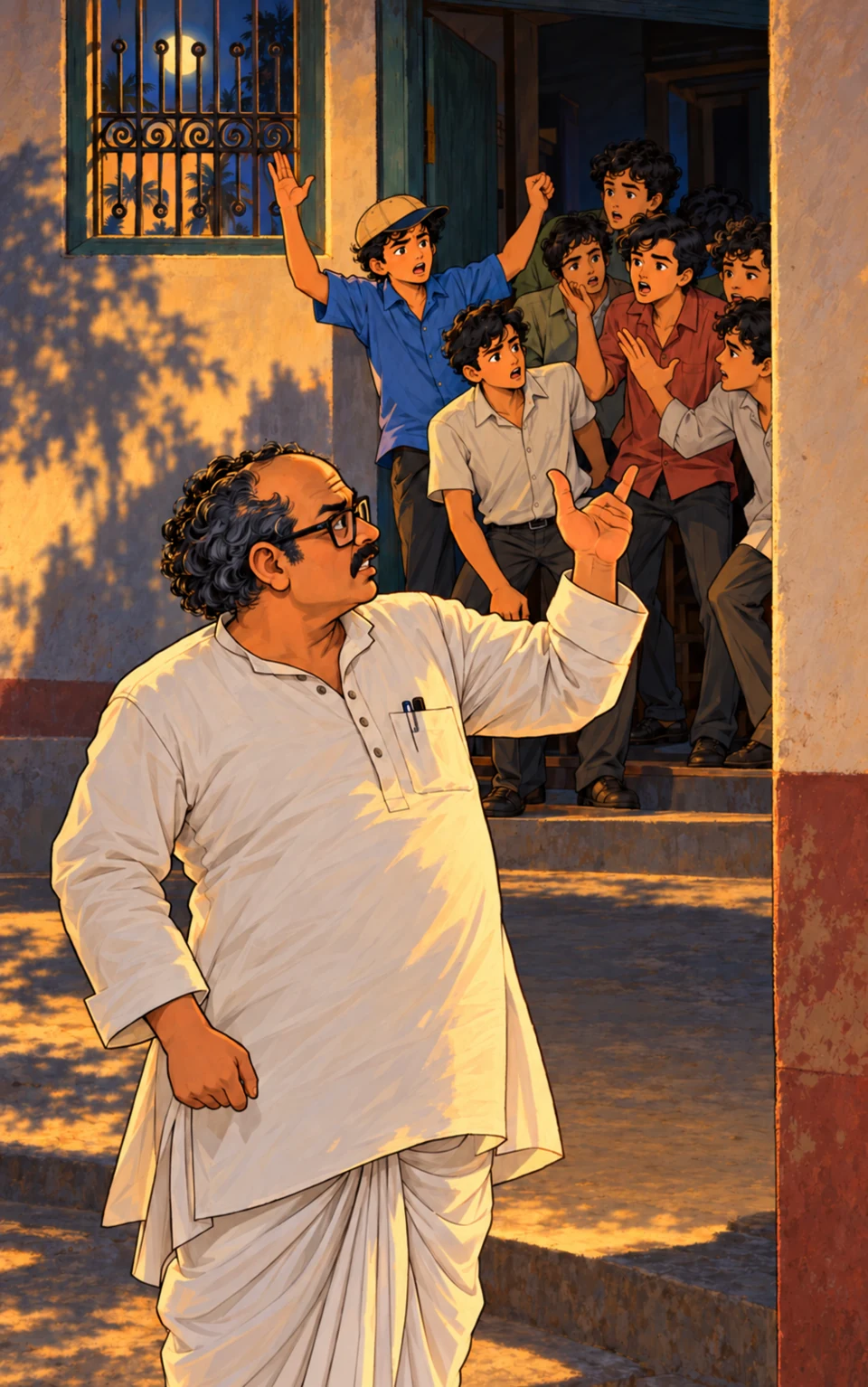
That night, at around half past eight, the electricity went out. The entire hostel was plunged into darkness. Such power cut is quite usual. Whenever the lights go out, all the boys come out of their rooms. Studying comes to a halt. They wander up and down the veranda. The veranda is very high and long. Some even climb down from the veranda and roam about in the open field in front, bare-bodied. At such times, theyseem to be granted complete freedom. Some take off theirlungis in the darkness and wave them like flags. A few strip completely naked. Some run; while some dance.
They come up with new ways to savour this sudden taste of freedom to the fullest. Loud shouting and clamour can be heard everywhere. Some laugh uproariously, like kings in a theatre. Others sing tuneless songs in harsh, grating voices. Their donkey-like braying fills the dark surroundings of the hostel with noise. Some abuse one another. Some bark like dogs. Some turn into jackals, while others become roosters in the darkness.
It seemed as though all of us had actually been waiting for that darkness. While we were thoroughly enjoying the darkness—or the power cut—Superintendent Chintamani Behera would suddenly appear like an enemy.
There would be a mad rush along the veranda and in the field in front. Someone would bump into someone else. Someone would push someone. Someone would fall. Someone would get up. Taking advantage of the situation, someone would splash water on someone else.
The hostel would turn into a storehouse of every kind of mischief.
The superintendent’s office would be plunged into darkness. In those days, there were no inverters or generators. The superintendent would come out of his office and stand on the veranda. It was only natural that he would not be pleased with the children taking such outrageous advantage of their newfound freedom. He would begin scolding them loudly:
“Stop! Stop this ear-splitting noise!”
But who was listening to him? His warnings would be swallowed up by the collective uproar. He would shout again:
“Are you human beings or not? Why are you howling like animals?”
He would continue showering us with abuse, but none of it would reach the boys’ ears. They would carry on with their howling and shouting. Taking advantage of the situation, I would make my way to the front of his office and enjoy his scolding. I, too, had a role to play in all that mischief. I could bark exactly like a dog. Standing close to the superintendent I would bark loudly, just like a dog. The superintendent would be dressed in a white dhoti and kurta. Even in the darkness, his white clothes would be faintly visible. He would appear agitated. He must certainly have been startled. Saying, “Who is it? Who is it?” he would come charging toward me. In the darkness, he had no way of recognizing me. I would bark like a dog right next to him and then leap away and run off.
Suddenly, the power would come back on. Everyone would become alert. Like monkeys, we would all jump into our respective rooms and hide, transforming ourselves into well-behaved, disciplined boys. There would be no more shouting or commotion. Silence would prevail everywhere. The atmosphere would once again become conducive to studying.
The next day, an order would be issued from the superintendent’s office. Everyone would be sternly warned that even if the power went out, nobody was allowed to make noise or create a commotion. Strict action would be taken against anyone who shouted or caused a disturbance. They would be expelled from the hostel.
The warning had had only a limited effect on the inmates. The shouting and commotion had certainly diminished a little, but they had not stopped altogether. Mischief would raise its head whenever the darkness provided an opportunity. It is said that darkness is the breeding ground of crime.
That day, the superintendent was not in his office. Almost everyone had come to know this. So, that day, everyone was comfortably enjoying the freedom that darkness offered. There were such an uproar and such piercing shouting that it seemed as though the hostel itself might be torn apart and reduced to rubble by the sheer force of the explosion of sound.
Meanwhile, it was time for dinner at the hostel. Feeling my way through the darkness, I made my way to the dining hall. Darkness reigned there too. Although it was already time for dinner, thebell had not rung. The reason was simple: there was no electricity, and the preparation of the food had been delayed.
Eventually, the power came back on. Once the lights were restored, it became clear that even in the darkness, the hungry ones had already made their way to the dining hall. They had claimed their chairs and settled in. Now the dinner bell rang.
It was while we were eating that Durgamadhab arrived and gave us the important news.
He said, “The book has been found.”
I looked up from my half-eaten meal.
“Found? How?”
Durgamadhab explained that while the power was out, someone had come and left the book on the bed.
“You all didn’t notice?”
“Were we in the room? We were all wandering around on the veranda.”
“Was the room door open?”
“Yes! The door was open. Who would lock it at a time like this?”
“So, someone must have taken advantage of the darkness, come into the room, and left the book there.”
“Yes! That’s possible.”
I said, “All right. I’ll come after I finish eating.”
Durgamadhab now sat down to eat. Actually, he had come to the dining hall to have his meal. When he saw me, he took the opportunity to give me the news. Earlier, the three of them used to come together for their meals. But ever since they had begun suspecting one another, they had started coming separately.
Usually, whenever I came to eat, Vijay would be with me. But that day, I had no idea where Vijay had gone during the blackout. I had come alone. Now I spotted Vijay in the dining hall. He was sitting in another corner, eating. After washing my hands, I went over to him.
I said, “Come after you finish eating!”
Vijay asked, “What happened?”
I said, “The book has been found.”
Vijay looked relieved. He said, “Thank goodness. So, the investigation ends here.”
He began eating quickly. I waited outside for a while. When he finished eating, he came over to me and said, “Now go ahead and announce that the investigation is over.”
I said, “Come on. Let’s see what happened.”
This time, we went to Sanjay’s room, Room No. 47. Sanjay wasn’t there; only Ranjan was there. He was just about to leave for the dining hall.
I asked, “Where’s Sanjay?”
Ranjan said, “He’s gone to Ram Bhai. The book has been found, after all. He’s gone to return it.”
I asked, “Why did he leave so quickly? He couldn’t wait a little longer for us?”
“He was happy to have found the book and said there was no point in delaying any further.”
“Of course. It’s better to free yourself from a debt as quickly as possible.”
Ranjan said, “It’s not just that the book has been found; all of us have been saved. The way you played detective, interrogating and suspecting us, had scared us to death.”
Vijay expressed his delight: “The investigation is over!”
I paid no attention to what he said.
I asked, “Why haven’t you gone to eat?”
Ranjan told me the truth. He said, “Ever since that day, the three of us have been completely at odds with one another. When one of us turns his face one way, another turns the other way. Durgamadhab went to eat, so I didn’t.”
Vijay offered his opinion: “Now make peace with each other. The book has been found, after all.”
Ranjan sighed deeply. He said, “How can we make peace now? Detective Sahib will say that one of us must have put the book on the bed. He suspected us before, and he’ll continue to suspect us.”
I said, “All the evidence has come to light now. The book was stolen by an outsider. And now it has been returned.”
Ranjan looked somewhat relieved.
From there, Vijay and I went to Room No. 74. It was Ram Bhai’s room. Ram Bhai was there, but Sanjay wasn’t. Presumably, Sanjay had returned the book to Ram Bhai and gone straight to the dining hall for dinner. We must have missed each other on the way.
I asked Ram Bhai, “Have you got the book back?”
Ram Bhai said, “Yes! I got it back. To be honest, I didn’t really expect to get it back.”
I said, “May I have a look at the book?”
“Of course!”

He handed the book to me. It was a board-bound book of nearly five hundred pages. It had a new cover on it—a newspaper cover. There was nothing written on it. I flipped through the pages and looked at the price. It was only one hundred rupees. (The book was printed many years ago. Hence it was much cheaper.)
Ram Bhai said, “Sanjay was going through a lot of trouble. He was under a great deal of mental pressure. I got carried away by what you said that day and gave him quite a few threats. I didn’t feel good about it either. Anyway, the book has been found.”
I kept flipping through the pages. The book looked completely new and unused to me. It seemed as though it had just come straight from a bookshop. It even had a freshly made cover.
I suddenly asked, “By the way, Bhai, is this the same book that you had given to Sanjay?”
Ram Bhai took the book from me. He flipped through the pages and looked astonished. Suddenly, he said, “No! This isn’t the same book. This is a new book.”
I said, “What does that mean? Someone has replaced it with a new book.”
He looked even more bewildered and said, “Who could have done this? And why would anyone do such a thing?”
I said, “It could have been Sanjay himself. It could have been Durgamadhab or Ranjan. It could even have been some boy from outside.”
He asked, “Why?”
I said, “It’s all a result of the threats you made that day. The boy got frightened. But his mischief hasn’t disappeared.”
Vijay asked, “Then where did the old book go?”
I said, “That’s the mystery.”
Ram Bhai kept turning the pages of the book. He looked somewhat dejected. Perhaps he thought that Sanjay himself had bought a new copy and returned it, pretending that the missing book had been found.
I said to Ram Bhai, “You’ve got your book back. Now keep quiet. Don’t tell anyone anything. Don’t let anyone know that you’ve received a new book in place of the old one. I’ll see what other mystery lies behind all this.”
With a heavy heart, Ram Bhai left for dinner. Vijay and I returned to our room. On the way back, the two of us went over the whole incident again.
Vijay asked, “Why did he return the book?”
I said, “That day, when Ram Bhai said he would call the police and have every room searched, perhaps he got frightened. He thought it would be better to settle the matter and not let it go any further.”
Vijay said, “He could have returned the old book. Why did he buy a new one?”
I speculated, “Perhaps he doesn’t have the old book anymore. That’s why he bought a new one.”
“Where did the old book go?”
“It’s also possible that the boy who stole the book and the boy who returned it are not the same person. The second boy is afraid of the police. He’s afraid of the rooms to be searched. That means—could there be something illegal hidden in some room?”
“Was he waiting for today’s power cut so that he could return the book?”
“As far as I can tell, yes. He knew that the moment he stepped outside carrying the book, someone or other would notice him. The book is quite thick. It would certainly attract attention. The power cut gave him an opportunity—or perhaps he himself had something to do with the power going out.”
“How could he have anything to do with the power going out?”
“That’s exactly what I’m thinking too. Tomorrow, we’ll talk to the lineman who looks after the electricity in our hostel. Let’s see. Perhaps we can get some clue from him.”
We returned to our respective rooms.
Late that night, Sanjay came to our room. He looked extremely happy and relieved.
He said, “The book has been found. There’s no need for any more investigation now.”
I asked, “So, you want the investigation to stop?”
It seemed that he did not understand the sarcasm in my question. He said, “But the book has been found. Why is there any need for further investigation?”
I gave my opinion: “The problem hasn’t actually been solved. The boy who stole the book hasn’t been caught.”
Now he began defending the thief. He said, “The thief regretted what he had done and returned the book. Why do you still want to catch him?”
I decided to startle him. I said, “You surely know that the book that has been found is not the same book that was stolen. You returned a new book to Ram Bhai.”
Sanjay’s face fell.
I applied a little more detective work. I said, “It can even be established which shop the book was bought from. There are only four bookstores in our city that sell academic books. And this particular book was available at only two of them. It would be very easy to find out who bought this book and from which shop.”
Sanjay’s face was turning pale. He grabbed my hand and said, “Bhai! Please don’t investigate any further. Let this matter end here.”
I asked, “Why do you keep insisting that this investigation should end? Are you afraid of someone? Tell me the whole truth.”
Then he burst into tears.
He said, “You have already figured out the truth.”
“What?”
“A new book has been returned in place of the book that was stolen.”
“So, you did it.”
He confessed. “Yes! I just couldn’t take it anymore. I thought that if I returned the book, it would all be over. I wanted the matter to end right there.”
I asked, “So you were frightened by the threats Ram Bhai made that day?”
He shook his head to say no, though he was still trembling.
I pressed him: “Tell me the truth! Why did you do this? Are you afraid of someone?”
He couldn’t speak. He was trembling all over and kept looking around, as though he were afraid someone might be watching him. This time he nodded affirmatively—yes.
I asked, “Who are you afraid of?”
He finally stammered, “There is someone. He has been keeping an eye on us. He has even threatened me secretly. I’m completely frightened. That’s why I want this matter to end here.”
I asked, “What kind of threat? Did someone bump into you with a bicycle on the road? Did someone beat you up? Did someone threaten you and walk away? Was it some outsider who came here? Some thug, bully, or gangster-type boy?”
He said, “No! I received a letter. I read the letter and became frightened.”
I became anxious. A letter? Another development in the case. How far did the roots of this incident extend? The whole thing was beginning to seem increasingly mysterious.
I said, “Where is that letter? Let me see it.”
He had kept the letter in his pocket. He took it out and showed it to me. I read it. It was a short note, with only three lines written on the paper:
“Stop this investigation. There will be power cut tomorrow evening. Your fate will be decided then.”
I, too, was astonished by this unexpected turn of events. I asked, “How did you receive the letter?”
He said, “Someone must have thrown it onto my bed through the window.”
I asked, “Could this have been done by Durgamadhab or Ranjan?”
He said, “No! I don’t suspect either of them.”
“Was it thrown through that window—the one whose hook was broken? The one that could be opened from outside and wouldn’t close properly?”
“Probably. He must have thrown the letter through that window. Maybe he threw it at night, or perhaps while we were away having dinner. I found the letter in the morning and got frightened. So that evening I bought a new copy of the book and hid it. Once the power came back, I told everyone that the book had been found. I returned the book too. I’m very scared. I beg you, stop this investigation.”
I said, “All right. Let it be so. The book has been found. We shouldn’t get ourselves involved in any more trouble. You probably don’t know that I was attacked too. On my way back from the market, someone knocked me down with a bicycle. Whatever happens, we are village boys. The people behind this are town boys. So, let’s end the matter here. The investigation is over. Are you happy now?”
Sanjay was terribly frightened. He burst into tears. Hearing what I said, he gave a faint, strained smile.
He said, “That’s why I came to you so late at night, secretly. They are keeping an eye on us. They know everything we say and do.”
I reassured him: “Now go. Everything has been settled. What is there to be afraid of anymore?”
Sanjay’s face reflected a strange mixture of fear, sorrow, and relief. Seemingly reassured, he slipped out of my room like a thief, walking on tiptoe, as though trying to keep himself hidden from the eyes of some unknown criminal.
But one thing kept troubling me again and again: the power cut.
The culprit knew about the power cut—as though the power went out whenever he wanted it to. Otherwise, how could he have threatened that he would deal with Sanjay when the power went out? Did he know exactly when the power would be cut? How was that possible?
After he left, our roommate Padmanabha learned about the whole incident. He was something of a gadabout, always roaming around the city. He spent most of his time in movie theatres and was hardly ever in the room. But that night, when Sanjay had come to our room, he happened to be there. After listening to everything, he said, “Looks like you’ve opened a detective agency here.”
I gave a faint smile and said, “It was opened, but now it has been shut down.”
“How can it be shut down? Leave it to me. I’ll uncover everything.”
“I told you; the investigation is over!”
He tried to provoke me. “Are you scared, then? If a detective gets scared, it’s all over. Who are you afraid of? The town boys? There’s no need to be afraid. I have a hundred friends in town. If you agree, I’ll call them tomorrow and create a commotion in the hostel.”
I said, “There’s no need for any of that.”
He insisted again. “Give me charge of the investigation.”
“What do you mean, charge of the investigation? Is this a police station or something, where an investigation is going on?”
He persisted. “Give me some responsibility, or I’ll tell everyone. I’ll tell the superintendent. I’ll file a complaint against you.”
Reluctantly, I said to Padmanabha, “All right. From today onward, you are the investigating officer in this case.”
Padmanabha asked, “What do I have to do now?”
I said, “Find out which boy in our hostel has connections with outsiders.”
Padmanabha said proudly, “I do.”
I said, “Then you’re the real culprit.”
Padmanabha said, “Ha! So, in the end, you’ve made me responsible. Fine! I’ll find out who else has good terms with the town boys.”
We went to bed.
The next day, Vijay and I met our hostel electrician. He was assigned with a number of responsibilities. He operated the pump house and looked after the hostel’s electrical lines. As soon as study hour began at seven in the evening, he locked the hostel gate. After that, anyone returning to the hostel had to climb the steps near the boundary wall and enter the hostel that way. That was the usual arrangement. At ten at night, he would lock the gate at the back of the hostel.
There was a small one-room house near the pump house where he lived. His name was Giridhari. He was a short, dark-complexioned man who wore thick spectacles.
I asked him, “Brother, why does the power keep going out at the hostel so often?”
He expressed his frustration. “I can’t figure that out either.”
Vijay asked, “What do you mean?”
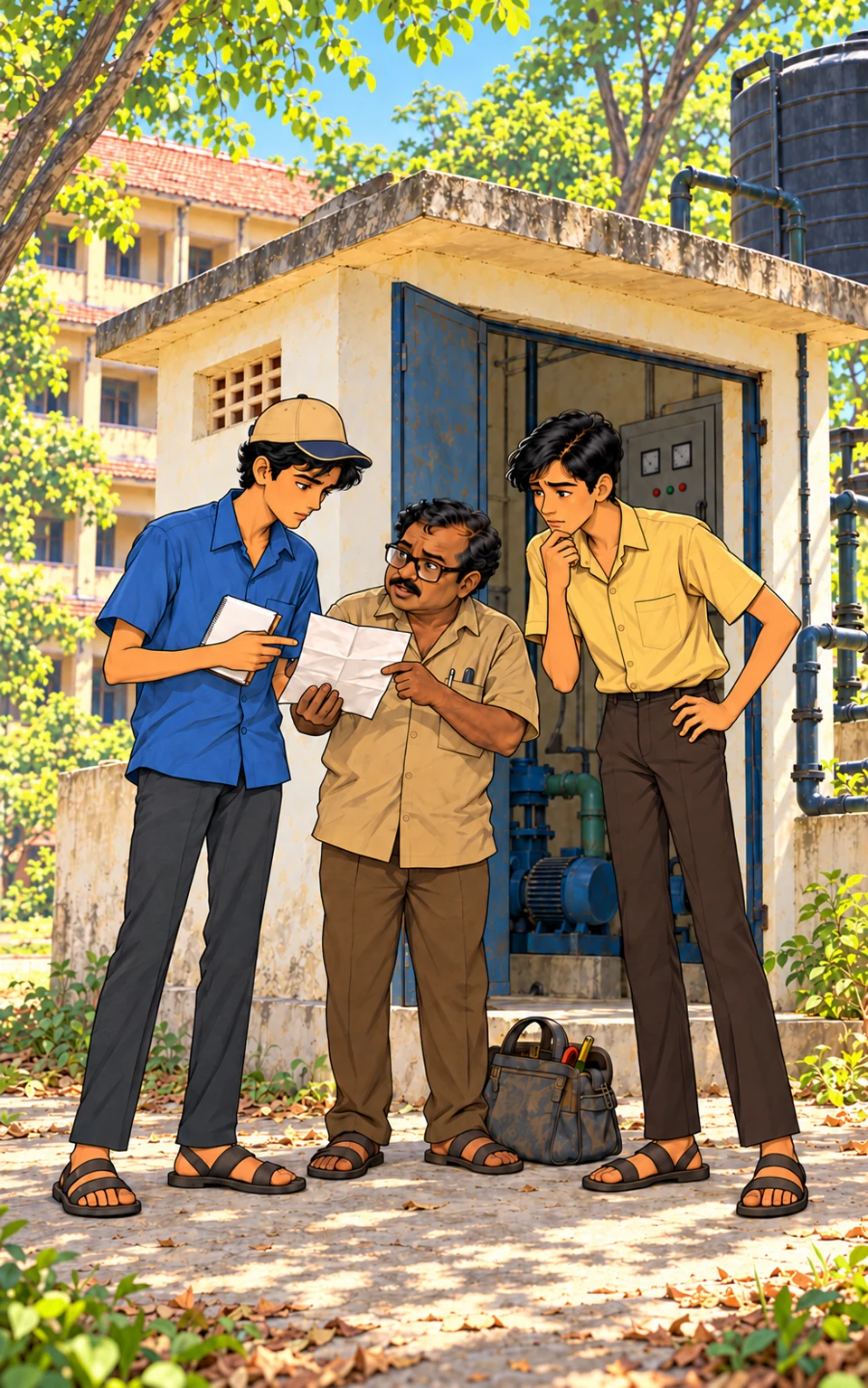
Giridhari said, “I’m fed up with it too. The fuses keep blowing. I’m exhausted from replacing them again and again.”
I asked, “Are the fuses blowing on their own, or is someone deliberately doing it?”
He said, “Someone is definitely playing mischief.
I asked, “Who is doing it? How?”
He then explained in detail. “Someone is connecting the negative and positive wires together in one of the rooms. That causes the fuse at the main switch to blow.”
I asked, “Who is this mischievous boy?”
He said, “How would I know? It’s such a big hostel with so many boys. How can I know which room he is sitting in and doing this? I’m troubled by it too. In the evenings, I work at an electrical shop nearby. Whenever I’m informed, I come over and replace the fuse.”
I said, rather sternly, “Does the superintendent know about this?”
He said, “Yes, he knows. The money I get from the hostel is barely enough to live on. That’s why I work at a shop in the evening. If the fuse keeps blowing like this, won’t I be the one who has to keep running back and forth?”
I said, “And what about the trouble the boys are facing? Once the power goes out, it takes half an hour to come back. Our studies are being disrupted. We’re thinking of lodging a complaint about this.”
He looked somewhat dejected. “You can do whatever you think you should. What else can I do? If it becomes too much trouble, I’ll quit this job.” The poor man seemed clearly distressed.
For a while, all of us remained silent.
Breaking the silence, I suggested a solution. I said, “Brother, if you want, we can catch that mischievous boy.”
He looked at me in surprise. “How can we catch him?”
I said, “You’re the electrician, aren’t you? You tell us how to catch him.”
He thought about the plan of how to catch the culprit.
I said, “The boy who is connecting the negative and positive wires in his room must surely be leaving some evidence behind.”
Giridhari’s face lit up.
He said, “There would be some black soot around the switchboard. If he’s doing it at a plug point, that would be burnt too. The switch itself might also show some burn marks.”
I said, “That’s it! We’ve got it.”
Vijay asked, “What?”
I proposed, “Giridhari Bhai will go around all the rooms in the hostel, supposedly to check and repair the electrical lines. He’ll look for the room where there’s black soot on the switchboard, or where the switch or plug has burn marks.”
Giridhari agreed to my proposal. He even looked pleased.
Vijay’s face looked terrified.
He said, “Oh no! Are we in trouble?”
I asked, “What’s wrong with you now?”
He said, “There’s a half-burnt switch in our room too.”
“How did it get burnt?”
“How would I know? I’ve seen that burnt switch there since the very first day.”
I reassured him, “Let Giridhari give us his report first. We’ll analyse it and identify the real culprit from the evidence.”
Giridhari was happy because he was answerable to many for the power cuts in the evenings. He had to leave the shop where he worked in the evening and come back to the hostel whenever the power went out.
He said, “I’ll give you the list within two days.”
Butthere was an obstacle in the investigation from another direction. That obstacle was Superintendent Chintamani Behera.
At first, I thought the old man had somehow found out that I had been barking like a dog. Perhaps someone had told him, or perhaps he had recognized me in the darkness. That evening, he sent for me through a boy.
I went to him.
In a rather threatening tone, he said, “I hear you’ve opened some kind of detective agency here. That will not be tolerated inside the hostel!”
I said, “No, sir! Why would I open a detective agency? We’ve come here to study. We’ll concentrate on study only.”
My answer sounded like that of a brilliant, single-minded student who was completely absorbed in his studies.
Superintendent Chintamani Behera frowned and said, “Complaints have been received against you. In the name of conducting an investigation, you’ve been subjecting mental harassment to boys by asking unnecessary questions.”
I folded my hands and said humbly, “Sir! A boy’s book was stolen. He suspected his roommates. He even threatened to bring boys from outside and have them beaten. Two innocent boys were terrified and reduced to tears. I had no choice but to intervene. I acted in such a way so that the book could be found.”
I gave him a carefully fabricated explanation, mixing a little truth with a few lies. The Superintendent was surprised.
“Has the book been found?”
In the same humble tone, I replied, “Yes, sir! The book has been found.”
He said, “Books and notebooks getting stolen in the hostel is nothing new. It happens all the time. Even trousers and shirts go missing. That is why I always warn the boys to remain alert and be careful. They should always keep their rooms locked.”
I agreed with him, as though eager to please him. “You are absolutely right, sir!”
He then gave me his advice—or rather, his warning.
“You cannot go around pretending to be a detective and conducting investigations like this. Whenever anything is stolen or any such incident occurs, you must first bring it to my notice. If you go against these instructions, action will be taken.”
I said, “Yes, sir!”
Before leaving, I asked him, “Sir, who told you about this? Did someone write you a letter, or did somebody make a verbal complaint?”
He became irritated. “You’ve started investigating again like a detective!”
In an apologetic tone, I said, “Sorry, sir!”
I was about to leave when he called me again from behind. “Listen!”
“Yes, sir?”
He said, “There is a boy in this hostel who barks like a dog. Whenever the power goes out, he creates a terrible nuisance. He keeps barking in front of our office in an extremely shrill voice and drives us crazy. That rascal even comes right up to my ear, barks, and runs away. Can you catch him?”
I replied, “I certainly can, sir!”
He said, “First catch that boy. I’ll get him expelled from the hostel. Only then will I have some peace. That troublesome boy is becoming a real nuisance.”
As though I were sharing some secret information with him, I said, “Sir! There is another troublesome boy in the hostel who is cutting the electric line. It is causing a great deal of disruption to our studies. I’m trying to find out him.”
He suddenly became angry and warned, “No! Finding him is not your job. The electrician, Giridhari, will find him out. If, under the pretext of finding that boy, you question any student or interrogate anyone like a policeman, I will take action against you.”
I lowered my head and said, “Yes, sir! I’ll do whatever you say.”
I was about to leave.
Chintamani Behera repeated his earlier instruction once again. He said, “Remember what I told you. Catch that boy who barks like a dog and bring him to me. I’ll reward you.”
I promised, “Yes, sir!”
And left that place.
Vijay and I sat down and discussed the matter. We tried to make sense of the whole affair. It had started with the theft of a book. Now it had ended with the disruption of the electric connection. What was the mystery behind all this? We could not make head or tail of it. And now an outsider was involved in it too. The whole thing seemed like a complicated sum.
I said, “Who told the Superintendent that I’ve set myself up as some kind of private detective here? We can’t ask anyone anything anymore. If we are caught, we’ll be thrown out of the hostel.”
Vijay said, “Forget it! What are we going to gain from this investigation anyway? It’s not as if anything is going to happen to us.”
I felt a little dejected. The dream I had of becoming a detective seemed to be crumbling before my eyes.
I said, “Let’s do one thing. We won’t ask anyone anything. We’ll simply observe everything quietly. I have a feeling that we’ll succeed.”
Vijay looked at me in surprise.
“Do you really think we’ll succeed?”
“Definitely. We’ll certainly be able to uncover this mystery.”
Vijay asked, “What are you planning to do?”
Vijay asked, “What are you planning to do?”
I said, “I can see one possible way now. Come on, let’s go to that lane. We’ll hang around there in the evening. The people who knocked me down with a bicycle are bound to come there.”
Vijay expressed his doubts. “What will happen if they do come? Do you think we can catch them? We’ll probably just get beaten up instead.”
“I’m not saying we should catch them,” I said. “They’re town boys. If we catch one of them, another ten or fifty will show up. Besides, we have no evidence in our hands. We can’t take them on by force. You’re weak. And I’m extremely weak.”
Needless to say, I was very thin and frail in those days. Whenever I introduced myself, I jokingly called myself the president of the All-Odisha Extremely Weak Men’s Association. Everyone used to tease me, saying, “Do you eat rice, or do you live on air?” Vijay was even thinner than I was. The other boys called him a bamboo stick.
We might be able to investigate by using our brains, but catching people by force was simply beyond us.
Vijay asked me again, “So what are we going to do?”
I suggested, “Let’s buy a torch. When they come near us, we’ll shine the torch on them and identify them.”
Vijay asked, “Where will we get the money for a torch?”
“You pay half and I’ll pay half. We’ll buy one together.”
Though he wasn’t particularly happy about it, Vijay agreed.
Our financial condition wasn’t good in those days. Whatever money came from home was used up paying the hostel and college fees. Eating snacks outside was a luxury we simply couldn’t afford. Twice a day, we had flattened rice and sattu that we brought from home as snacks. We had only one real addiction: watching movies. But even for that, we had to make considerable sacrifices.
Whenever we wanted to go to a movie, we would mark ourselves down for a “sick meal” at the hostel. The rule was that anyone who opted for a sick meal would be given milk and bread. We would tell the mess manager, “Don’t give us the milk and bread. The bread you bring is inedible anyway. Just give us the money. We’ll buy our own from the market.”
The mess manager would hand us the money. We would use it to watch a movie. And then we would spend the entire night hungry.
We decided to use the same trick to raise money for the torch. One of us put in for a sick meal, while the other kept his regular meal. The one who had the regular meal told the mess manager, “I’m going to the movies for the second show. I’ll eat when I come back. Please keep my meal covered and set aside in the dining hall.”
After we had collected the money for one sick meal, we waited until midnight. After everyone had gone to sleep, we went to the dining hall, pretending that we had returned after watching a second-show movie. We divided one meal between the two of us and ate it. Even then, we did not have enough money. So, reluctantly, we took out a little from our savings. In this way, we managed to collect some money and finally bought a torch.
We had thought that we would get no help from the electrician, Giridhari. But we did. Because of the repeated power failures in the evenings, the superintendent had scolded him. He had also forbidden Giridhari from working at another place in the evening. The students’ studies were the first priority. There could be no power cut during study hour. And if the electricity did go out, it had to be restored immediately. Frightened, Giridhari got to work and soon brought us a report.
The list contained the names of all the rooms where there were slight traces of smoke on the switchboards, or where a switch or plug had been slightly burnt. I began analysing the list.
First, I eliminated the rooms on the upper floor from the list. Someone from the upper floor could not easily come downstairs, take away a book, or throw a letter through the window. Senior-class students lived on the upper floor, so it was reasonable to assume that they were not involved in this affair.
Now I was left with a list of five rooms on the ground floor. I began examining them one by one.
Room No. 35. Vijay, Adhibas and Pradipta lived in this room. They were Arts students. Vijay was working with me on the investigation. So, for the time being, I ruled them out as suspects.
Room No. 47. Sanjay, Durgamadhab and Ranjan lived here. Sanjay’s book had been stolen. Durgamadhab and Ranjan had helped with the investigation. Later, Sanjay had bought a new copy of the book and returned it. For the time being, they too could be excluded from suspicion.
Room No. 49. This was also a room for three persons, but one of the beds was vacant. The student to whom the bed had been allotted did not join. Alekh and Binod lived in this room. Both were Arts students. They would have no reason to take a Physics textbook. Therefore, they too could be ruled out.
However, one thing was now clear: the boys living in three-person rooms could not be responsible for this. Unless all three of them were working together, one of them would be noticed by the others while doing it. The power was being cut in the evening, during study hour. So, if three boys were present in a room, it would not be possible to carry out such an act unnoticed.The boys in a two-person room, however, could do it. Either both of them could be acting together willingly, or one could have intimidated and silenced the other. Or one of them might be doing it when the other was away. The last possibility seemed the most likely.
Room No. 53. Two boys lived in this room. Both were Science students and both were brilliant. They had been allotted a two-person room because of their good academic results. They were always engrossed in their studies. They did not go out much and did not mix with many people. They could hardly have any connection with anyone from town. So, I ruled them out.
Room No. 55. This was also a two-person room. Both boys were brilliant Science students. They were followers of a particular religious faith and were deeply religious. Every morning at five o’clock, devotional songs could be heard coming from their room— “Jai Radhe Radhe, Krishna Krishna, Govinda Govinda…” They were religious boys. Surely, they could not be thieves.
As I kept eliminating one room after another from the circle of suspicion, eventually every room had been ruled out. I was puzzled again. Where was the culprit? In which room was he hiding?
But my detective training told me that no matter how religious, educated, wealthy, or knowledgeable a person might be, there was no guarantee that criminal tendencies could not exist within them. Many learned, wealthy, and religious people in the world had been proven to be criminals.
So, I had to start the analysis all over again.
Just then, I remembered something Vijay had said. There was no rule that an Arts student could not steal a Science textbook simply because he had no use for it. He could steal it for someone else. He could steal it for some other purpose.
At that very moment, Padmanabha also returned from his investigation with a list. It contained the names of those boys who regularly mixed with students from town and went around with them.
I compared Padmanabha’s list with Giridhari’s list. One room immediately came under suspicion.
Room No. 49.
There was only one common link between the room where the short circuits were taking place and the room occupied by a boy who had connections with outsiders: Room No. 49.
My suspicion of the two occupants of that room becgfame much stronger.
There were two boys in the room—Alekh and Binod. Initially, I had ruled them out because they were Arts students. Now I once again turned my attention to their room.
Alekh was a simple-looking, village boy. Binod, on the other hand, seemed rather cunning. According to Padmanabha’s report, it was Binod who had good terms with the town boys.So, it was quite possible that Binod was the mastermind behind this whole drama. Perhaps, thinking Alekh to be an innocent and harmless fellow, he had intimidated and threatened him into keeping quiet while he himself carried out all these activities.
I did not reveal my suspicion.
Instead, I turned to Padmanabha and asked him:
“You go to Superintendent Chintamani Behera’s house from time to time in the mornings. Did you tell him that I was playing detective?”
Padmanabha immediately admitted it. He said, “Yes! I told him. I told him that you were the detective and I was your assistant.”
I said, “You’ve ruined everything!”
He asked, “What happened?”
I said, “The superintendent has threatened to throw me out of the hostel.”
He laughed and said, “He can’t do anything. I’ll go right now and tell him that I am the detective and you are nobody. He won’t do anything to me.”
This, too, seemed like another mystery.
I asked, “Why won’t he do anything to you?”
Padmanabha said, “I know all his weaknesses. The old man drinks a little. I buy all that stuff from the market and supply it to him. He won’t dare do anything to me.”
I said, “Oh!”
In the evening, Vijay and I patrolled that lane. We were hoping that the two boys on bicycles would suddenly pounce on us, abuse us, and threaten us. We would then use the opportunity to shine our torchlight on their faces and identify them.
But that did not happen.
They did not come anywhere near us. There could have been two reasons for this. Perhaps they had assumed that the investigation was over. The book had been found, the superintendent had scolded me, and I had withdrawn from the investigation. The second possibility was that they had realized that we had laid a trap to catch them. If they fell into the trap, everything would be exposed. So, they kept themselves hidden.
The criminals’ minds, it seemed, were more fertile than a detective.
I now concentrated my suspicion on Room No. 49. My main suspicion was on Binod. I kept an eye on him. He was rarely seen in the hostel. He spent a lot of time outside and mixed with the town boys. I waited for an opportunity to catch him red-handed.
My intuition told me that one evening the power would go out in the middle of study hour—at a time when the electrician, Giridhari, would be away, so that it would take longer to replace the fuse.
And, sure enough, that was exactly what happened.
It was two days later, in the evening. At around eight o’clock, the power went out.
I immediately got ready. I hurried over and reached Room No. 49. My torch was in my pocket.
It was pitch-dark everywhere. You could hardly see the person standing right in front of you.
As always happened during a power cut, everyone came out of their rooms. They wandered along the veranda and in the field below it. They shouted, sang songs, and barked like jackals and dogs.
I was standing in the darkness near Room No. 49.
Then someone came out of that room.
After stepping outside, he closed the door and locked it—all in the darkness.
I immediately understood that perhaps he was alone in the room, or that he had locked his roommate inside before coming out. But the latter was impossible. Surely there was no one else inside.
At this hour, the hostel residents did not lock their doors because they remained somewhere nearby. The electricity could return at any moment. But this boy locked the door.
Then he slowly descended from the veranda.He now began walking towards the gate.I followed him, keeping a safe distance behind him. Since I could see very little in the darkness, I moved forward by judging his movements and estimating where he was.He reached the hostel gate.The gate had already been locked. Every day, as soon as study hour began, the gate was locked. Giridhari would lock it and then leave for the shop where he worked part-time.
The boy now climbed the steps beside the boundary wall near the gate, crossed over, and went outside.I followed him.
He came up onto the road. Two other boys were standing there with bicycles. They were probably town boys. They whispered something to each other. It seemed as though some sort of exchange had taken place. Then the boy turned back, and the two cyclists also rode away.
The boy was returning with something in his hand. He reached the gate, where I was waiting for him. Suddenly, I switched on my torch. The light fell directly on his face. He was caught off guard and tried to hide his face. I moved very close to him and said softly:
“Your game is over now, my friend!”
He was startled and said, “Who? What?”
He could not see me because I was standing in the darkness. I too was shocked when I saw his face. My suspicion proved to be wrong. It was not Binod. It was Alekh—the simple, village-looking boy from Room No. 49.
I went very close to him and grabbed his hand.“What, my friend? Don’t you recognize me?” I asked.
He struggled and tried to break free. He had a thick book in his hand. In the struggle, I managed to grab the book. His hand slipped out of my grasp, and he was now free. He immediately ran away toward the town.I returned to the hostel with the book in my hand.
A little later, the electrician, Giridhari, arrived after hearing the news. He replaced the fuse at the main switch, and the electricity supply to the hostel was restored.
The boys who had been shouting outside and howling like jackals and dogs suddenly became quiet, well-behaved students and returned to their respective rooms.
I went back to my room and opened the book. What I saw left me absolutely stunned. Without telling anyone anything, I quietly went over to my study table. I sat down on the chair and began studying.
Late that night, there was a knock on the door of our room. I opened it and found Alekh standing there.He fell at my feet and pleaded:
“Save me, brother! I’m going to die.”
I reassured him and brought him inside the room. I closed the door. Naba and Padmanabha had woken up and surrounded him.
Looking at me, they asked, “What has happened?”
I said to Alekh, “You tell us, my friend. Tell us the whole truth.”
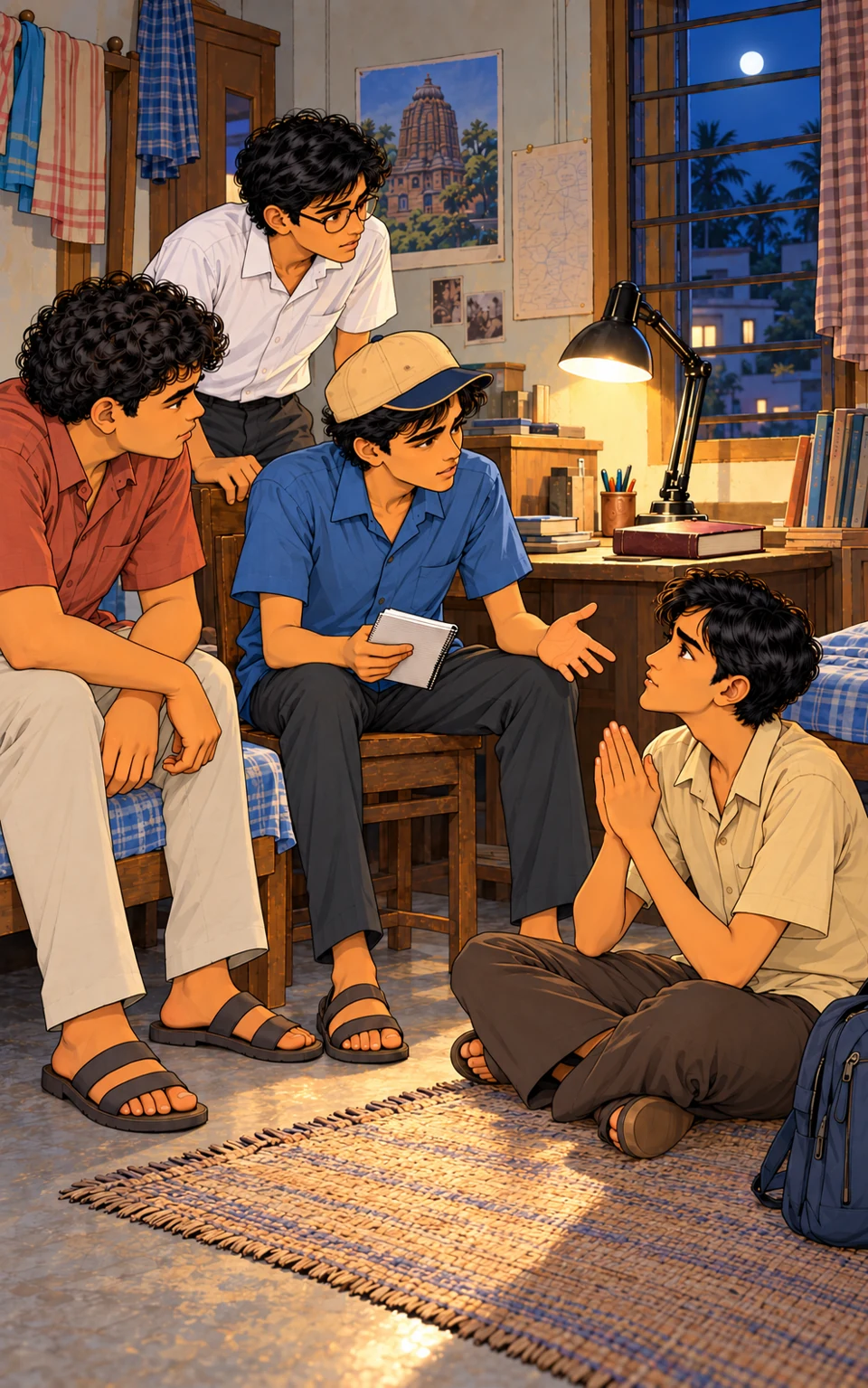
He sat down on the floor with his hands folded and pleaded, “Save me!”
I said, “Admit everything truthfully. Start from the beginning. Tell us everything you have done.”
He replied, “You must have opened the book and seen everything. You already know.”
“I know everything,” I said. “But I want to hear it from your own mouth.”
Padmanabha said, “Let me see the book.”
I stopped him. “First let Alekh finish telling his story. Everyone, swear that this will remain a secret among us. I have promised to protect him.”
Then I looked at Alekh and said, “Tell us the truth. You were the one who stole Sanjay’s book, weren’t you?”
He said, “Yes.”
I asked, “Why did you steal it?”
He replied, “You already know. Our business is conducted through that book.”
Padmanabha and Naba stared in astonishment. They snatched the book from my table. I took it back from them, opened it, and showed them.From the outside, the hardbound book looked like an ordinary book. But the pages inside had been cut out, creating a hollow compartment. That hidden compartment was used to conceal contraband—namely, Ganja—and transport it safely.
I asked, “How did you steal Sanjay’s book?”
He said, “I once saw the book lying on his table. I thought that if I took that book, I could put it to use. We needed a thick, hardbound book. So, one day, when the electricity went out, I picked it up. When the power goes out, nobody locks their rooms. Everyone usually wanders around nearby. In that darkness, I was able to carry out my work. I made a hollow compartment inside the book and used it to transport Ganja back and forth.”
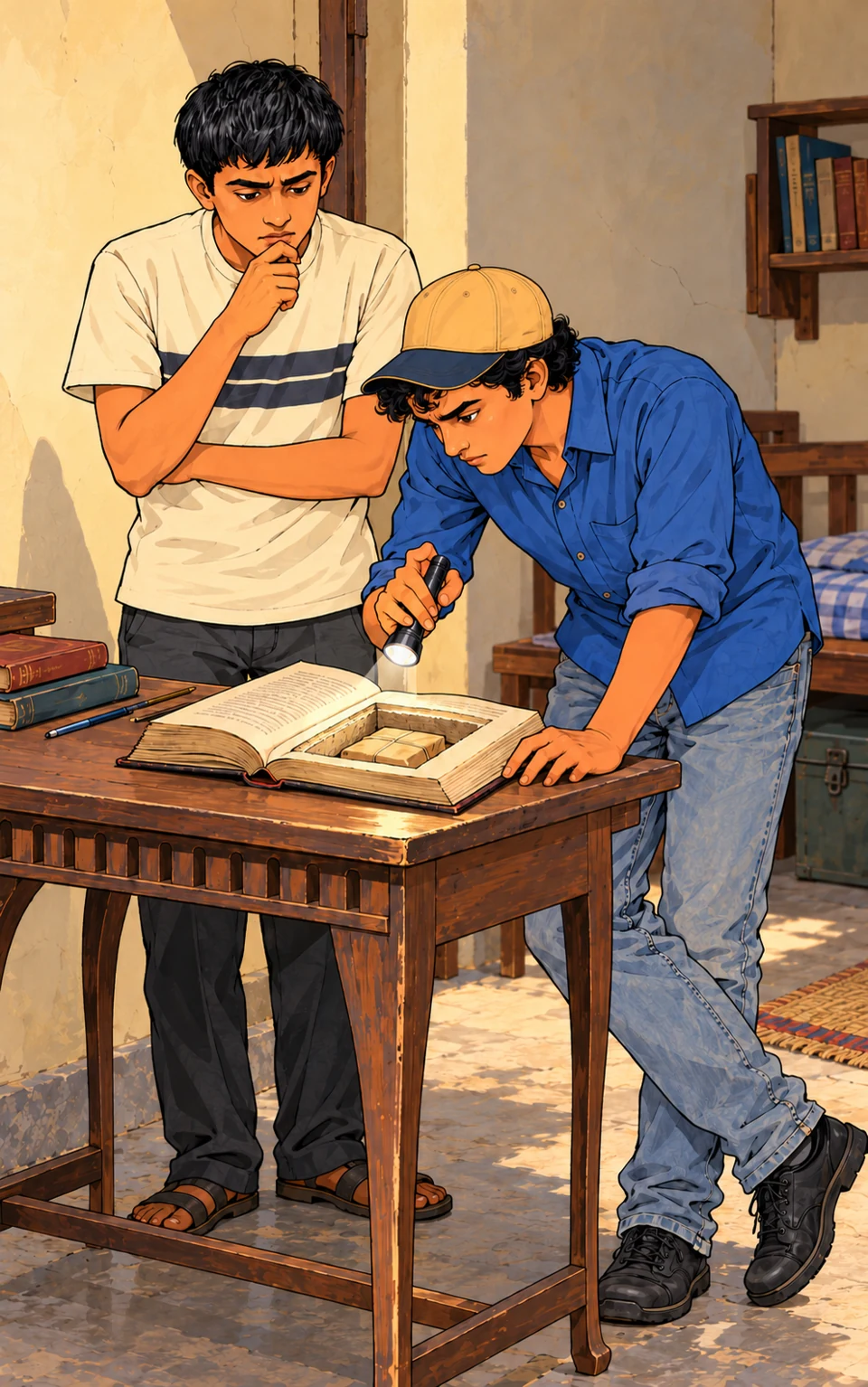
I asked, “Were you the one cutting the power?”
He said, “Yes. I connect the negative and positive wires in my room and blow the fuse at the main switch. At that time, two boys from town come carrying Ganja. I take the Ganja from them and keep it.”
“Your roommate doesn’t know anything?”
“My roommate, Binod, oftenremains absent in the roomin the evening. He roams around and returns to the hostel after ten at night. I remain alone in the room and do all this by myself.”
“What do you do with all that Ganja?”
“I take it to my village and sell it at a shop there. I have about ten such books with me. The Ganja is transported inside those books. Nobody suspects anything.”
I said, “You know that all this is wrong. These are serious crimes. A police case can be filed against you. How did you get into this business?”
Alekh now clung to my feet.
“Save me. I have made a mistake. Please save me,” he pleaded.
Then he grabbed Naba’s feet and, one after another, he also caught hold of Padmanabha’s feet.
After that, he told us the story of his personal misfortune. He said that his family was in a very difficult financial situation. His father could not afford the expenses of keeping him in the hostel. So, he had to earn some money himself. He had initially been giving private tuition. Later, a Ganja dealer from his village showed him the way into this business. Since then, he had been making a living through it. The reason was simple: there was little effort but huge profit.
I said, “Look brother, wrong is wrong. A crime is a crime. And the consequence of a crime is punishment.”
He began to cry. Tears streamed continuously from his eyes.“Save me. I swear I will give up this work. I will become a good person. I want to study. I got into this business because I wanted to continue my education. Please help me.”
Padmanabha’s face was becoming stern.
He said, “This is a heinous crime. There is no forgiveness for this crime. You will be handed over to the police.”
Naba said, “Forgive him.”
Bowing down with folded hands Alekh told, “I was thinking of leaving this place and die. I had decided to commit suicide. It will be terribly humiliating if the whole hostel finds it out. The police will arrest me, and my study will come to an end. Police will arrest me. Thinking about all these consequences I had decided to put an end to my life. You can only save me from this trouble. Otherwise, suicide is the only option for me.”
Padmanabha harshly replied, “You must die.”
Now I announced my decision. I said, “I believe what he has told us. He should be given another chance. I am sure he will mend his ways. Padmanabha, I hope you will keep this matter confidential.”
Padmanabha became angry. He said, “You are supporting his wrongdoing.”
I said, “What is right and what is wrong? Your Superintendent drinks the stuff, and you buy it and supply it to him. Is that right? Let this matter end here. And, Padmanabha, if you reveal this outside, I will bring the weakness that exists between you and your superintendent to the attention of the college principal.”
Padmanabha was seething with anger, but he remained silent. Alekh had stopped crying by then. He quietly kept bowing his head to the floor without saying a word, as though offering his obeisance to some unknown god—or to fate.
I said, “Listen, Alekh! You will have to agree to two conditions.”
He said, “I will. I will agree to everything.”
I said, “The first condition is that you must give up this business. You must destroy the Ganja in your room and cut off all contact with the Ganja dealers in town.”
He said desperately, “I agree. I agree.”
I said, “My second condition is that you will do me a personal favour. Tomorrow, I will take you to the Superintendent, Chintamani Behera. In front of him, you will admit that at night, after the power goes out, you bark like a dog.”
Alekh said, “I agree! I agree. I will do it. I will do whatever you say.”
The following evening, I took Alekh with me to the Superintendent’s office—the office inside our hostel. He raised his glasses and looked at us. I said, “Sir! You were looking for that boy who can bark like a dog, weren’t you?”
Chintamani Behera became interested and said, “Yes! Yes! Where is the boy?”
Pointing to Alekh, I said, “This is the boy. I brought him here telling him that you would give him a reward.”
Chintamani Sir seemed to become angry. He looked Alekh up and down and, curling his lips, said, “A reward—or something else?”
I said, “Sir! I have done what you entrusted me with. Now it is up to you. You can give him whatever you think he deserves.”
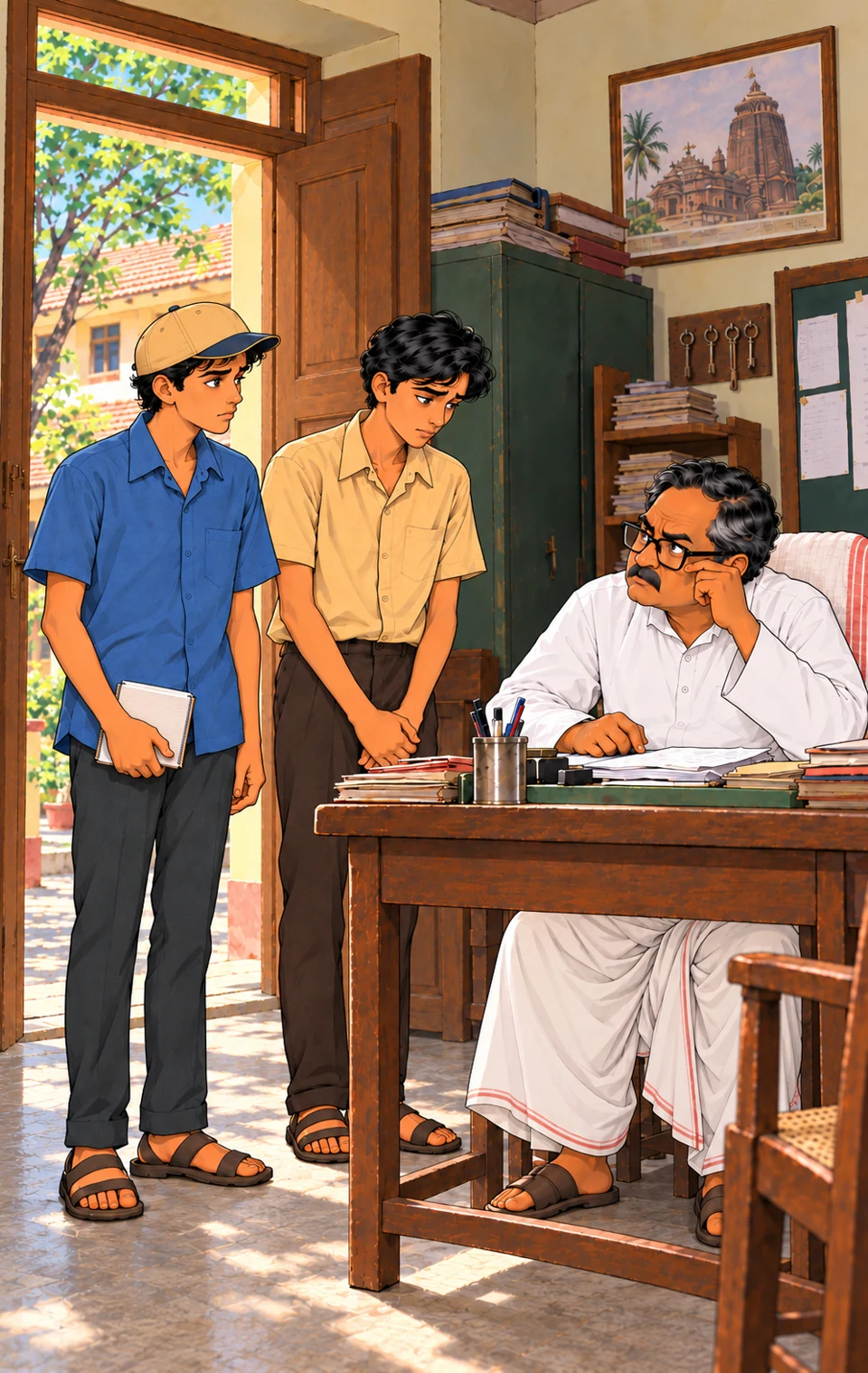
Chintamani Sir said, “Hey, boy! Let’s see you bark like a dog.”
Alekh barked like a dog. But it sounded more like a cat meowing. Chintamani Behera looked dissatisfied. He said, “No, this isn’t the boy. When that boy barks, it feels as if he’s going to split your ears. He roars so loudly that it makes my head spin.”
The two of us returned from his office.
Later, Alekh started taking tuition and did well in his examinations.
There were no more power cuts in the hostel in the evenings.
Girdhari, the electrician, was happy. The Superintendent Chintamani Behera was happy too.
Vijay did not know that the investigation had ended in this rather unusual way. I handed over full ownership of the torch to him.
I said, “Enough, brother! There’s no need to take the investigation any further. You were right—we’ve come here to study. So, let’s concentrate on our studies. Why get involved in these pointless activities? Whyinvite unnecessary trouble?”
By then, Vijay’s opinion had changed a little. He said, “Our detective work is being praised throughout the hostel. Everyone is saying that Sanjay got his book back because you got involved.”
I said, “Really!”
Vijay said, “Now we’ve got several more cases in our hands. Shall we investigate them?”
I asked, “What cases have come our way? Tell me.”
Vijay told me about the cases that had come in. He said, “Kashinath’s towel has gone missing. He has filed a complaint. Anil’s underwear has been stolen. He has filed a complaint too. Jayakrishna’s metal water pot has also gone missing.”
I put my hands on my head and sat down.
The Mystery of the Stolen Magnet
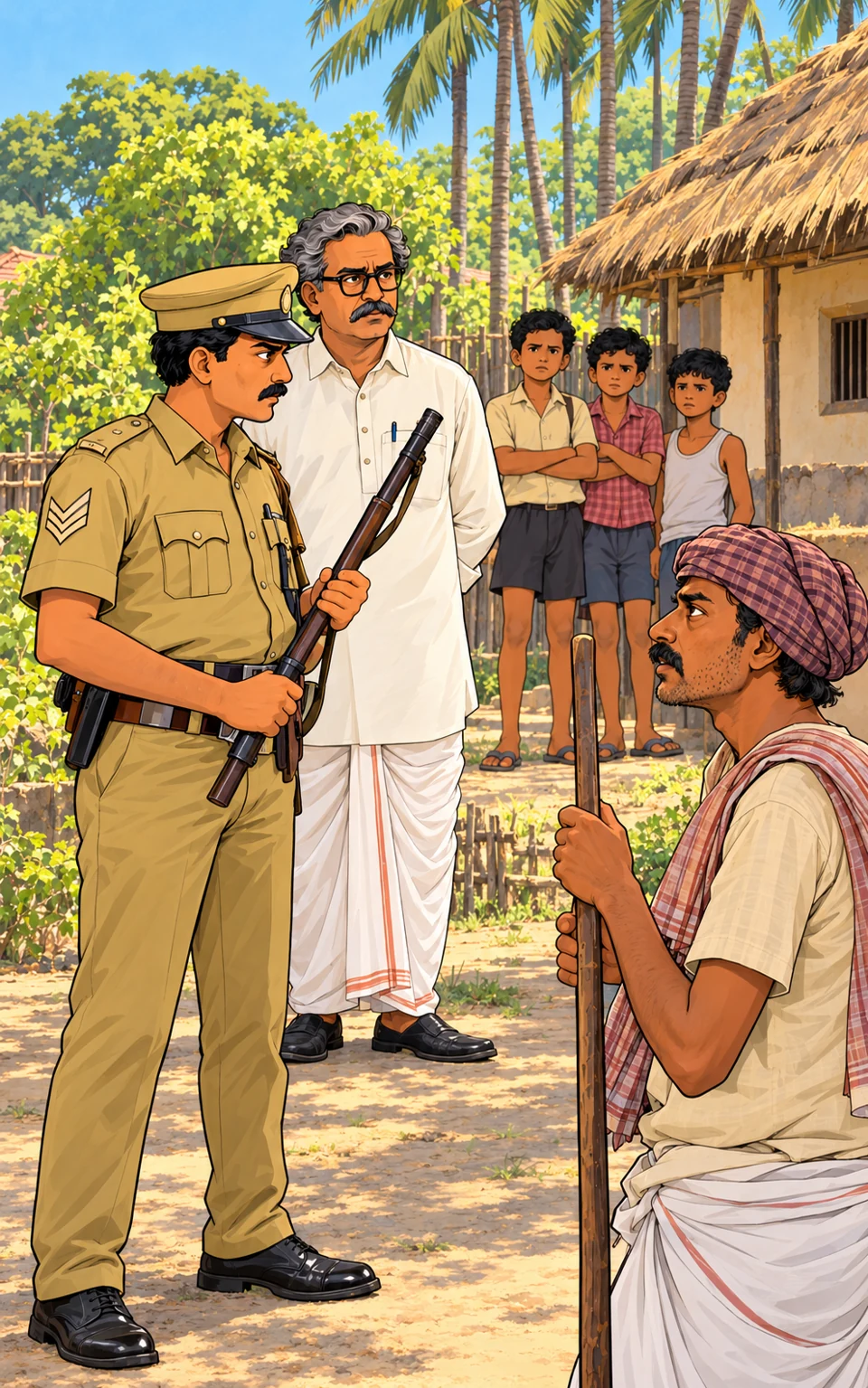
The theft at the house of Nabaghana Sahu was the most sensational incident that had ever occurred in our area.
By morning, the news had spread like wildfire, and without wasting any time, we reached the scene of the incident. Nabaghana Sahu was a well-known moneylender in our village. He owned a great deal of property. Besides that, he was engaged in lending money at interest. People used to pawn their gold to him for cash. So, everyone knew that a considerable amount of gold and silver was kept in his house. Perhaps this information had reached the ears of the dacoits, and they raided Nabaghana Sahu’s house in the middle of the night.
By the time we reached the scene, the police had already arrived. Two constables were standing guard outside and were not allowing anyone to enter. A large crowd had gathered there. They were all staring towards the house as though some kind of show was taking place there. The investigation was going on at the back of the house. We remained stuck in that crowd.
Nabaghana Sahu and the officer-in-charge of the police station were standing near the door of the house. We could hear their conversation clearly. I listened to them attentively.
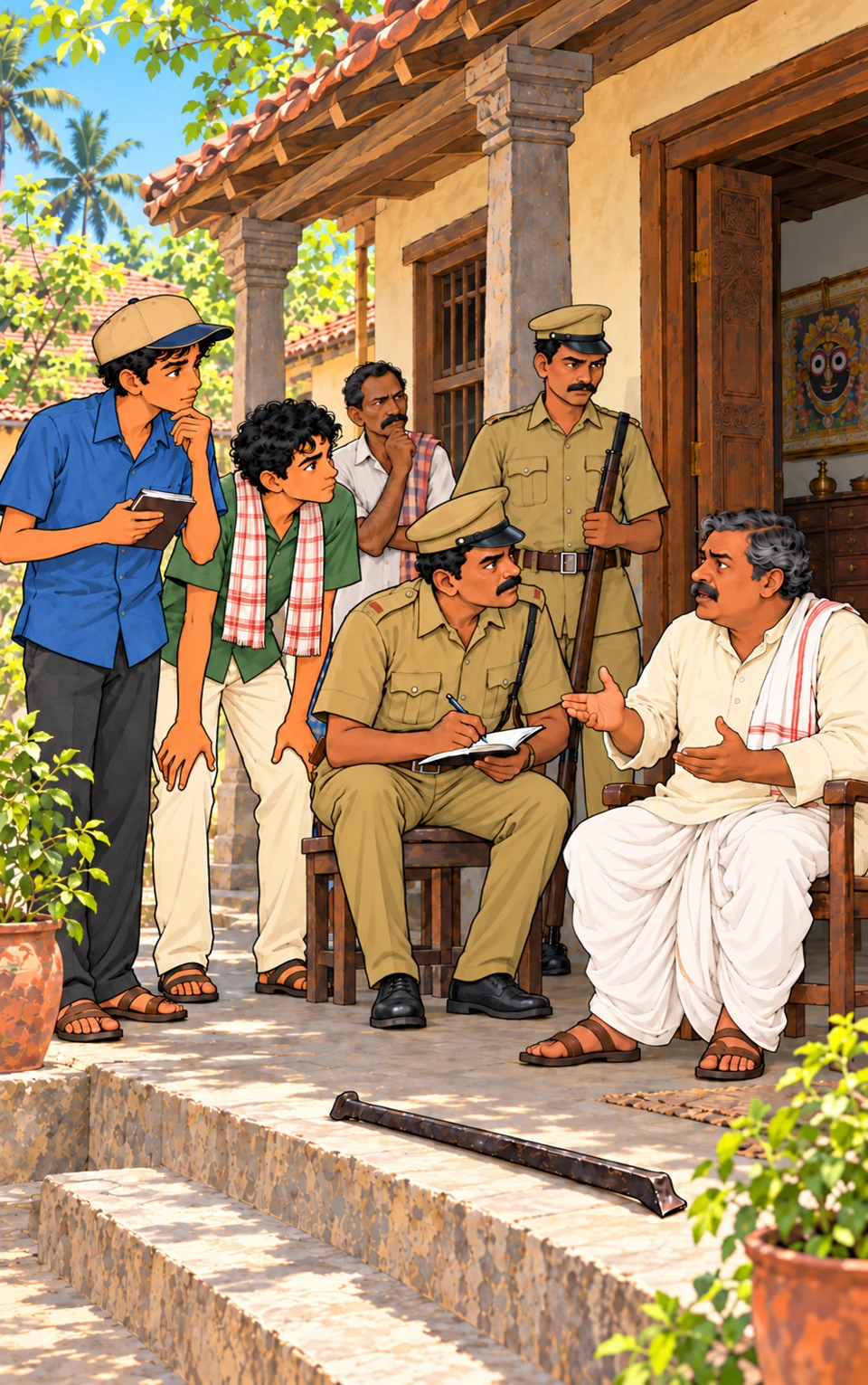
Nabaghana Sahu was saying:“It must have been around two o’clock at night. I had fallen sleep. Everyone in our house had also fallen asleep. Just then, we heard a loud noise coming from the backyard. I woke up with a start. All of us in the house got up. When we came into the courtyard, we saw that the dacoits had broken open the door and entered the house.”
“What happened after that?”
“The thieves were carrying knives and bombs in their hands. They were dressed in black and had masks over their faces. They threatened us with their knives and made us stand in a line. We were all trembling with fear. There were five of us—myself, my wife, my two sons and my daughter.”
“Were there only those people in your house?”
“We have a servant and two farmhands. They stay in the house at the back. The thieves locked them in from the outside. After entering the house, they also brought us outside and made us stand on the veranda. They frightened us by showing us their knives.”
“What language were the thieves speaking? Odia or Hindi?”
“They were speaking in Odia.”
“Was it standard Odia or the rural dialect?”
“They were speaking Odia.”
The officer-in-charge tried to clarify what he meant by the question. He said, “There are different styles of speaking Odia, aren’t there? For example, the dialectof Ganjam, or the dialect of Dhenkanal or Cuttack. Were they speaking in the dialectof Puri?”
“I couldn’t make out anything like that, sir!”
“How many were there in total?”
“Six of them entered the house. We don’t know how many more might have been standing guard outside.”
“They threatened you with knives.”
“Yes, sir!”
“What did they say while pointing the knives at you?”
“They asked for the keys.”
“Did you give them the keys?”
“No!I wanted to know which keys they needed. One of them, probably their leader, came rushing towards me and demanded me to give him the key to the shrine room.
I told him thatthe shrine room in our house was not locked. Then they asked, where the shrine room was. The moment I pointed at the direction they rushed towards the shrine room. Two of them stayed behind to guard us.”
The police officer asked, “Why did they go to the shrine room? Were those fellows thieves or priests?”
No one responded to the police officer’s light-hearted remark. Nobody even laughed. Who would dare laugh? After all, this was a remark made by a police officer.
The police officer resumed his interrogation. He asked, “What happened after that?”
Nabaghana Sahu said that they searched the shrine room and then fled.
“What did they take from there?”
“It doesn’t seem that they took anything! But they left after throwing everything in the shrine room into disarray. They had also dug around and rummaged through things. They even dug into the walls.”
“Was there anything valuable in that room?”
“No! What valuable thing could be there? There were only the idols of the deities, a sandalwood rubbing stone, a box of incense sticks, bells and other such things.”
“Where did you keep the gold and silver?”
Nabaghana Sahu seemed reluctant to answer this question. He hesitated for a moment and looked around. A large number of people had gathered all around them. Perhaps he felt embarrassed to reveal where he kept his gold and silver in front of so many people. Seeing his silence, the police officer also looked around. When he noticed the crowd of people standing nearby, he realized that he should not have asked such a question. So, he did not repeat it.
He continued writing all the information in his diary.
It was then that the most important piece of evidence came to light: an object left behind by the thieves. The thieves had left behind an iron rod. It was about two feet long and four inches wide, and it was lying on the veranda. Nabaghana Sahu provided this information.
The police officer screamed, “Where is that iron rod? Noone must touch it.”
The police officer went inside the house, while the crowd remained outside.
For a moment, the two constables who were guarding the crowd became distracted. Taking advantage of the opportunity, some villagers slipped into the courtyard. Yogia and I were among them. We could see the iron rod lying on the veranda.
The police officer was now standing beside the iron rod, examining it very carefully. It was as thoughnot a mere piece of iron but a live bomb that could explode at any moment.
One of the police constables began ordering the people to move back. He pushed them towards the outside and warned them repeatedly, “Stay away! Stay away!”
We watched the object from a safe distance.
The police officer asked, “What is this?”
Nabaghana Sahu replied, “It’s just a piece of iron!”
“How do you know it’s a piece of iron?”
“It looks like iron.”
“Does something have to be what it looks like? Look at all these people. They all look like human beings, don’t they? But there may be a thief hiding among them.”
Nabaghana Sahu repeated his answer: “Can we commit mistake in recognizing an iron rod! This is a piece of iron!”
“The thieves left it behind?”
“Yes, sir!”
“Think carefully before you answer.”
“There was no such piece of iron in our house before! So where did it come from? They must have left it behind.”
“Did you actually see them leave it behind?”
“No, sir!”
“Did you see them holding this in their hands? I mean, can you say that they had brought it with them?”
“No, we didn’t see that. They were carrying knives. They showed us their knives. They were also carrying torches. But we didn’t see anyone holding this piece of iron.”
“When did you see it?”
“We saw it in the morning. We found it lying here. It wasn’t in our house before. So, they must have left it behind.”
The officer-in-charge now touched the piece of iron. He turned it over and examined it from different angles. He did not reveal what information he had gathered from it. He simply wrote something down in his notebook.
Then he asked, “Did they leave behind anything else?”
Nabaghana Sahu replied, “No!”
The officer-in-charge remarked, almost as if thinking aloud, “They didn’t take anything; instead, they left behind a piece of iron. What kind of thieves are these?”
No one said anything about his remark.
The officer-in-charge walked around the entire house, twirling the baton in his hand. He examined every corner carefully. He even entered the shrine room. Of course, he was about to enter with his shoes on when someone called out from behind, “Sir! Please take off your shoes before going inside.”
He turned around angrily. He tried to find out who had said it, but failed. Then he went inside. After some time, he came out. From the expression on his face, it was clear that he had finished his investigation.
Green coconuts were plucked from the coconut tree and brought over. The police officer and his staff were served with coconut water. The onlookers, however, got nothing.
Just then, another sensational piece of news arrived. Dikshit Bhaina, the priest of the Gatishwar Temple, came there and made a new complaint.
He said, “Sir! Please listen to me for a moment! The thieves had broken into the Gatishwar Temple as well.”
The police Officer asked, “Who told you that they had been to the Gatishwar’s temple?”
The temple priest, Dikshit Bhaina, replied, “I entered the inner sanctum of the temple at dawn today. I found the door wide open. I thought someone else must have entered. When I looked inside, I saw that everything had been thrown about. Someone had entered the temple and completely ransacked the place.”
The police officer in charge looked worried. Drawing on his vast experience, he gave his verdict:
“Why would thieves go to a Shiva temple? I’ve heard that they usually go to Kali temples. They believe that Mother Kali will let them carry out their thefts smoothly. She won’t let them get caught. She will protect them. But Lord Bholanath does not protect thieves. There is nothing about that in any scripture or Purana. What kind of thieves are these?”
Dikshit Bhaina continued speaking. He said, “Our temple is never locked. There is a door, of course, but at night it is merely kept shut. Our deity is very powerful. No one except devotees would dare enter the sanctum. This is the first time anything like this has ever happened.”
The police officer said, “How do you know they weren’t devotees?”
Dikshit Bhaina replied sharply, almost as if he had been stung by the question, “If they had been devotees, would they have thrown things around like that? Would they have trampled and ransacked the deity’s sanctum in such a manner? They are certainly thieves. They entered the temple before breaking into Nabaghana Sahu’s house.”
The police officer gave his opinion: “All this seems rather confusing to me. How can you say so confidently that they went to the temple before coming here? How do you know that the same gang of thieves was behind both incidents?”
Dikshit Bhaina could not say anything. He remained silent. But he kept shaking his head. And with every movement of his head, his sacred tuft of hair swayed as well. Seeing the spectacle, the onlookers—especially the children—burst into loud laughter. But their laughter had no effect on either the police officer or Dikshit Bhaina. They both looked serious.
The police officer asked, “Have they taken anything from there?”
“No!”
“Did they leave anything behind?”
“No!”
“Did they perform any worship or rituals there?”
“What worship or rituals would they perform? They have thrown things around and ransacked the place.”
The police officer gave his final opinion: “A dog must have got in. It probably knocked things around.”
Dikshit Bhaina became a little angry. He said, “A dog got in? A dog would dare do that? A dog would enter Lord Shiva’s sanctum? If fire were to blaze forth from Lord Shiva’s third eye, the animal would be burned to ashes right there. Sir! We have been serving the deity for so many years. Never has a dog ever entered the sanctum. What more can I tell you about Lord Shiva? He is a wrathful deity. Once he becomes angry, he can destroy the entire universe. After all, he is the Destroyer.”
The police officer said reassuringly, “Oh, we know that! You don’t need to explain it to us.”
Then the police officer took off his shoes and, standing barefoot, offered a respectful salute to Lord Shiva in the air.
He then questioned Dikshit Bhaina again: “Tell me one thing. Whom do you suspect?”
Dikshit Bhaina looked completely bewildered. He glanced around in all directions, as though searching for some suspicious-looking person.
The police officer encouraged him: “Don’t be afraid. Tell me openly whom you suspect.”
Dikshit Bhaina swallowed hard and said, “I have a feeling that the robbers who broke into Nabaghana Sahu’s house were the same ones who entered the Shiva temple.”
The police officer waved his stick and asked, “How do you know that?”
“Why, it’s plain as day.”
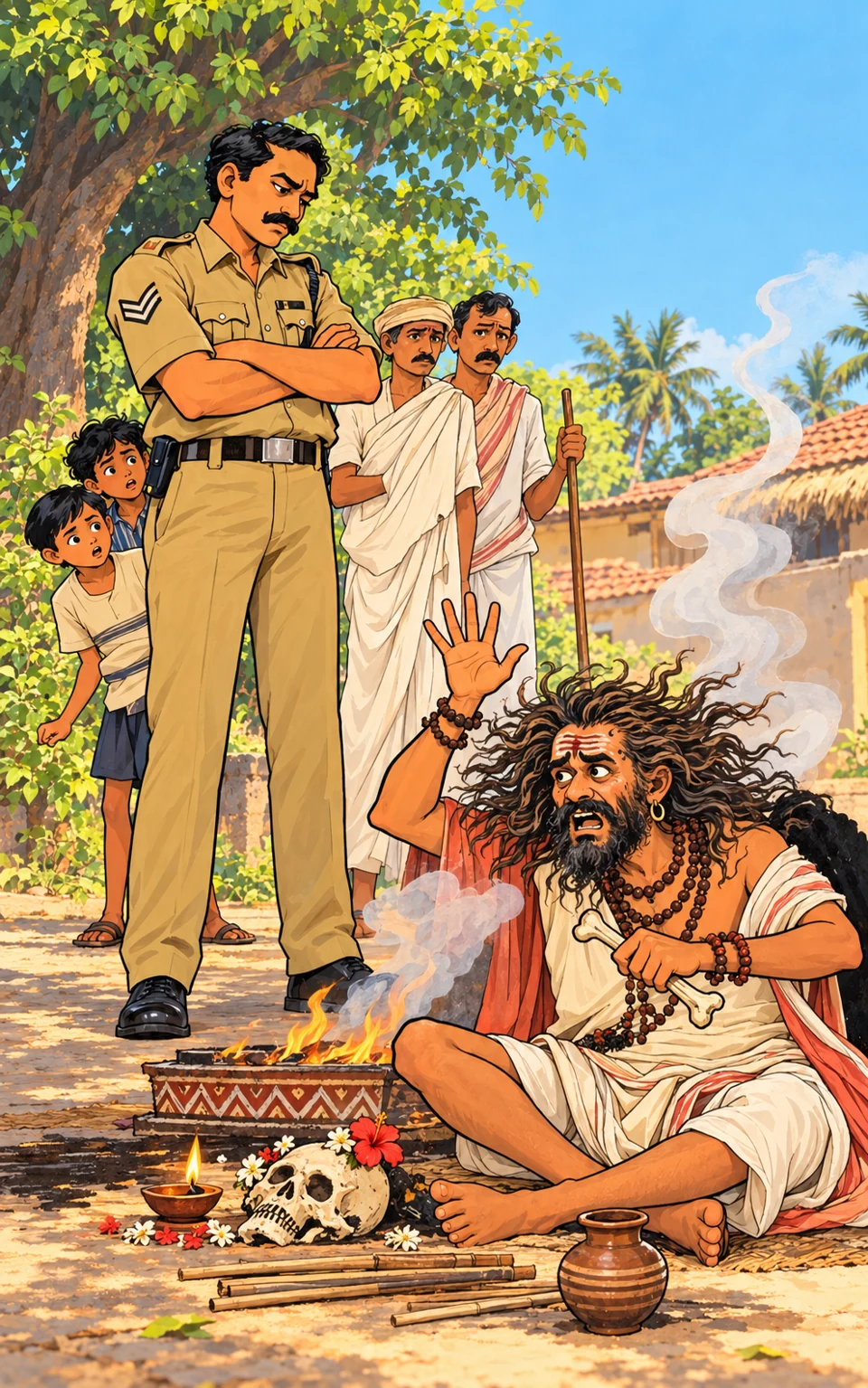
“You can see everything, can’t you? Are you performing worship in the temple, or practicing some kind of Tantric ritual?”
“I am performing worship, of course.”
“Then what exactly can you see?”
Dikshit Bhaina scratched his ear and said, “Where else in our village would you find thieves capable of entering the temple like that? It must have been the work of that same gang of thieves.”
The police officer said, “Are you the police, or are we the police? If you can figure everything out, why do you come to us? Everything is apparently crystal clear to you, so why don’t you go and catch the thieves yourself?”
Dikshit Bhaina fell silent.
Back then, people in our village were very much afraid of the police. The policemen wore red caps and khaki-coloured shorts. Whenever they walked down the village street, all the doors and windows would immediately be shut.
Lord Shiva might be terribly wrathful, but that did not mean that his devotees would have no fear of the police. Dikshit Bhaina’s face turned pale.
The police officer said in a slightly raised voice, “Come to the police station. You’ll write down your statement there. Only then can we sort out your case. It’s just like you happen to meet a blacksmith on the way and you wish him to sharpen your axe. This won’t do.”
One of the constables joined in. He said, “If we see a barber on the way, our nails grow longer. Seeing us here makes people think of theft.”
The police officer shouted, “Come to the police station!”
Dikshit Bhaina nodded his head. But whether he was saying yes or no, it was not clear.
The police officer went inside Nabaghana Sahu’s house and held a private discussion with him. Outsiders were not allowed to enter that part of the house, so we could not know what was discussed inside. After some time, the police officer left the place with his men. They did not take the iron rod with them. They left it in Nabaghana Sahu’s custody.
Jogia and I returned to our detective office. For the readers’ information, let me mention here that at the time I called myself a self-proclaimed detective, with Jogia as my assistant. I was studying in college and visiting the village from time to time. I called myself Herlock Soms, a disciple of the world-famous detective Sherlock Holmes, while Jogia played the part of Dr. Watson.My study room was outside our house. We called it our “detective office,” and from there we conducted our own investigations.As soon as we reached our office, Jogia was the first to speak.
He said, “What’s your opinion?”
I asked, “About what?”
He asked, “Should we take up this case?”
“Who is going to give us this case?”
“Why, Natia will!”
Natia was Nabaghana Sahu’s middle son, and he was our friend. He had given up his studies and was looking after his father’s rice mill. He was a little slow-witted, so his father did not entrust him with anything particularly important.
I said, “What does Natia have in his hands that he can simply hand the case over to us?”
Jogia said, “Natia will convince his father to give us the case.”
I smiled a little. Ever since Jogia had heard me talk about Sherlock Holmes and I had given him the name Watson, the detective’s assistant, he had been working with tremendous enthusiasm. He wanted to take on every case that came his way and solve every mystery. He was hopeful that our detective company would become world-famous overnight. I poured a little cold water on his enthusiasm.
I said, “The police are investigating this case.”
He said, “The police aren’t going to investigate anything. Didn’t you see the way that police officer was talking? When Dikshit Bhaina told him that the thieves had entered the temple too, he didn’t even bother going over to the temple. I can tell—they aren’t going to do anything.”
I said, “Look! This is a robbery case, and it seems that people from outside our village are involved. What authority do we have to catch them and punish them? Even Sherlock Holmes didn’t take on cases like this.”
Jogia’s enthusiasm, however, remained undiminished.
Trying to convince me, he said, “The robbers may be outsiders. But how could they manage to do a robbery like this? Surely someone from our own village must be involved. Without help from someone here, people from another village couldn’t have carried out such a robbery.”
I said, “Your guess may be right.”
Jogia suggested, “Come on, let’s find out that person from our village. We may not be able to punish him, but at least we can identify him. If necessary, we can gather all the evidence and hand him over to the police.”
Jogia’s words gradually began to convince me. What we were proposing was almost impossible. It was an ordinary robbery, after all. Trying to extract clues from it was like shootingin pitch darkness.
I said, “Let’s analyse whatever information we have gathered from this incident. Let’s knead it and work it over like a lump of mud. In the end, we might find something.”
Our guru, Sherlock Holmes, used to analyse things in exactly this way—turning them over and over, examining them from every angle. Great detectives do the same.
So, to analyse the case, we began questioning each other back and forth. Whenever a new possibility or line of inquiry emerged, we immediately wrote it down in our notebooks.
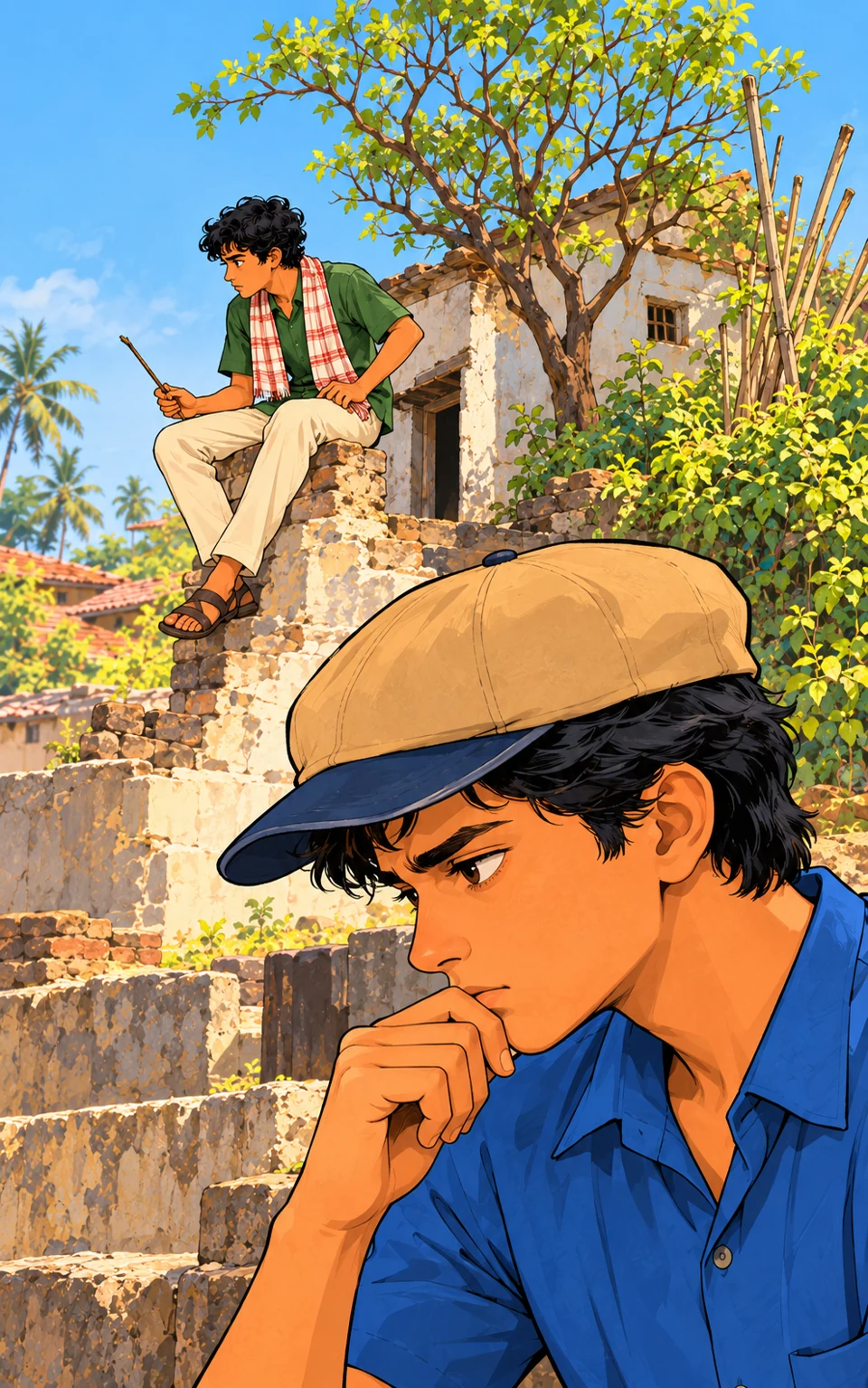
I asked, “What did the robbers take?”
Jogia replied, “Nothing.”
“Then why did they come to commit the robbery?”
“Can’t say.”
“They entered the family shrine.”
“There could be some mystery there.”
“They also went to the Shiva temple.”
“They must have some connection with the deity or the temple.”
“What did they take from the temple?”
“Not known. According to Dikshit Bhaina, they didn’t take anything.”
“Which means they got nothing out of this robbery.”
“That seems mysterious.”
“Everyone knows that Nabaghana Sahu is a wealthy man.”
“He has a lot of gold and silver in his house.”
“But the thieves didn’t search for money or gold.”
“Money and gold were not their objective.”
“Then what was their objective?”
“That is the mystery.”
“They left behind a piece of iron rod.”
“Did they leave it behind by accident, or did they leave it deliberately?”
“Who knows?”
“Can there be some secret hidden in that iron rod?”
“There may be.”
“It isn’t a weapon.”
“It couldn’t be used to break open the locks.”
“Then why did they bring it with them?”
“And why did they leave it behind?”
“That piece of iron is still at Nabaghana Sahu’s house. The police didn’t take it. We need to examine it.”
“Can it provide us with some clue?”
“It might.”
In the middle of an unfathomable sea, a little boat of hope suddenly appeared. All our analysis had come to a standstill around that piece of iron. We had reached the conclusion that some mystery was hidden in it. We had to uncover it.For this, we could seek Natia’s help. He was our friend, so it would be easy for us to get access to the iron rod.
The two of us went together to see Nabaghana Sahu. Our friend Natia took us to him and introduced us, saying, “These are my friends. They will investigate this theft case.”
Nabaghana Sahu stared at us in surprise and examined us from head to toe.
He asked, “But the police are already investigating. What can these boys do?”
I said, “The police will catch the thief, send him to jail, and make sure he is punished. We will investigate the other aspects of the case.”
The look of astonishment did not leave his face.
He asked, “What other aspects?”
I said, “Who are they? What was their motive? Is anyone from our village involved with them? Why did they bring this iron rod with them? Why did they leave it behind? These are the things we will investigate.”
He smiled a little and said, “You boys are just too young to be involved in such cases. It will be better if you stayout of such matters.”
I said humbly, “Sir! Investigation is a subject taught at our college. I am studying that subject. I have to investigate one or two cases of theft like this and submit a report. This is our practical assignment. Please help us. Otherwise, I will fail the examination.”
He muttered to himself, “What a strange thing! Are these kinds of subjects really taught in college? Theft and robbery!”
I folded my hands and said, “Many other subjects are taught at college too. This is just one of them. I have enrolled in this subject, and that is why I am asking for your help.”
Nabaghana Sahu asked, “What will you gain by studying this subject?”
I replied, “The criminal tendencies of human beings can be learnt.”
He asked, “Do people become policemen after studying this subject?”
I said, “No, they don’t become policemen. They become criminologists.”
Finally, he made a wry face and said, “Well, whatever they become, let them become it. We have never even set foot on a college veranda, so what can we possibly do?”
Jogia said, “Then shall we take up this case?”
He looked at Jogia. He already knew about Jogia. It was no secret to anyone that Jogia had failed his matriculation examination twice and spent his time roaming around the village playing volleyball.
Nabaghana Sahu said, “Is he studying at college too?”
I replied, “He is my assistant. He helps me with my work.”
Listening to our conversation, he looked rather bewildered. I said a few more things to impress him. At last, he said irritably, “Do whatever you want. But don’t get me into any trouble. This is a police case.”
I said, “We will need answers to a few questions from you, and we would also like to examine the piece of iron that the thieves left behind.”
He said, “Ask whatever you want to ask. The police have already questioned me enough. Now you are there to interrogate.”
Just then, his son spoke up in my favour and said, “These questions are going to come up in his examination. If you help him a little, do you think the police are going to arrest you?”
He agreed, but imposed one condition. He said, “You can look at the piece of iron, but you cannot touch it. The police left it in my custody.”
I then began my questioning.
I said, “Please show me the piece of iron.”
He had kept the piece of iron locked inside the house. He brought it out and showed it to me.
“Have a look,” he said.
I said, “Please put it down.”
He placed the piece of iron on the floor. I examined it carefully. It looked old. It was about two feet long and three inches wide. It might have weighed around one and a half kilograms.
I took an eight-anna coin from my pocket and rolled it towards the piece of iron. It stuck to the iron.
I said, “This is not ordinary iron. It is a magnet.”
Nabaghana Sahu looked at me in amazement. He seemed impressed by my examination and must have been thinking to himself, “This boy certainly knows his stuff.”
I asked, “Did you see them holding this piece of iron?”
He said, “No!”
I asked, “When they were searching around in the shrine room, where were you?”
He said, “We were standing on the veranda. One of them was keeping watch over us. He had a knife in his hand.”
I asked, “Did you hear any sounds coming from the shrine room?”
“Yes! There were sounds of bumping. We could hear the sound of things being thrown around.”
I asked, “Did you hear the sound of something heavy falling?”
He thought for a moment and said, “Yes! There was a sound like that in the middle of it.”
Suddenly, I did something quite unexpected. I pulled the piece of iron towards me, picked it up, and abruptly dropped it on the floor. It hit the floor with a metallic clang.
Nabaghana Sahu exclaimed, “Oh! Oh!” and wrinkled his nose. Irritated, he said, “What have you done? What if it had broken? What would I have done then? What answer would I have given the police?”
I said, “Don’t worry. This is strong iron. It won’t break so easily. Just tell me whether you heard a sound like that.”
He carefully picked up the piece of iron from the floor. He turned it over and examined it, checking to see whether it had been damaged anywhere. The eight-anna coin I had dropped rolled off the iron and went some distance away. Jogia picked it up.
I repeated my question: “Just tell me whether you heard a sound like that or not.”
He was relieved to see that the piece of iron was still intact.
He said, “Yes! I did hear such a sound. Perhaps this piece of iron slipped from their hands and fell.”
I said, “That is exactly what I had suspected.”
He was impressed by my investigation.
He asked, “How did you figure that out?”
I said, “I told you from the beginning that this is a magnet. It is a powerful magnet. But it had fallen to the ground. When a magnet suffers an impact, its magnetic strength decreases. Even now, this magnet can attract the eight-anna coin, but it does not pull it very strongly. So, I suspect that its magnetic strength has diminished.”
He asked, “What does that tell us?”
I said, “The magnet must have fallen from their hands and lost some of its magnetic strength. Realizing that it would no longer be useful to them, they left it behind and went away.”
Jogia asked, “What were they doing with a magnet?”
I said, “It is already clear that they were not looking for gold or money. If that were what they wanted, why would they have entered the shrine room? They were looking for something else. I suspect they were searching for some hidden treasure. The magnet was helping them in their search.”
The moment the words “hidden treasure” came out of my mouth, everyone’s eyes widened. Their mouths fell open in astonishment.
Nabaghana Sahu exclaimed in amazement, “Hidden treasure! Where is it? Where is it?”
I said, “That, I don’t know. But they must have received the information or somehow known about it. Otherwise, someone must have given them the information. That is why they were searching for the hidden treasure instead of looking for gold or silver.”
Nabaghana Sahu looked disturbed. He said, “Who gave them this information? How could there be hidden treasure in our house? Some rogue must have lured those thieves here by giving them this false information.”
I said, “It is possible.”
He was trembling with fear and astonishment.
I reassured him, “Please don’t worry. I will certainly uncover the mystery behind all this. You just cooperate with me.”
By now, he had developed complete faith in my words and actions.
He said, “Ask what else you want to know.”
I said, “You tell me if the thieves were wearing shoes or sandals?”
Nabaghana Sahu said, “They were wearing shoes.”
“What kind of shoes?”
“I can’t say.”
“Were they good leather shoes or rubber shoes?”
“I didn’t notice that.”
I then said to Jogia, “Look for shoe marks inside the house.”
We walked around and examined the entire house, including the shrine room. The shrine room had not yet been put back in order. The idols and pictures of the deities were lying here and there. There were marks on the walls. Some parts had been broken, and the walls had been scratched. We found shoe marks on the floor. There was also some sand scattered along with the shoe marks.
I said, “Collect that sand and keep it safely on a piece of paper.”
Jogia asked, “Where did this sand come from?”
I said, “There is a pile of sand behind this house. It had been kept there for construction work. The thieves must have walked over that pile of sand on their way into the house.”
We went outside and examined the pile of sand. There were shoeprints on it. I picked up a handful of sand from the pile, wrapped it in a piece of paper, and kept it safely.
I suggested, “Let’s go to the temple. Let’s find out whether what Dikhit Bhaina was saying is true or not.”
Jogia said, “The police didn’t attach any importance to what he said. They didn’t even go towards the temple.”
I said, “The police didn’t believe him, but we will. A detective believes everything—and then believes nothing. Come on, let’s go to the temple.”
We set off towards the temple.
Before leaving, I wanted to thank Nabaghana Sahu.
I said, “Uncle! Thank you.”
He was still worried.
He asked, “Is there any hidden treasure inside our house? What kind of treasure is it?”
I said, “The investigation is still going on. We will certainly find out.”
He was not reassured. There was astonishment in his eyes, and a glint of greed could also be seen in them. Natia seemed even more curious and eager.
We reached the Gatiswar Temple. The temple was a public place, and there was no need to seek special permission to enter. So, we freely examined every part of the temple. There was not much sand on the veranda at the entrance. There were only a few scattered patches of sand here and there. We compared this sand with the sand found at Nabaghana Sahu’s house. There was no similarity between them.
This meant that if the thieves had indeed come to the temple, they must have come here first. If they had come here after leaving Nabaghana Sahu’s house, sand from the pile behind his house would have been carried here on their shoes.
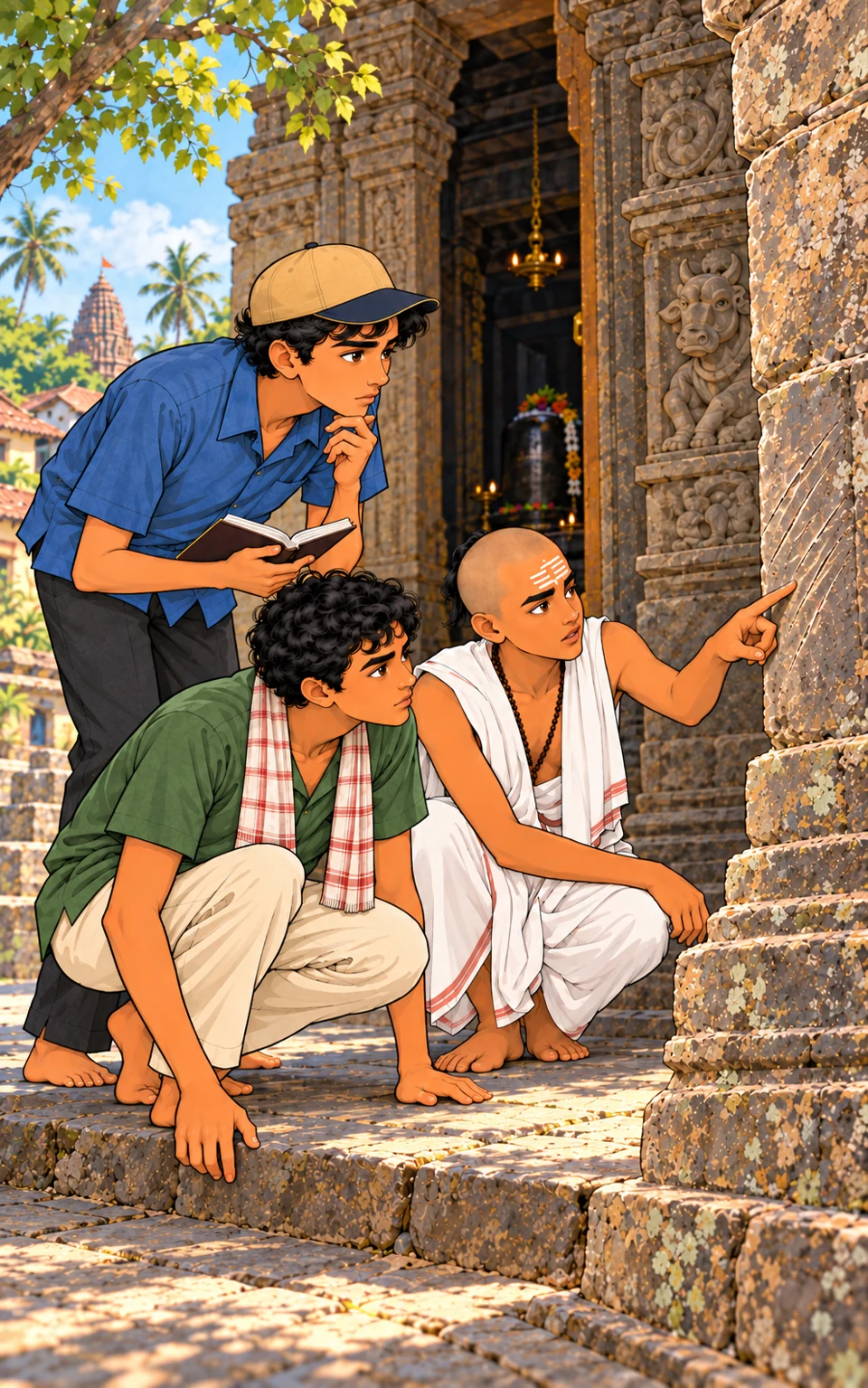
There was another point to consider. Once thieves leave a house after committing a theft, they usually do not dare to go anywhere else. If someone has seen them, there is a possibility that the alarm will be raised after they leave. Therefore, once Nabaghana Sahu and his family had seen them, the thieves must certainly have fled.
If nobody had seen them, however, they might take advantage of the opportunity to commit a second theft. Otherwise, they would not.
Therefore, it would be reasonable to conclude that they had gone to the Gatiswar Temple first. But why?
We met Dikhit Bhaina, the priest of the Gatiswar Temple. He looked very sad.
Jogia asked, “Bhaina, why are you so unhappy?”
Dikhit Bhaina said, “These are bad times. Nowadays, nobody believes the truth. I told the police that thieves had entered the temple, but they didn’t believe me.”
I consoled, “But we believe you.”
His face brightened. He seemed very happy. He said, “Nothing has been stolen. Does that mean the thieves didn’t enter?”
I said, “We know that what you told us is true. Come, let’s see what the thieves did and where they went.”
We went inside the inner sanctum with him. The sanctum of the deity was dim and dark. A flight of stairs led down into it, and the steps were uneven and rough. We had to descend carefully. Once we reached the bottom, we saw a small oil lamp burning, but its light was not enough to dispel the darkness.
I took a torchlight out of my pocket and switched it on.
Dikhit Bhaina was displeased. He said, “Hey! Don’t switch on the torch.”
I said, “If we don’t use the torch, how will we find out what the thieves have been up to?”
Dikhit Bhaina said, “We never use a torch here. The deity will be angry.”
I explained to him, “There is nothing written in any scripture that says the deity will be angry if a torch is used. Besides, how are we supposed to find anything if we don’t use the torch? It’s completely dark in here.”
Ignoring Dikhit Bhaina’s objections, I continued moving the torch around. Its beam fell across the walls. I noticed marks in several places. They looked fresh, as though someone had scratched the walls with some sharp object.
I remembered that similar marks had been found on the walls of Nabaghana Sahu’s shrine room. It was reasonable to suspect that these marks had been made by the thieves.
I pointed out the marks to Dikhit Bhaina.
I said, “Do you see these scratch marks? Were they there before?”
He looked astonished. “No, they weren’t.”
I said, “These were made by the same thieves who entered here last night.”
He asked, “What were the thieves doing to the walls of the sanctum?”
I said, “They were looking for something.”
He asked, “What?”
I said, “That, we don’t know. And the police wouldn’t believe it either.”
He asked, “What should we do now?”
I said, “Nothing. Don’t tell anyone about this. Put a lock on the temple door this time.”
We came out of the inner sanctum of the temple.
There, we met another man who was standing outside the temple. We knew him. He was loitering outside. He was a man from our village, named Balaram Pradhan.
He asked us, “What were you two doing inside the sanctum?”
Jogia replied, “Thieves broke into the temple last night, so we were checking it out.”
He said, “Why are you listening to all these lies? The whole story about the thieves is completely false. Dikhit Bhaina must have had some strange dream last night, and now he’s rambling on about it.”
I did not find the man’s comment acceptable. I looked at him closely. I remembered that when the police were investigating at Nabaghana Sahu’s house that morning, this man had been there. He had listened carefully to everything. Wherever the police went, he followed closely behind them.
Could this man have a guilty conscience? Many eminent criminologists have said that a criminal is always apprehensive and cannot stay away from the scene of the crime or from news about the crime. Balaram Pradhan seemed to me to be just such a suspicious character.
After we returned from the temple, I said to Jogia, “Keep an eye on Balaram Pradhan. I find his behaviour suspicious.”
Jogia said, “He often wanders around near this temple. From time to time, he goes somewhere outside and returns after two or three days.”
I said, “We can’t say anything for certain at this point. But we’ll have to keep an eye on him.”
The two of us, Jogia and I, went over the information we had gathered once again.
Jogia asked, “What do you suspect?”
I said, “These people are not ordinary thieves who steal money or gold.”
He asked, “Then what kind of thieves are they?”
“They are searching for some hidden treasure.”
“What hidden treasure?”
“Something that is hidden in a temple or shrine.”
“What about the iron rod?”
“That is their tool—the instrument they use to search for the hidden treasure.”
“They have scratched the walls of the temple.”
“They probably did it with that iron rod.”
“They scratched the walls of Nabaghana Sahu’s shrine room too.”
“Both sets of scratch marks are identical.”
“What clue do we have now to move the investigation forward?”
“Nothing at the moment. But Balaram Pradhan can be used as a lead.”
“We have no evidence against him.”
“We may find some evidence. That is why we need to keep an eye on him.”
The very next day, another piece of news came to light, pointing us in a new direction in the investigation. A long matted-haired holy man arrived at Nabaghana Sahu’s house. He was identified as the monk of the Bentapur monastery.
It was Nabaghana Sahu’s son, Natia, who brought this news to us. We immediately went to his house and saw the holy man. He was dressed in white clothes and a sleeveless vest. He wore a tulsi-bead necklace around his neck and a Ramanandi tilak on his forehead.Many people in our village were disciples of the Mahant of Bentapur. They had come to pay their respect by touching his feet, putting the dust from the sage’s feet to their heads, and bowed before him.
The Mahant was talking to Nabaghana Sahu about the piece of iron. He also said that he wanted to see it.
Nabaghana Sahu asked, “Why do you want to see the iron rod?”
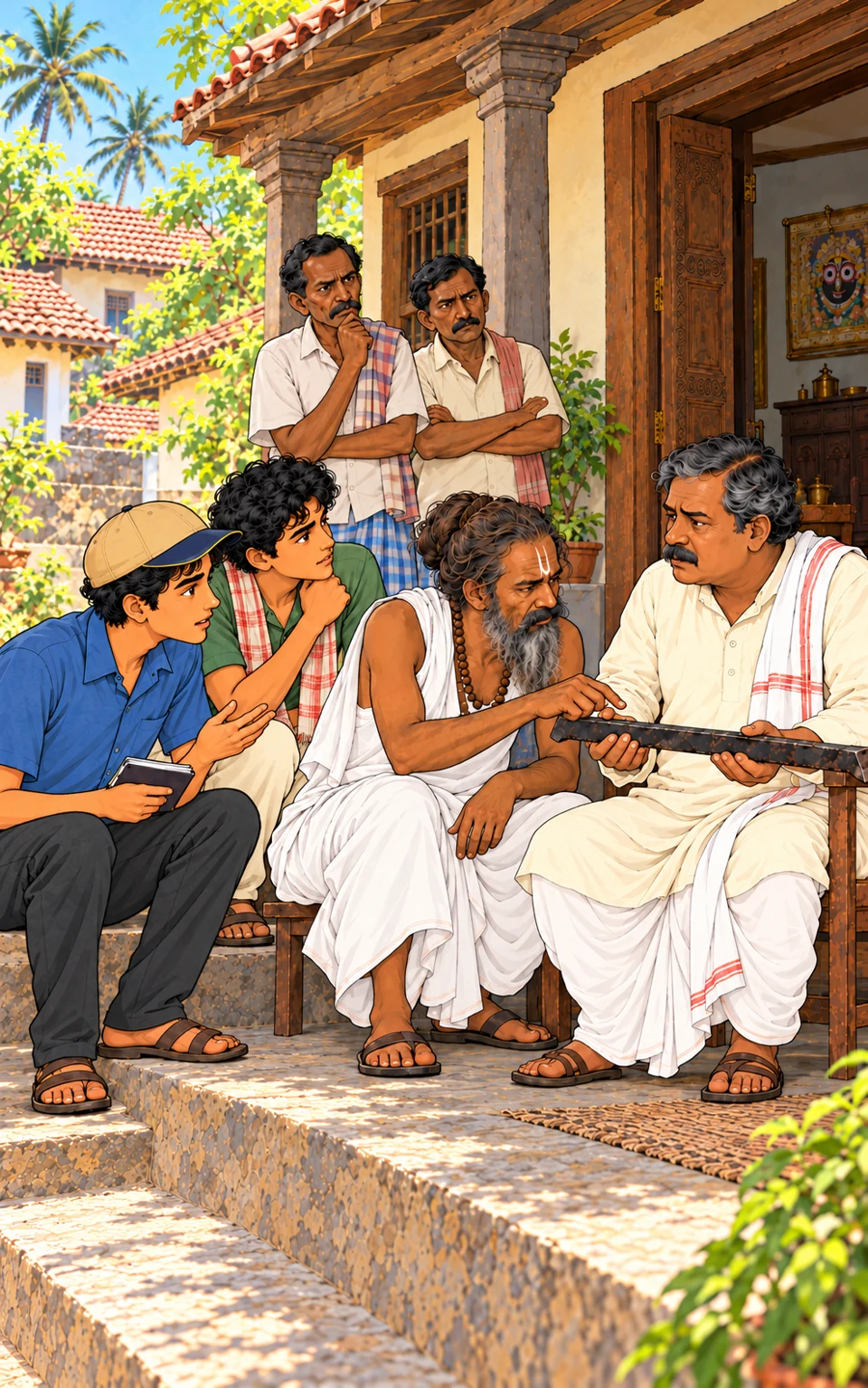
The Mahant said that a few days earlier, a theft had taken place at his monastery as well, and the thieves had taken away a piece of iron. That was why he had come. He had heard that the thieves had left a piece of iron behind at Nabaghana Sahu’s house, so he wanted to find out whether it was the same piece of iron that had been stolen from his monastery.
Nabaghana Sahu explained that the police had left the piece of iron in his custody, so he could not hand it over to him.
The Mahant said, “I don’t want to take it. I just want to have a look at it.”
Nabaghana Sahu agreed and showed him the piece of iron.
He said, “Have a look and identify it. Is this the same piece of iron?”
The Mahant examined the piece of iron closely. He gestured that he wanted to hold it in his hand, but Nabaghana Sahu did not hand it over. He continued showing it to him from a distance.
The Mahant said, “Give it to me for a moment.”
Nabaghana Sahu said, “The police have forbidden me from doing so.”
The Mahant said, “I am a holy man. Do you really consider me a thief?”
Nabaghana Sahu said, “That’s exactly why I’m afraid to give it to you. You are a holy man. You must be knowing all kinds of supernatural powers. If you touch this piece of iron and do something to it, I’ll be in serious trouble. You might turn it into clay, or perhaps even into a piece of wood. Sages can do such things. Then the police will put me in custody.”
The Mahant laughed and said, “Oh, no! I won’t do anything like that. Believe me. I also have good relations with many people in your village. They regularly visit our Bentpur monastery.”
Nabaghana Sahu said, “I know that. I’ve also heard many things about your monastery. There are two goats somewhere in your monastery that look black during the day and turn white at night. There is also a tree there that lies down on the ground at night and stands upright again in the morning.”
The mahant smiled slyly. He neither admitted nor denied that such supernatural events took place at his monastery.
It became clear that Nabaghana Sahu was afraid of holy men like the Mahant.
The Mahant felt as if his respect increased after hearing about all these strange happenings at his monastery. So, he silently decided not to argue any further and said “All right. You can show me the piece of iron from there.”
Just then, someone from behind said, “This Mahant of Bentpur can make the iron float in midair if he wants to.”
Someone else said, “This is actually a piece of gold. After the thieves stole it, the mahant used his yogic powers to turn it into iron.”
The Mahant heard all these remarks. Without reacting, he simply gave an even tighter, more mysterious smile. Nabaghana Sahu must have heard them too. He became even more cautious as he showed the piece of iron to the mahant.
At this point, I interrupted their conversation.
I asked, “Were you able to identify it? Was this the piece of iron that was stolen from your monastery?”
A change came over the mahant’s face. He looked at me. Instead of answering my question, he asked me another.
“Who are you, young man?”
I said, “I’m a student. But I’m under training to become a private detective.”
He was not satisfied with my explanation.
He said, “If you’re studying, then study. Study seriously. Don’t become a private detective.”
I said, “Why aren’t you answering my question? Was this piece of iron stolen from your monastery?”
He avoided the question.
“It’s difficult to say for sure. It has been quite some time.”
I then asked, “Did this piece of iron have any magnetic power?”
He was startled and looked me up and down.
“How can I possibly say that?” he replied.
I said, “This piece of iron had magnetic properties. It was once a powerful magnet. You tell me—was the piece of iron stolen from your monastery a magnet or not?”
He gave a suspiciously evasive answer to my question.
“I don’t know,” he said.
I asked again, “What was this piece of iron used for at your monastery?”
He became flustered.
“Son! You are asking me so many questions, but the police didn’t ask me anything. I went to the police station, but I came back disappointed. I don’t know all these things.”
With that, he stood up and folded his hands in the manner of a holy man.
“I’m getting late. I must leave. There is still a lot of work left to be done at our monastery.”
The two disciples who had accompanied him stood beside him like bodyguards. The Mahant got ready to leave. The devotees from our village touched his feet and bowed before him. A crowd gathered around him.
The mahant made his way outside. I pushed through the crowd and went after him.
I said, “Sir! You haven’t told me anything.”
He said, “What more can I say? I don’t know much.”
His disciples pushed me away.The Mahant moved ahead, and I was left behind. I could not push my way through the crowd and reach him again. I remained stuck at the back.
When I turned around, I saw that Balaram Pradhan was also there. He was watching everything very carefully. My suspicion grew a little stronger.
Later, Jogia and I discussed the matter again in our detective room.
Jogia asked, “Why did this Mahant come here again?”
I said, “He knows a lot of things, but is not willing to talk.”
“Then, did the iron come from the monastery?”
“That is what we suspect.”
“He didn’t say whether he recognized it or not.”
“Perhaps he will tell the police about it. He may not have wanted to say it in front of so many people.”
“Why did he avoid mentioning the fact that the iron had magnetic properties?”
“That too seems mysterious.”
“Could the Mahant be connected with the gang of thieves?”
“It’s not impossible. Many people are committing theft these days while disguised as holy men.”
“What was the iron being used for at the monastery?”
“The Mahant didn’t say.”
“There are two clues in front of us now. One is the Mahant, and the other is Balaram Pradhan. Both of them seem to be mysterious characters.”
“Now we have to reach the Bentapur monastery. There may be some secret hidden there.”
“Let’s go to Bentapur.”
The two of us decided that we had to go to Bentapur.
The Bentapur monastery was located about ten kilometres away from our village. People tell many stories about the monastery, such as the tale of the black goat and the white goat, or the story of the tree that supposedly lies down on the ground. We too had heard many supernatural stories about the place. But we had never been to that place.
The next afternoon, we rode our bicycles to the Benatpur monastery.
The monastery was situated outside the village. It had beautiful and peaceful surroundings—clean and well-maintained, with trees all around, a pond nearby, and a boundary wall surrounding the monastery. The wall had been painted recently, and various religious teachings had been written all over it. The atmosphere of the monastery was deeply spiritual.
We left our bicycles outside and entered the monastery. It was afternoon, and the deity was resting.
Inside the monastery compound, there was a cement platform built around a banyan tree. The Mahant Maharaj was sitting on the platform. Five disciples were standing nearby with their hands folded. The Mahant seemed to be giving them some instructions.
We walked up to him and offered our respects.
He looked sharply at me.
“Who are you, young man?” he asked.
I replied politely, “Maharaj! Have you forgotten me so soon? We met only yesterday.”
He asked, “Where did we meet?”
I realized that the Mahant Maharaj was pretending not to recognize me.
I said, “We met yesterday at Nabaghana Sahu’s house. You had gone there to examine the piece of iron that the thief had left behind.”
He said, “Yes! Yes! Now I remember. You said you were going to become a private detective.”
“I wasn’t going to become one,” I replied. “I already am one.”
“Good! Good! And what brings you here?”
I said, “I just felt like having darshan of the deity.”
Jogia said, “We want to see that black goat and white goat!”
I took my turn: “We’d like to see the tree that lies down too.”
The Mahant laughed. “You can’t see all those things every day, young man! They have their own auspicious dates and astrological timings!”
I said, “Do we need an auspicious date and time to have darshan of the deity?”
He laughed again. “No! No! There are no restrictions on having darshan of the deity. But the deity is resting at the moment. You can have darshan once the resting period is over.”
We had time on our hands now. Within that time, we had to win the Mahant over.
He looked us up and down once again and said, “Having darshan of the deity is not your real purpose. You have some other reason for coming here.”
Jogia praised him. “Maharaj! You are a seer who knows the past, present, and future. You know everything.”
I took my turn: “There are many of your disciples in our village too. They say that you can make the impossible possible.”
He was pleased. “Oh! Is that what people say about me?”
Jogia continued, “They sing your praises. You are the protector of orphans, the refuge of the helpless. You relieve the suffering and misfortunes of your devotees.”
After hearing so much praise, there was no way the Mahant’s heart could remain unmoved.
He said, “Now tell me the real reason you have come, young men!”
I said, “Why didn’t you answer my question yesterday?”
He replied, “It isn’t appropriate to discuss the truths in the middle of a marketplace. Nor is it proper to discuss the monastery’s secrets in front of so many people. Does everyone need to know everything? It was because of these thieves managed to enter the monastery.”
I asked, “Then was that piece of iron—the one the thief left behind at Nabaghana Sahu’s house—stolen from the monastery?”
He said, “I cannot say that for certain.”
Even now, he was unwilling to admit the truth.
I said, “Then you must be thinking us as members of the gang of thieves.”
The Mahant said, “No! I don’t think that.”
I asked, “Did the piece of iron that was stolen from the monastery have magnetic properties?”
He was startled. Once again, he stared intently at me.
He said, “How would I know that? We are holy men. We are not scientists.”
In a slightly hurt tone, I said, “Perhaps you don’t want to help us.”
He replied, “I help everyone. I have told you whatever I know. You are young boys; you don’t understand that this world is very complicated. The people who come to the monastery pretending to be devotees are the ones who committed the theft. I know that. That is why I no longer trust anyone.”
I argued a little. “Can you really say that? You are a holy man. This monastery was built to show people the righteous path. If the devotees are not following the righteous path and are instead choosing the path of wrongdoing, then we have to conclude that your religious teachings are having no effect.”
He fell silent for a while. He seemed unable to decide what to say or how to argue his point. After a little while, he said,“There is a saint within every human being. But there is a devil within them too. It is impossible to drive the devil out completely. We can only try to strengthen the goodness within a person. If the devilish nature grows stronger within him, he will choose the wrong path. What else can anyone do? Even Ravana, despite being a great scholar, chose the path of evil.”
I returned to my investigative questions.
I asked, “What was the use of that piece of iron in your monastery?”
He avoided the question once again.
He said, “It wasn’t used for anything. It was just lying there.”
“Did you report the matter to the police?”
“I did. But they didn’t take it seriously. They said, ‘It’s just a piece of iron.’”
“You probably didn’t tell them about the importance of that iron.”
“The iron wasn’t particularly important.”
“If it wasn’t important, then why are you looking for it? Why did you search for it all the way to Nabaghana Sahu’s house?”
He looked as though he had been defeated. He said, “There’s no getting past you. You could become a good detective in the future. It’s getting late now. The deity’s resting period is about to end. Go and have darshan of the deity, and then return home happily.”
He took us with him to the deity’s shrine. We had darshan of the deity.
A single idol was being worshipped there. I recognized him as Krishna, the flute-player. He was alone. Radha was not beside him. Usually, in monasteries, Radha and Krishna are worshipped together. I noticed that this place was an exception.
I examined the idol more closely. The deity was covered with flowers. Then I noticed that about two feet above the place where the deity was seated, there was a metal plate. Looking more carefully, I realized that it was an iron rod.
It was exactly like the iron rod that the thieves had left behind at Nabaghana Sahu’s house.
I examined the shrine again. I could see signs that something had been hastily disturbed or removed. Although the marks had been covered with flowers, they were still faintly visible.
By then, I had become almost certain that the stolen piece of iron had come from this very place.
We bowed before the deity and came out of the inner sanctum. The Mahant came out with us.
Once we were outside, I began questioning him again.
I said, “You are a holy man, but lies do not suit you. After observing everything personally I am able to figure out that the stolen piece of iron was from the lower part of the deity’s shrine. Even now, another piece, just like the stolen iron rod, is fixed above it. It too has magnetic properties. Yet you say that the iron was simply lying around in your monastery.”
He stared at me, utterly stunned.
After a moment, he regained his composure and said, “Who are you, young man? How can you know so much?”
I said, “Please trust me. Explain the mystery of that iron rod to me. I may be able to help you.”
He sighed deeply and wiped his face with his towel. Beads of sweat had appeared on his face from anxiety.
He said, “That is a secret of the monastery. I do not want it to become known outside. But some miscreant managed to discover the secret and carried out the theft. Since then, I have been extremely cautious. I have now posted night guards at the monastery. All of us are keeping watch as well.”
I repeated my question.
“Now tell me—what was that iron used for?”
He smiled.
“You have been able to figure out so many things, yet you cannot figure this one out. Make a guess. You will be able to work it out.”
I tried to make a guess, but I could not find any clue or reach any conclusion. Just then, I remembered the hundreds of rumours spread about the Bentapur monastery—from the stories of the white goat and the black goat to the tree that supposedly lies down.
I also remembered the strange stories about how dogs never enter the monastery even when the gate is wide open; how, if someone visits the monastery after eating non-vegetarian food, one of the cats in the monastery supposedly chases them away. That cat, they say, has itself become a vegetarian after eating sundried rice and dalma.
All these stories came flooding back to me.
Then, suddenly, I remembered how the deity of the monastery was said to float in mid-air.
I arrived at a solution.
I said, “My guess may be wrong, but I’ll tell you what I have been able to deduce. The deity you worship here is a metal idol. There were two powerful magnetic iron rods in its shrine, which made the deity appear to be suspended in mid-air. I had heard about this before.
“One of those iron rods has been stolen. But the other one is still there. The two magnets exerted an equal attraction on the metal idol, keeping it suspended in the air. Now the deity is resting on a pedestal.
“Although that object may look like an ordinary piece of iron from the outside, it is actually a powerful magnet—and that is what you have been searching for. Once you recover it, the deity can be suspended in mid-air again.”
The Mahant was deeply impressed by my deduction. He placed his hand on my head in blessing.
He said, “My boy, may you prosper more and more. Never tell anyone that this deity used to float in mid-air by the power of magnets. I had kept it a secret too. Long ago, our ancestors constructed the idol using this ingenious technique. Devotees would be fascinated when they saw the miraculous sight in our monastery. But what can we do now? Everything is on the verge of being destroyed.”
I said, “The Sun Temple at Konark also had a statue of the Sun God that was said to have floated in mid-air in a similar way. But that has disappeared now.”
The Mahant said, “You are right. Now go and uncover this mystery. But do not publicize the secret of our monastery. It would bring disgrace to the monastery.”
Jogia and I bowed to him once again and took our leave.
Just then, Jogia said, “We’ll come back again. We’ll uncover the mystery of the black goat and the white goat. We’ll see the tree that lies down. And we’ll also see the cat that became a vegetarian after eating sundried rice and dalma.”
Hearing Jogia’s words, the Mahant’s face suddenly looked gloomy.
We returned home.
Now Jogia and I discussed the entire incident once again. Many of the mysteries were gradually becoming clear before our eyes. It was becoming apparent that these thieves were not ordinary thieves. They were searching for ancient Ashtadhatu idols—idols made of eight metals. Their weapon for locating them was the magnetic iron rod that had been stolen from the Bentapur monastery.
But why had they come to our village? Why had they entered the Gatiswara Temple? What had they been searching for in Nabaghana Sahu’s shrine?
We kept asking ourselves these questions again and again, but we could not find the answers.
Then Jogia mentioned an article that had appeared in the Samaja newspaper about a month earlier. The director of the museum had written an article in the newspaper in which he had established that the Gatiswara Temple in our village was an ancient temple. It was even older than the Jagannath Temple. The article also mentioned that many ancient monuments and relics were hidden in our village or in the surrounding areas.
After the article was published, there had been much discussion in our village, and we had all felt very proud. According to Jogia, the thieves had read the newspaper and had entered the Gatiswara Temple in search of ancient relics.
That is the problem when news is published in newspapers. Scholars and knowledgeable people read it and gain knowledge from it. Thieves and criminals read it and use that knowledge to plan their crimes.
After that, Jogia asked me about the statue that was said to have hung in mid-air at the Konark Temple—the one I had mentioned while speaking with the Mahant at the Bentpur monastery.
I told him whatever information I had.
The Konark Temple was built in the thirteenth century, during the reign of Langula Narasimha Deva. That much is recorded in history books.
But there was one thing the history books did not explain: Why did the temple collapse?
It is generally believed that the temple fell into ruin sometime between the seventeenth and eighteenth centuries. During the Maratha period, the Arun Stambha, or Pillar of Arun, which stood in front of the temple, was moved to Puri. It now stands proudly in front of the Jagannath Temple.

In 1894, during British rule, some of the temple’s sculptures and relics were transferred to the museum in Calcutta. However, the Navagraha idols could not be moved. It is said that they were so heavy that the British were unable to carry them away. The local people also opposed their removal. They are now located near the Konark Temple and are still worshipped.
The Konark Temple was built for the worship of the Sun God. It was designed in the shape of a chariot. The three statues positioned on three sides of the temple represented the Sun God at different times of the day. One represented the morning sun, another the midday sun, and the third the afternoon sun. The first rays of the rising sun would enter through the temple doorway and fall directly upon the Sun God’s image.
The principal Sun God idol in the main temple was said to have been suspended in mid-air because of a magnetic field.
It is also said that there was a powerful magnet at the top of the Konark Temple. According to the legend, it attracted ships sailing in the deep sea, causing them to lose their course and become stranded after running aground. Some ships even sank. These ships were supposedly British vessels. The British investigated the cause and eventually reached the vicinity of the Konark Temple. They broke the top of the temple and removed the magnet. They then built a lighthouse so that ships would be able to navigate safely.
However, many people blame Kalapahad for the destruction of the temple. Others say that the temple simply collapsed on its own.
Had the Konark Temple survived intact, it would have been the tallest temple in Odisha.
According to legend, Samba, the son of Lord Krishna, came here after being afflicted with leprosy and was cured. This story inspired a Bengali novel titled Samba.
Gopabandhu also wrote his famous poem Dharmapada based on the Konark Temple, and it became immensely popular. Nilakantha Das wrote about Konark as well, as did Sachidananda Routray.
In fact, I have written about it too
Jogia was surprised.
“You’ve written about it too?” he asked.
“Yes, I have,” I replied. “It is said that after completing the crowning stone of the Konark Temple, Dharmapada jumped from the top of the temple and plunged into the sea. I challenged that version in an article I wrote.I argued that if someone jumped from the top of the temple, there was no way he could land in the sea, because the sea is nearly three kilometres away from the temple. So Dharmapada could not have fallen into the sea. It is much more likely that he was killed.Think about it. If he had successfully completed the crowning stone, why would the king have been angry with him? On the contrary, the other craftsmen might have become jealous of him and killed him.”
Jogia said, “It’s possible!”
We suspected that the thieves were reading newspapers. So, we thought we could use a newspaper to lure them out.
I now came up with a plan.
The local correspondent of the Samaja newspaper lived in Sakhigopal. Jogia and I went to meet him. He had a shop in the Sakhigopal market where he spent most of his time. As a journalist, he was well respected in the local area.
I requested him to get an article published in the newspaper.
He said, “Impossible! Your article cannot be published. Only articles written by prominent people are published there.”
I said, “Then publish it under your own name. You don’t have to mention my name. The important thing is that the article gets published.”
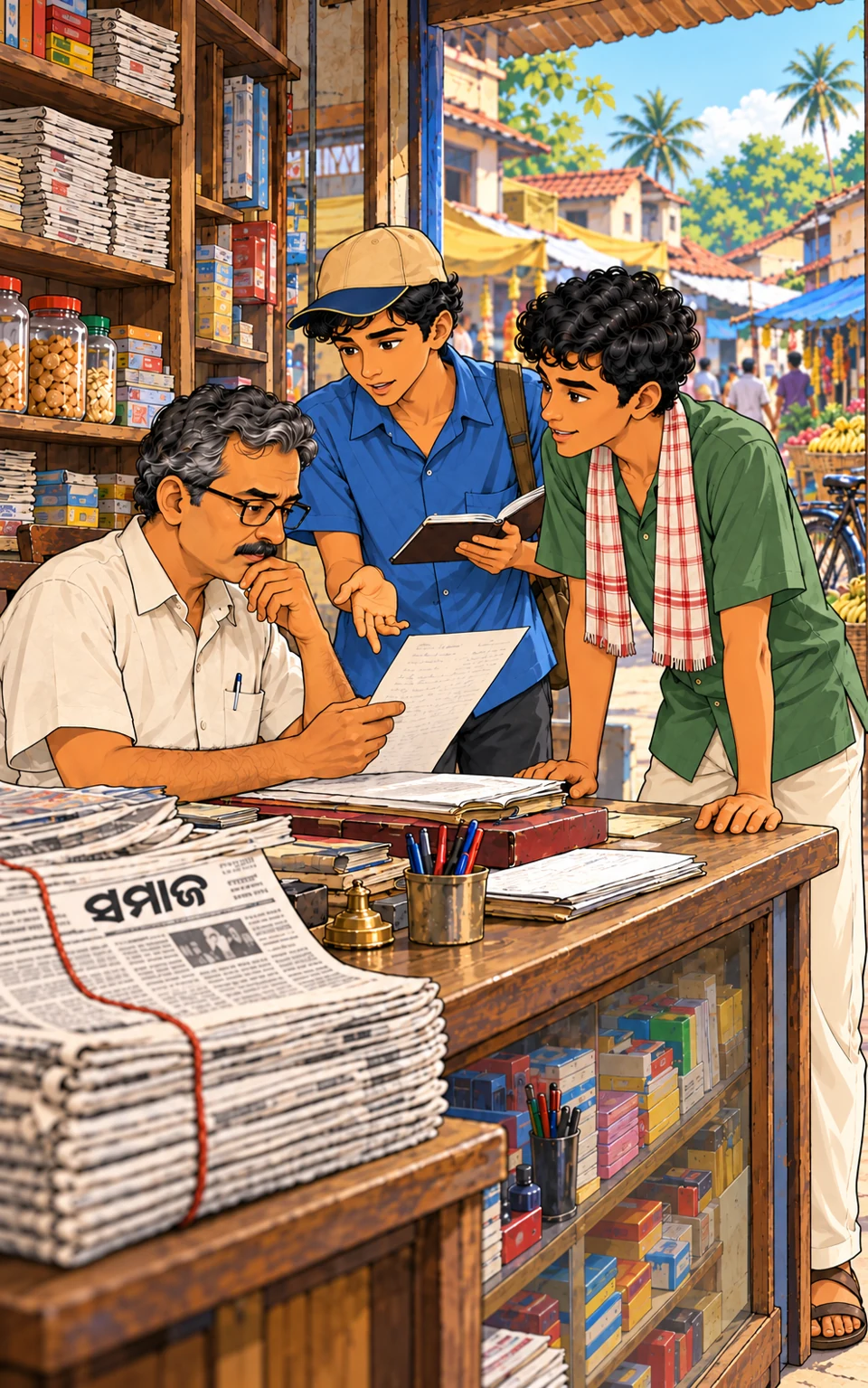
He said, “That isn’t possible either. I only send news reports. It doesn’t mean that everything I send gets published. My job is to send the news. Whether they publish it or not is up to them. Sometimes it feels insulting when a report I have sent is not published. But what can I do?”
Jogia and I looked disappointed.
I said, “Sir, Samaja is Gopabandhu’s newspaper. It was first printed right here in Sakhigopal before it was moved to Cuttack. They shouldn’t be reluctant to publish news from Sakhigopal.”
He said, “I have told that to sir many times. But it hasn’t made any difference.”
He then gave me some advice.
“You’re not old enough to write articles yet. You should write for children. We have a separate children’s page called Shishuraija. We can publish your writing there. Otherwise, we have a weekly literary page named Naba BharataraNutanaPrastha, dedicated to Pandit Nilakantha Das. Send us stories and poems, and we can publish them there.”
I said, “No! I have written an article.”
Taking pity on me, he listened to the entire article. At the end, he said, “There’s no problem. We can publish this as a news report. Give me the article. I’ll turn it into a news story.”
That was how my article was transformed into a news report and eventually appeared in the Samaja as a report from its own correspondent. I hoped that the thieves would certainly read it.
The report was published as follows:
‘The Ancient Heritage Sites in Danger
It has come to light that numerous ancient monuments and relics in the Algum area are lying in an unprotected condition. The Superintendent of the State Museum has reportedly stated that excavation work will soon be undertaken in the village and that the ancient relics will be recovered. However, the work has not yet begun.
According to reliable sources, the mysterious Sun God idol of Konark is located in this very village. The idol, made of Ashtadhatu (an alloy of eight metals), is reportedly being kept in his house by a wealthy moneylender from the village.
Local residents have demanded that the government take steps to recover the idol.’
After this news was published, there was considerable excitement in our village. People gathered here and there and discussed the report.
“Is the Konark Sun idol really in our village?”
“Whose house is it in?”
“Who is this moneylender?”
These questions became the subject of widespread discussion.
Meanwhile, we kept a close watch on Balaram Pradhan.
He would dismiss the whole thing, saying, “Huh! It’s all nonsense! Which journalist wrote this? No journalist has even come to our village!”
But the villagers said, “If it has been printed in the newspaper, then it must be absolutely true.” In those days, people trusted newspaper reports and believed them to be true.
The villagers were waiting for the government officials to arrive in our village, begin the excavation, and start the process of recovering the Sun idol.
Jogia said, “The trap we have set is ready. The thieves will come like fish and fall right into it.”
I said, “Let’s see.”
Two days later, Nabaghana Sahu’s son, Natia, came to me and told me that his father wanted to see me. Jogia and I went to their house together.
We met him. He looked worried.
He said, “Young man! You’ve studied something about investigation and all that, haven’t you?”

“Yes,” I replied.
He took out a crumpled piece of paper and handed it to me.
“This letter came by post. It’s an anonymous letter. Take a look at it and tell me—who do you think wrote it?”
I read the letter. It contained a warning. It said:
“Moneylender! We had left a piece of iron at your house. Give that iron back to us. Keep it near the back entrance of your house. We will come and take it.”
After reading the letter, I looked at his face. He was not merely worried; he looked frightened as well.
I said, “From the contents of the letter, it appears to be the work of those thieves.”
He said, “What should I do now? I cannot simply hand over the iron to them. The police have left it in my custody. If the police question me, what will I tell them?”
I advised him, “You must inform the police about this.”
He asked, “Can you tell for certain that this letter was written by that gang of thieves?”
I asked, “How did the letter arrive?”
He said, “It came by post.”
He took out the envelope in which the letter had arrived. I examined it carefully. Nabaghana Sahu’s address was written on it in crooked, uneven handwriting. There was no sender’s name.
I said, “You must inform the police immediately. Someone from our village is involved in this entire conspiracy. That person is giving all the information to the gang of thieves.”
He asked, “How do you know that?”
I turned the envelope over and examined it carefully.
“The letter was posted from our own post office. It bears the stamp of our local post office. I think the thief is hiding somewhere in our village. So, we have to proceed very carefully—without letting the thief know what you are doing.”
He looked even more frightened.
“Who is this person?” he asked.
“We are looking for him too,” I said. “We have been keeping an eye on him.”
He decided to go to the police station. I also offered to accompany him.
We went to the police station together. We showed the letter to the officer in charge and explained everything to him.
But he was not impressed by what we told him. Instead, he said, “If the thieves are asking you to give them the iron, then give it to them. What’s going to happen to that piece of iron? They haven’t stolen any gold or silver from your house. So, there’s no case to investigate.”
I protested.“What are you saying, sir? That piece of iron is not an ordinary piece of iron. It is a powerful magnet. The thieves are using it to search for idols made of Ashtadhatuidols. If it falls into their hands, they will have an opportunity to carry out even more thefts.”
The police officer stared at me.
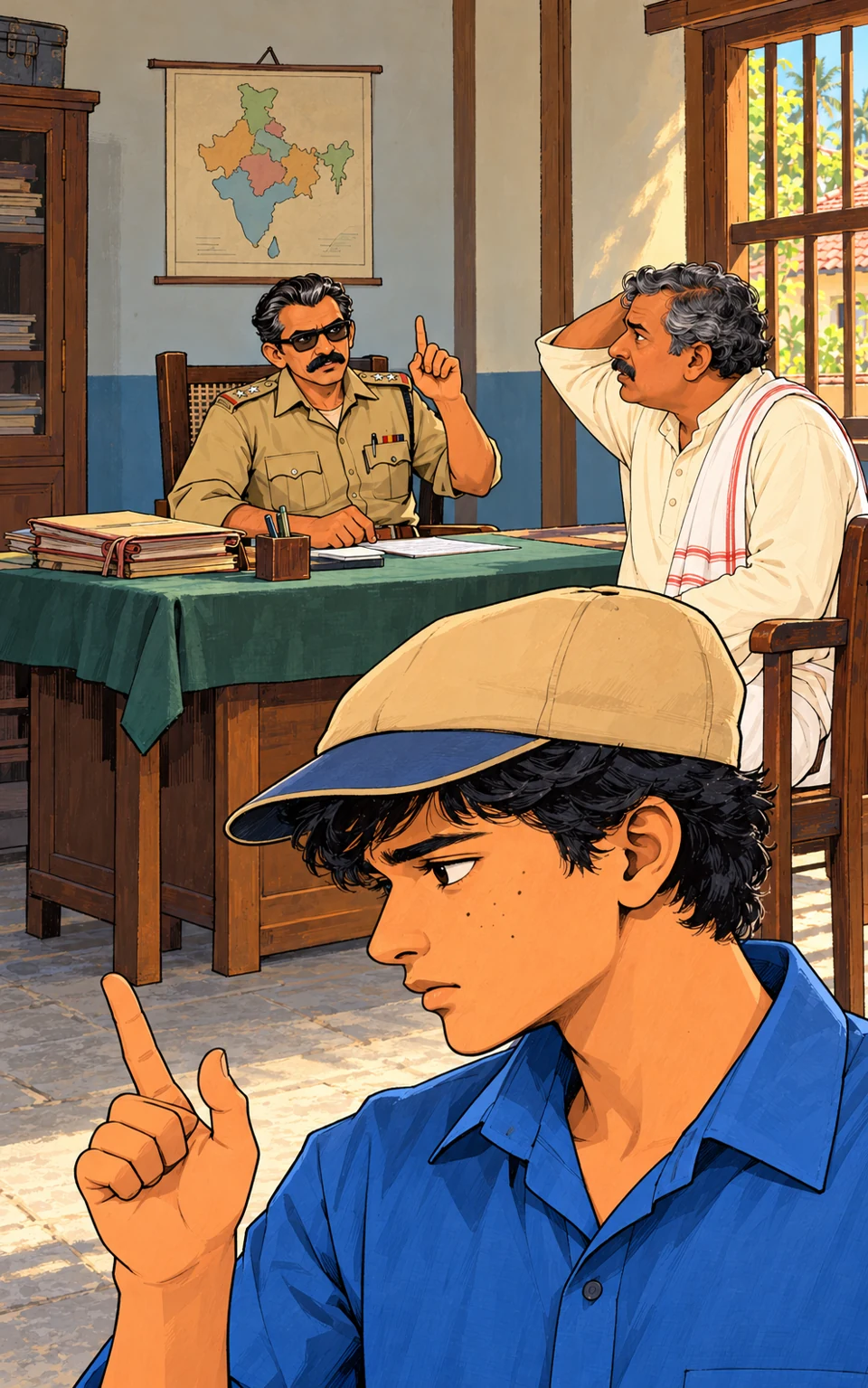
“Who are you, young man? How do you know so much?”
I said, “I have read about it. It is a powerful magnet. It was stolen from the Bentapur monastery. They reported the theft at the police station too.”
The police officer remembered and said, “Yes! Yes! You are absolutely right. A few days ago, thieves broke into the Bentapur monastery. They did not take anything. However, a report was filed that a piece of iron had been stolen.
I said, “This is that very piece of iron. It used to be a powerful magnet. Of course, its strength has weakened a little now. But this must not fall into the hands of the thieves. Send someone to the Bentapur monastery. Everything will become clear.”
The station officer looked at me intently.
He asked, “How do you know so much about all this, young man?”
I folded my hands, bowed my head, and said, “Sir, I have studied detective work, so I can make these deductions. My guess may be wrong, but sometimes it turns out to be correct. This letter has been posted from our village. Therefore, I suspect that the thieves will certainly come back within a day or two.”
The station officer was impressed.
He asked, “What do you want now?”
Before Nabaghana Sahu could say anything, I said, “We are not going to hand over that piece of iron. The thieves could come any day. So, if you wish, you can keep watch over the house.”
The station officer expressed his helplessness. He said, “Where do I have enough staff at this police station to send them to your village and keep watch? If we arrive in the village, the thieves will find out and certainly won't come. Besides, you yourself said that they have an informer in your village. And the thieves haven't mentioned any particular day when they will come.”
Nabaghana Sahu asked, “Then what should we do?”
The station officer said, “Find a few strong men from your village. Keep them secretly at your house to guard it. If the thieves come, beat them mercilessly. If someone gets beaten and dies, you won't be held responsible—I will take care of it. We have to catch these thieves.”
Nabaghana Sahu said, “They may have knives or even guns.”
The station officer replied, “Let them have knives and guns! Beat them with sticks in the darkness and drive them away. These idol thieves don't carry guns.”
Nabaghana Sahu folded his hands and said, “It would be good if you could help us a little.”
After much pleading, the station officer finally agreed. He said, “All right. I will send a constable. He will go in plain clothes and stay at your house. You will have to take care of his food and other needs. But he will not be carrying a gun, nor has he been given permission to use one. You arrange for ten young men from the village to stay there as well. They will be useful.”
It was decided that a police constable named Kambupani would come with us. We returned home.
After we returned, Jogia gave me another piece of information. He had been keeping an eye on Balia Pradhan. Now he told me that Balia Pradhan was no longer in the village. He had gone somewhere. My suspicion onBalia Pradhan became even stronger. Perhaps he had gone to inform someone.
Then we received another piece of news: thieves had entered the Bentapurmonastery, but they had not been able to take anything.
I said, “They must have stolen the second magnet. The Mahant does not want anyone outside to know about it, because people will find out about all the supernatural mysteries of the monastery. Jogia! The time has come. They will come.”
Jogia said, “They will come—and they will fall into the trap.”
Nabaghana Sahu gathered ten men, including his farmhands and labourers, and stationed them near his house with sticks and clubs. Everything was arranged with the utmost secrecy.
Our suspicion proved to be correct. On the third night, the thieves arrived. Around midnight, they broke open the back door of the house and entered.
They threatened the members of the household with knives and asked, “Tell us where the Ashtadhatu Sun idol is.”
But their threats had no effect. The young men who had been hiding behind the house suddenly attacked them. Two of the thieves were knocked to the ground by blows from the sticks. The others in the gang managed to escape. As they fled, they set off a bomb. The sound woke the villagers, who chased after the thieves and managed to catch one of them.
When we received the news in the morning and reached the scene, three thieves had been tied up. Constable Kambupani was sitting on a chair with his legs stretched out, sipping tea. He was twisting his moustache in such a way that it looked as though he alone had caught all three thieves.
The police station had been informed, and we heard that the station officer was on his way.
Jogia and I went over to meet the three thieves. They were sitting with their faces lowered, badly bruised. Their hands and feet were tied. There were marks of beatings all over their bodies, and they kept groaning in pain.
I asked, “Who is your leader?”
They gave no answer.
Just then, the officer in charge of the police station arrived. He tapped his baton against the ground two or three times with loud thuds.
He said, “Will these fellows say anything without getting a beating?”
The three men acted as though they were about to fall at the officer in charge’s feet.
They said, “Please, sir! Don't beat us. We don't know anything.”
The officer in charge mocked them, “You don't know anything? Then why did you come here?”
One of them said, “Sir, a Bengali gentleman hired us for this job. He is searching for the Sun idol of Konark.”
The officer in charge asked, “Who told you that the Sun idol ofKonark is in this village? This isn't your first time here—you have already come here twice.”
The thief replied, “The Bengali gentleman learned all this by reading the newspaper. He also has informers. They told him that the Sun idol was in this house.”
The officer in charge asked, “Who is this informer? Is he from this village?”
The thief said, “We don't know. The Bengali gentleman would be knowing.”
Another thief added, “He doesn't tell us anything about these matters. He simply pays us and sends us to steal.”
The officer in charge asked, “Had you stolen the magnet from Bentapur Math?”
The thief replied, “The Bengali gentleman told us to steal it. He said that if we pointed it in a particular direction, the iron would be pulled toward whichever direction the idol was located.”
The officer in charge asked, “Then why did you leave that piece of iron here the last time?”
The thief stared at him in bewilderment. He said, “It didn't work. So, we threw it away.”
The officer in charge asked, “Didn't you bring the magnet with you this time?”
The thief said, “We brought it! We broke into Bentapur Math and brought another magnet.”
Just then, Jogia whispered in my ear, “Balia Pradhan was here just a moment ago. He suddenly disappeared. I don't know where he has gone.”
I said, “He may have left for Puri. He will inform the leader of this gang of thieves.”
The officer in charge continued questioning them. He asked, “Where is the piece of iron?”
The thief replied, “It must be lying somewhere around here. Kalu had it in his hand. He must have taken it with him.”
The officer in charge questioned, “Who is Kalu?”
The thief replied, “He was with us. He managed to escape.”
The officer in charge enquired, “Where is your Bengali gentleman?”
The thief said, “Sir, he is in Puri. He is staying at a hotel.”
The officer in charge said, “We have to catch him.”
I interrupted his questioning and said, “Sir, look for him immediately. The informer from this village has already left to warn him.”
The officer in charge shouted, “That's enough! Let's go to Puri!”
The officer in charge left with the thieves.
He must have taken them to Puri and searched for the Bengali gentleman. He must also have searched for the other members of the gang. We did not receive any news immediately. Later, we learned that the Bengali gentleman had already escaped from Puri after receiving advance warning. The police could not catch him. They were also unable to catch the other members of the gang. The three thieves who had been captured were sent to jail.
Jogia investigated further and found out that Balia Pradhan had gone to Puri that very day. He was the Bengali gentleman's informer, and he had gone to Puri to warn him that three of the thieves had been caught. As a result, the mastermind behind the entire operation—the Bengali gentleman—managed to escape easily. The members of the gang did not know Balia Pradhan personally, which was why the police could not catch him.
After learning all these details, Mahapatra Babu, new correspondent of the Samaja at Sakhigopal, published a report:
‘Attempted Robbery Foiled
An attempt was made to commit a robbery in Alagum village, but it failed. When the villagers woke up, the robbers tried to flee, but three of them were caught. They had been searching for the Sun idol of Konark. It has been learned that the mastermind behind the incident was a Bengali man. He escaped. The police investigation is continuing.’
Thus, the mystery surrounding the theft at Nabaghan Sahu's house was solved. Although the main mastermind and the informer in our village were not caught, we were satisfied that we had played at least some role in solving the case. Nabaghan Sahu himself praised us.
Balia Pradhan no longer stayed in the village. He was probably afraid that the police would eventually catch him. So, he had fled somewhere.
I told Nabaghan Sahu, “Balia Pradhan is the real mastermind behind all this. He brought a Bengali gentleman into the affair and staged this entire drama. But how did he know that the Sun idol of Konark was supposedly hidden in your house?”
Nabaghan Sahu asked in astonishment, “The Sun idol of Konark is in our house?”
I gave him a mysterious answer. “It may be. It may be hidden somewhere in secret.”
He looked serious. But I could tell that he was secretly delighted. The thought that one day the Sun idol of Konark might come into his possession caused a wave of hope to rise within him.
Later, while Jogiā and I were chatting and thinking about taking up a new case, I said, “The Sun idol of Konark is truly a mystery. No one knows where it is now. Yet many people are searching for it—historians, archaeologists, and thieves alike. Who will find it, and when? Who knows?”
Jogiā said, “I keep thinking about Balia Pradhan. Why did he create this whole drama by telling lies?”
I said, “There are many people like him in this world. We should also investigate why they behave this way. People like Balia Pradhan lie, spread rumours, and deliberately create confusions.”
Jogiā said, “There is one more thing I cannot understand. Are these thieves foolish or simply stupid? They wrote a letter beforehand and warned us. But that day, one of the thieves said that the magnet had not worked. So, they had thrown it away. Then why did they write the letter later?”
I said, “They had failed to achieve anything by using that piece of iron. Perhaps the piece of iron had fallen to the ground and lost some of its magnetism. So, before coming this time, they stole the second magnetic piece of iron from Bentapurmonastery and brought it with them. Besides, this time they wanted to frighten the family into giving them what they wanted.”
Jogiā was still not satisfied.
He asked, “Then why did they send the letter? It was specifically mentioned in that letter to leave that piece of iron at the back door.”
I smiled and said, “They had not sent the letter. I had written it.”
Jogiā stared at me in astonishment.
“Why?”
I said, “If I hadn't done that, Nabaghan Sahu would not have become alert. He would not have engaged those men in keeping a watch of his house. He would not have gone to the police station. The police officer would not have become so vigilant. It isn't enough merely to set a trap! You also need people to pull the net tight.”
Jogiā clapped his hands happily.
The mystery of the Sun idol of Konark remained a mystery. It still remains a mystery today. The thieves are still searching for it. The supposed way to find it is through a magnet. That is why they are stealing magnets. It would not be surprising if some more incidents of this kind were to occur in the near future.
That piece of iron is still at Nabaghan Sahu's house. No one knows what happened to the second piece of iron. The Mahant of Bentpur monastery has never come back to look for the piece of iron.